. 2023 Jul 3;192(3):2081-2101.
doi: 10.1093/plphys/kiad119.

Abscisic acid and regulation of the sugar transporter gene MdSWEET9b promote apple sugar accumulation

Affiliations

Abscisic acid and regulation of the sugar transporter gene MdSWEET9b promote apple sugar accumulation

Shuhui Zhang et al. Plant Physiol. .

Abstract

Enhancing fruit sugar contents, especially for high-flavonoid apples with a sour taste, is one of the main goals of horticultural crop breeders. This study analyzed sugar accumulation and the underlying mechanisms in the F2 progenies of a hybridization between the high-sugar apple (Malus × domestica) variety "Gala" and high-flavonoid apple germplasm "CSR6R6". We revealed that MdSWEET9b (sugars will eventually be exported transporter) helps mediate sugar accumulation in fruits. Functional characterization of MdSWEET9b in yeast mutants lacking sugar transport as well as in overexpressing and CRISPR/Cas9 knockdown apple calli revealed MdSWEET9b could transport sucrose specifically, ultimately promoting normal yeast growth and accumulation of total sugar contents. Moreover, MdWRKY9 bound to the MdSWEET9b promoter and regulated its activity, which responded to abscisic acid (ABA) signaling. Furthermore, MdWRKY9 interacted with MdbZIP23 (basic leucine zipper) and MdbZIP46, key ABA signal transducers, at the protein and DNA levels to enhance its regulatory effect on MdSWEET9b expression, thereby influencing sugar accumulation. Based on the contents of ABA in lines with differing sugar contents and the effects of ABA treatments on fruits and calli, we revealed ABA as one of the main factors responsible for the diversity in apple fruit sugar content. The results of this study have clarified how MdSWEET9b influences fruit sugar accumulation, while also further elucidating the regulatory effects of the ABA-signaling network on fruit sugar accumulation. This work provides a basis for future explorations of the crosstalk between hormone and sugar metabolism pathways.


Conflict of interest statement

Conflict of interest statement. The authors declare no conflict of interest.

Figures
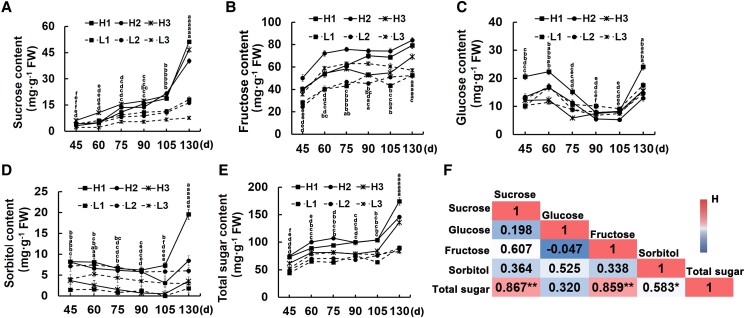
Figure 1.
Figure 1.
Analysis of sugar components in fruit of different lines at developing stage. The contents of A) sucrose, B) fructose, C) glucose, D) sorbitol, and E) total sugar in different lines during development were determined and analyzed. FW, fresh weight. The numbers below the X-axis indicated the days after full bloom (d). Error bars represent the averages of three biological replicates ± SD. Different letters represent differences in the fruit development process. From top to bottom, they are H1, H2, H3, L1, L2, L3, respectively. Significance was defined at P < 0.05 (Student's t-test). F) Correlation analysis of sugar components and total sugar contents in fruit during development. Asterisks indicate statistical significance (**P < 0.01, *P < 0.05, Student's t-test).
Figure 2.
Figure 2.
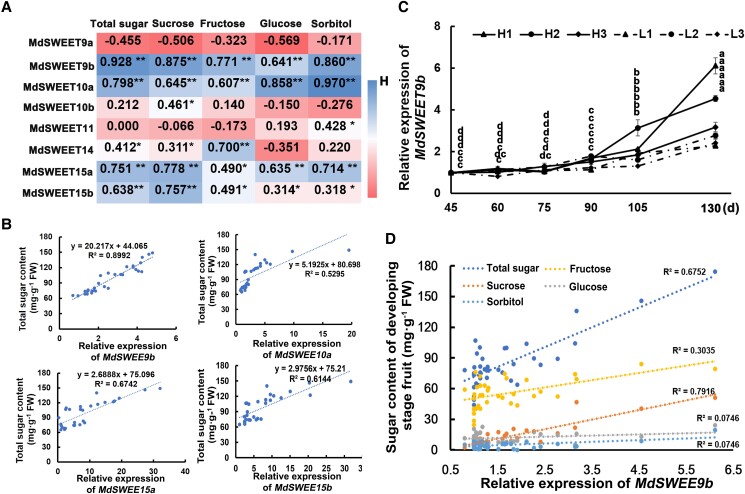
Analysis of MdSWEET III family expression in different lines and correlation with sugar contents. A) Correlation analysis between MdSWEET III family gene expression level and the content of total sugar and sugar components in different lines. Asterisks indicate statistical significance (**P < 0.01, *P < 0.05, Student's t-test). B) Association analysis of MdSWEET9b/10a/15a/15b expression level and total sugar content in hybrid progenies. C, D) Expression level of MdSWEET9b(C) and its correlation with total sugar and sugar components content (D) in different sugar content lines during development. FW, fresh weight. Analyzed and drawn using Microsoft Excel. The larger the R2, the higher the correlation between the data. Error bars represent the averages of three biological replicates ± SD. Different letters represent differences in the fruit development process. Significance was defined at P < 0.05 (Student's t-test).
Figure 3.
Figure 3.
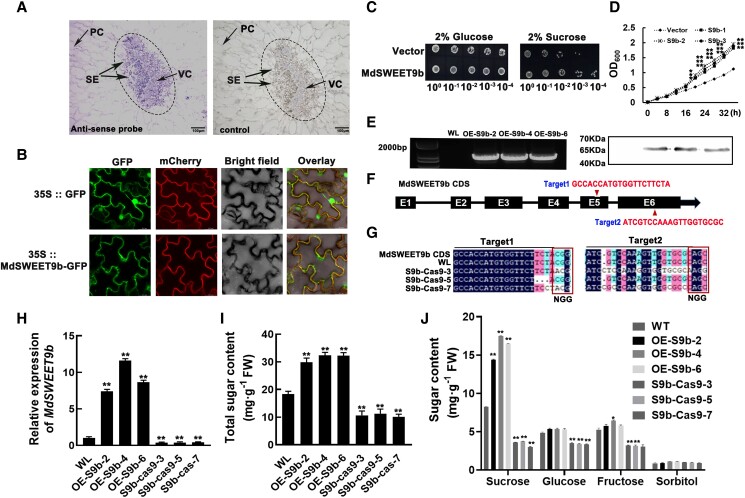
Subcellular localization and functional analysis of MdSWEET9b in sugar transport deficient yeast mutants and apple calli. A) Cell-specific localization of MdSWEET9b transcripts analyzed by in situ hybridization. Cross-sections of apple fruits were hybridized with MdSWEET9b-specific antisense probes, and the sense probe was used as control. The vascular bundle and surrounding parenchyma cells were outlined by dotted lines. The location containing the target gene was stained blue-purple. SE, sieve elements; VC, vascular bundle parenchyma cells; PC, pulp cells. B) Image of MdSWEET9b-GFP subcellular localization in N. benthamiana leaves. An mCherry-labeled plasma membrane marker (AtPIP2A) was co-expressed to visualize the plasma membrane. C) Functional validation of MdSWEET9b in SUSY7/ura3 yeast mutants with sucrose transport deficiency. Empty vector was transformed as a growth control, the numbers under the panel indicate the dilution fold. D) Growth curves of SUSY7/ura3 yeast mutants containing MdSWEET9b-PYES or vector (as a negative control). The number below the X-axis indicates the measurement time (h). E)MdSWEET9b overexpression in “Orin” calli (OE-S9b-2/4/6) verified by PCR amplification and western blotting. F, G)MdSWEET9b knockdown target design (F) and transgenic sequencing results (G). Sequences were aligned using DNAMAN. Before NGG was the target sequence. The dark region was the target sequence, and the other colored region was the difference in sequence among the lines indicated. There was no difference between wild type (wild-type “Orin”) calli and target sequence, and multiple base mutations appeared in the knockdown calli (S9b-Cas9-3/5/7). H) Expression level of MdSWEET9b in overexpression and knockdown calli. I, J) Contents of total sugar (I) and individual sugar components (J) in transgenic calli. Error bars represent the averages of three biological replicates ± SD. Asterisks indicate statistical significance (**P < 0.01, *P < 0.05, Student's t-test).
Figure 4.
Figure 4.
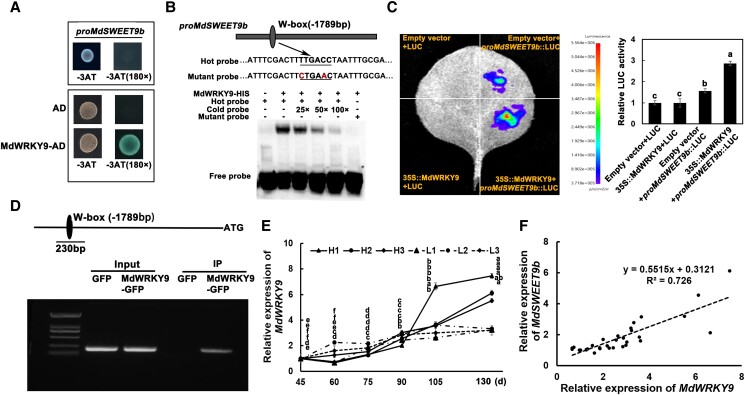
MdWRKY9 protein directly binds to the promoter region of MdSWEET9b.A) Y1H assays. The empty pGADT7 vector (AD) served as a negative control. The growth of the strain indicate the interaction between MdWRKY9 and the MdSWEET9b promoter. B) EMSA experiments showing the binding of MdWRKY9 to the MdSWEET9b promoter. Hot probes represented biotin-conjugated promoter fragments that contained specific W-box motifs of MdSWEET9b. The cold probe was an unlabeled competitive probe. The mutant probe was a marker fragment containing the mutant candidate W-box motifs of MdSWEET9b. Cold probes were added in increasing amounts (25×, 50×, and 100× fold probe concentration). The “+” and “−” indicate the presence and absence of the indicated probe or protein, respectively. C) LUC experiment showing the binding of MdWRKY9 to the MdSWEET9b promoter in vivo. D) Binding of MdWRKY9 to the MdSWEET9b promoter in vivo in ChIP-PCR assay. Those DNA fragments enriched in every ChIP served as the biological replicate in PCR. E, F) The expression level of MdWRKY9(E) and its association analysis with MdSWEET9b expression level (F) in different sugar content lines during development. Error bars represent the averages of three biological replicates ± SD. Different letters represent differences in the fruit development process. Significance was defined at P < 0.05 (Student's t-test). The statistical analysis described here was applicable to all data that requires statistical analysis.
Figure 5.
Figure 5.
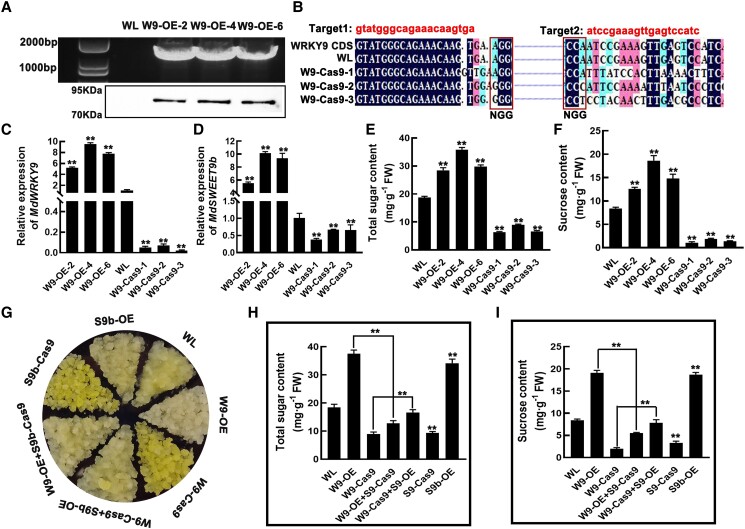
MdWRKY9 positively regulates MdSWEET9b expression and promotes sugar accumulation in apple calli. A)MdWRKY9 overexpression (W9-OE-2/4/6) in “Orin” calli verified by PCR amplification and western blotting. B)MdWRKY9 CRISPR/Cas9 knockdown sites and first-generation sequencing of MdWRKY9-Cas9 knockdown (W9-Cas9-1/2/3) calli. Sequences were aligned using DNAMAN. Before NGG was the target sequence. The dark region was the target sequence, and the other colored region was the difference in sequence among the lines indicated. There was no difference between wild-type (wild-type “Orin”) calli and target sequence, and multiple base mutations appeared in the knockdown calli. C, D) Expression analysis of MdWRKY9(C) and MdSWEET9b(D) in MdWRKY9 transgenic calli. E, F) Total sugar (E) and sucrose contents (F) in MdWRKY9 transgenic calli. G) Calli phenotypes of wild type, MdWRKY9 and MdSWEET9b single and co-transferable calli (overexpression and knockdown). H, I) Total sugar (H) and sucrose (I) in MdWRKY9 and MdSWEET9b single and co-transferable calli. FW, fresh weight. Error bars represent the ±SD of three independent biological replicates. Asterisks indicate statistical significance (**P < 0.01, *P < 0.05, Student's t-test). The statistical analysis described here was applicable to all data that requires statistical analysis.
Figure 6.
Figure 6.
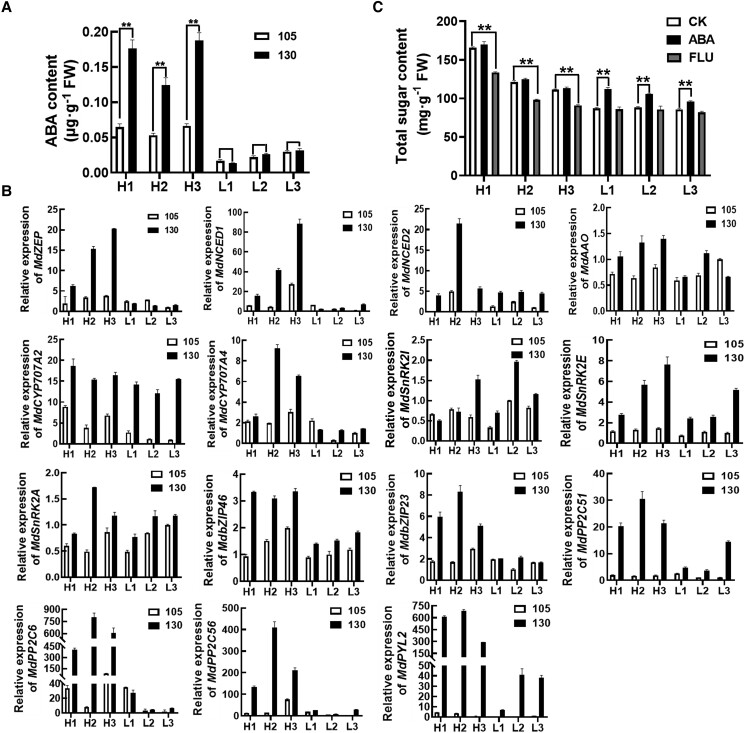
Detection of ABA signal in fruit of hybrid progenies and its effect on fruits sugar contents. A) ABA contents in fruits of different lines during late fruit development. B) Expression levels of genes related to ABA synthesis (MdZEP/MdNCED1/MdNCED2/MdAAO), metabolism (MdCYP707A2/4), and signal transduction (MdSnRK2I/SnRK2E/SnRK2A/MdbZIP46/MdbZIP23/PYL2/PP2C51/PP-2C6/PP2C56) in fruits of different lines during late fruit development. 105 and 130 represent the days after full bloom, respectively. C) Effects of ABA and FLU on sugar contents in fruit of different lines. FW, fresh weight. Error bars represent the ±SD of three independent biological replicates. Asterisks indicate statistical significance by SPSS statistical 22 software (**P < 0.01, *P < 0.05, Student's t-test). The statistical analysis described here was applicable to all data that requires statistical analysis.
Figure 7.
Figure 7.
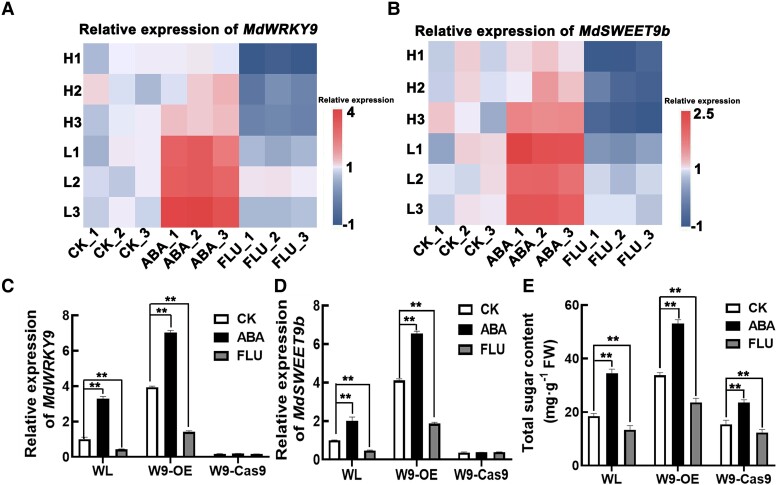
ABA signal enhanced the regulation of MdWRKY9 on MdSWEET9b and increased the sugar content in fruit. A, B) Expression level analysis of MdWRKY9 and MdSWEET9b in different lines under different treatments (CK, water solution, ABA, abscisic acid solution, FLU, fluridone solution). The redder the color, the higher the gene expression level, the bluer the lower the gene expression level. C–E) Effects of ABA on MdWRKY9(C), MdSWEET9b(D) gene expression and sugar contents (E) in transgenic calli (overexpression calli: W9-OE and knockdown calli: W9-Cas9). WL (wild-type “Orin”) as a control. After 14 d of treatment, the related indexes were determined. Error bars represent the ±SD of three independent biological replicates. Asterisks indicate statistical significance (**P < 0.01, *P < 0.05, Student's t-test).
Figure 8.
Figure 8.
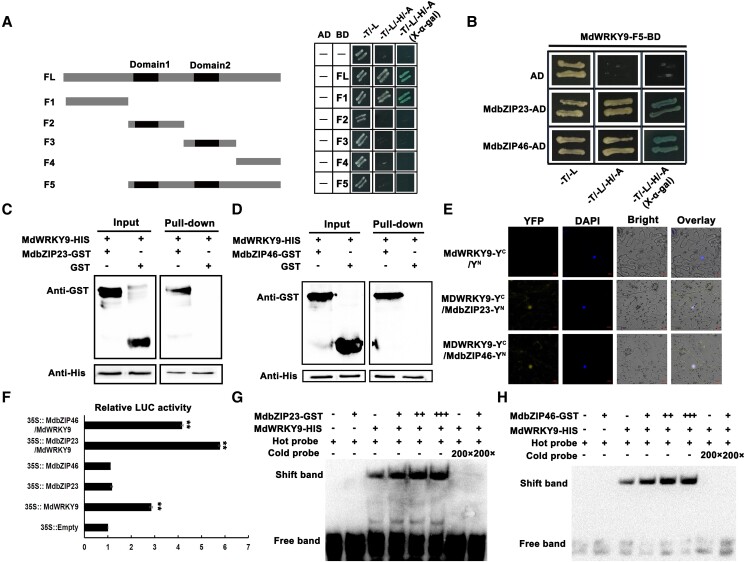
ABA signal transduction factors MdbZIP23 and MdbZIP46 interact with MdWRKY9 in vivo and vitro to further regulate the activity of MdSWEET9b. A, B) Y2H assays. (A) Screening for self-activating regions of MdWRKY9-BD vector that F1 segment was self-activated. Thus, we used MdWRKY9-F5-PGBKT7 as the bait for subsequent Y2H assays. (B) MdWRKY9 interacted with MdbZIP23 and MdbZIP46. The empty pGADT7 vector (AD) served as a negative control. Blue lines indicate interactions between MdWRKY9 and MdbZIP23/46. C, D) MdWRKY9 interacted with MdbZIP23 and MdbZIP46 in pull-down assays. The “+” and “−” indicate the presence and absence of the indicated protein, respectively. E) MdWRKY9 interacted with MdbZIP23 and MdbZIP46 in BiFC assays. F) LUC experiments showed that MdbZIP23 and MdbZIP46 interacted with MdWRKY9 to promote the regulation of MdWRKY9 on MdSWEET9b. Error bars represent the ±SD of three independent biological replicates. Asterisks indicate statistical significance (**P < 0.01, Student's t-test). G, H) EMSA experiments showed that MdbZIP23 and MdbZIP46 interacted with MdWRKY9 to promote the regulation of MdWRKY9 on MdSWEET9b. The “+” and “−” indicate the presence and absence of the indicated probe or protein, respectively.
Figure 9.
Figure 9.
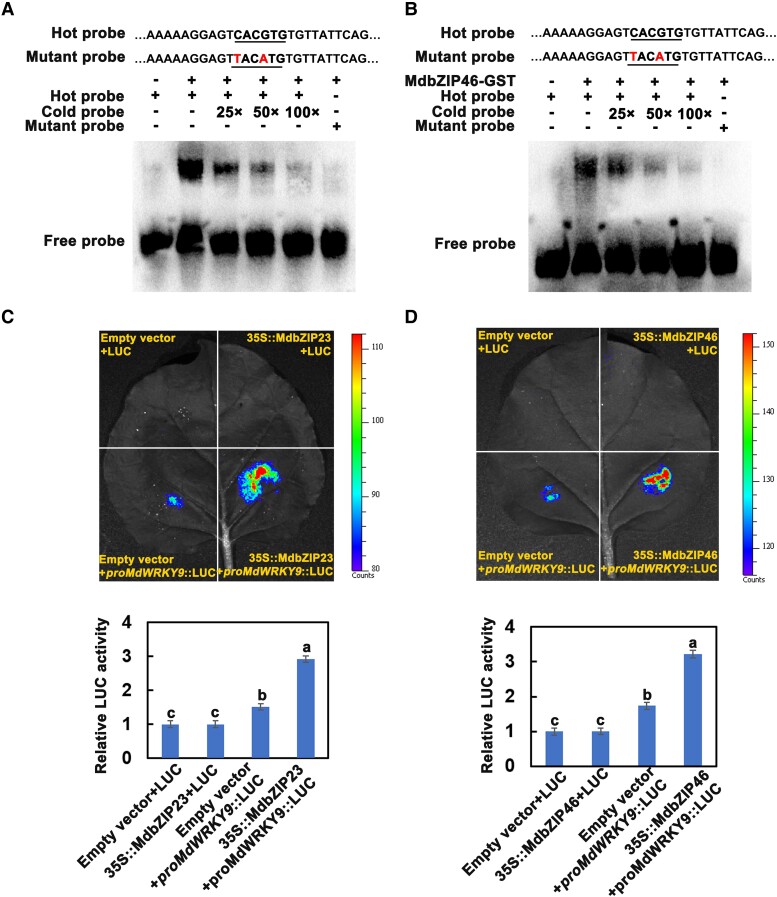
ABA signal transduction factor MdbZIP23 and MdbZIP46 protein directly binds to the promoter region of MdWRKY9.A, B) EMSA experiments showed that the binding of MdbZIP23 (A) and MdbZIP46 (B) to the MdWRKY9 promoter. Hot probes represented biotin-conjugated promoter fragments that contained specific G-box motifs of MdWRKY9. The “+” and “−” indicate the presence and absence of the indicated probe or protein, respectively. C, D) LUC experiment showed that the binding of MdbZIP23 (C) and MdbZIP46 (D) to the MdWRKY9 promoter in vivo. Error bars represent the averages of three biological replicates ± SD. Different letters represent differences in the fruit development process. Significance was defined at P < 0.05 (Student's t-test).
Figure 10.
Figure 10.
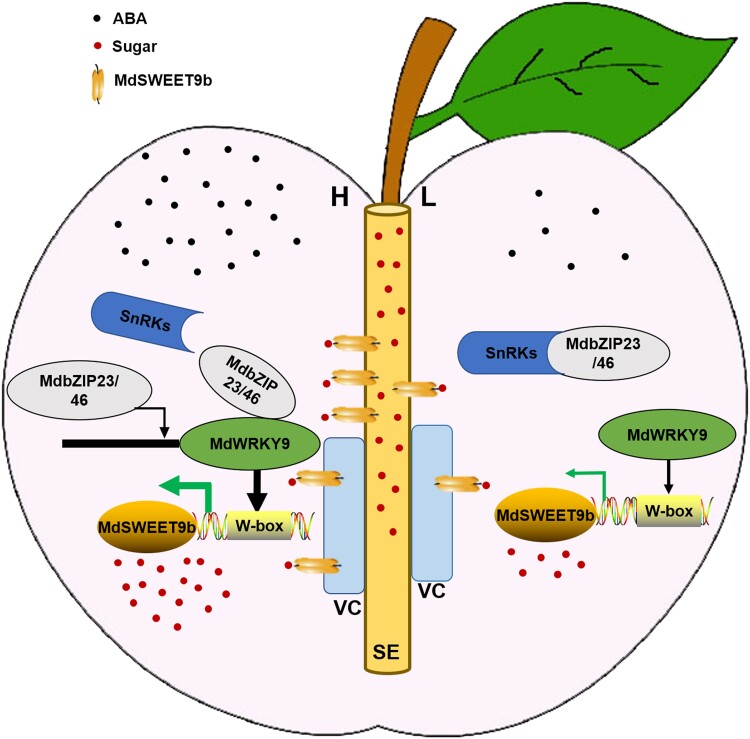
Proposed model for MdWRKY9 to mediate its regulation of MdSWEET9b and promote apple fruits sugar accumulation under ABA-signaling conditions. MdSWEET9b was located in the SE and its VC to promote sugar unloading into the fruit. Its activity was regulated by MdWRKY9, which can be induced by ABA signaling. The key ABA signal transducers MdbZIP23 and MdbZIP46 were interacted with MdWRKY9 at the protein and DNA levels. The high concentration of ABA in high-sugar lines (H) promoted this pathway and made the fruit show high sugar content. MdbZIP23/46 represents that these two proteins interact with WRKY9, respectively.

References

    1. Ackerson RC. Invertase activity and abscisic acid in relation to carbohydrate status in developing soybean reproductive structures. Crop Sci. 1985:25(4):615–618. 10.2135/cropsci1985.0011183X002500040009x - DOI
    1. Adriana B, María LC, Mercedes V, Salvador R, Aurelio GC, Jose AC. Modulation of organic acids and sugar content in tomato fruits by an abscisic acid-regulated transcription factor. Physiol Plantarum. 2011:141(3):215–226. 10.1111/j.1399-3054.2010.01435.x - DOI - PubMed
    1. Afoufa-Bastien D, Medici A, Jeauffre J, Coutos-Thévenot P, Lemoine R, Atanassova R, Laloi M. The Vitis vinifera sugar transporter gene family: phylogenetic overview and macroarray expression profiling. BMC Plant Biol. 2010:10(1):245–271. 10.1186/1471-2229-10-245 - DOI - PMC - PubMed
    1. An J, Zeng T, Ji C, De Graaf S, Zheng Z, Xiao TT, Pan Z. A Medicago truncatula SWEET transporter implicated in arbuscule maintenance during arbuscular mycorrhizal symbiosis. New Phytol. 2019:224(1):396–408. 10.1111/nph.15975 - DOI - PubMed
    1. Antoni R, Gonzalez-Guzman M, Rodriguez L, Rodrigues A, Pizzio GA, Rodriguez PPL. Selective inhibition of clade a phosphatases type 2c by PYR/PYLl/RCAR abscisic acid receptors. Plant Physiol. 2012:158(2):970–980. 10.1104/pp.111.188623 - DOI - PMC - PubMed

Publication types

LinkOut - more resources