


Social determinants of neurocognitive and academic performance in sickle cell disease
- PMID: 36815529
- PMCID: PMC10339212
- DOI: 10.1002/pbc.30259
Social determinants of neurocognitive and academic performance in sickle cell disease
Abstract
Background: Sickle cell disease (SCD) is associated with poor neurocognitive outcomes due to biomedical and psychosocial factors. The aims of this study were to investigate associations between household and neighborhood socioeconomic status (SES) with cognitive and academic outcomes in SCD and to determine if these relationships were modified by sickle genotype, fetal hemoglobin, or age.
Procedure: We prospectively recruited patients to complete a battery of neurocognitive and academic measures. Household SES was measured using the Barratt Simplified Measure of Social Status, a composite index of parent education and occupation. The Social Vulnerability Index was used to classify individuals based on social vulnerabilities at the neighborhood level.
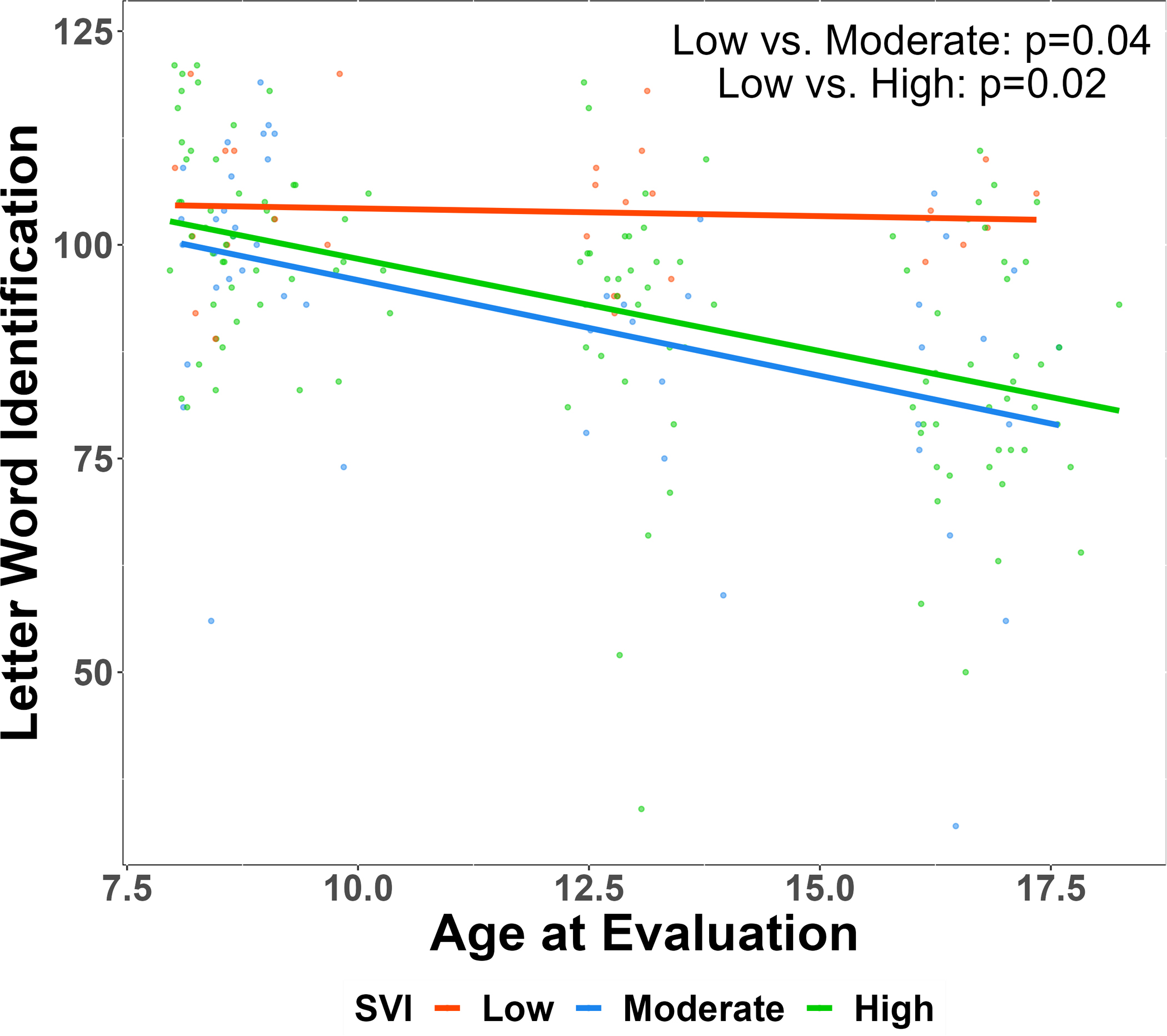
Results: Overall, 299 patients between the ages of 4 and 18 (mean = 11.4, standard deviation = 4.3) years diagnosed with SCD (57% SS/SB0 -thalassemia) completed testing. Stepwise multivariate models demonstrated that patients with low social vulnerability (i.e., high SES) at the neighborhood level displayed intelligence and math scores that were 4.70 and 7.64 points higher than those living in areas with moderate social vulnerability, respectively (p < .05). Reading performance did not differ based on neighborhood SES; however, the effect of neighborhood SES was dependent on age, such that older participants living in neighborhoods with moderate or high levels of social vulnerability displayed poorer reading scores than those with low social vulnerability (p < .05).
Conclusions: This study identified patients with SCD at higher risk of poor academic performance based on SES. Interventions addressing academic difficulties should be offered to all children with SCD, but should be emergently offered to this subpopulation.
Keywords: academic; anemia; neurocognitive; sickle cell; social determinant; socioeconomic status.
© 2023 Wiley Periodicals LLC.
Conflict of interest statement
Conflicts of Interest
J.S.H. receives consultancy fees from Global Blood Therapeutics, CVS Health, Forma Therapeutics, and UpToDate. A.M.H. receives consultancy fees from Global Blood Therapeutics. There are no other conflicts of interest to report.
Figures
References
-
- Baker EH. Socioeconomic status, definition. The Wiley Blackwell encyclopedia of health, illness, behavior, and society. 2014:2210–4.
-
- Korous KM, Causadias JM, Bradley RH, Luthar SS, Levy R. A systematic overview of meta-analyses on socioeconomic status, cognitive ability, and achievement: The need to focus on specific pathways. Psychol Rep. 2022;125(1):55–97. - PubMed
-
- Blums A, Belsky J, Grimm K, Chen Z. Building links between early socioeconomic status, cognitive ability, and math and science achievement. J Cogn Dev. 2017;18(1):16–40.
Publication types
MeSH terms
Grants and funding
LinkOut - more resources
Full Text Sources
Medical
