


Leveraging machine learning to identify acute myeloid leukemia patients and their chemotherapy regimens in an administrative database
- PMID: 36815580
- PMCID: PMC10402395
- DOI: 10.1002/pbc.30260
Leveraging machine learning to identify acute myeloid leukemia patients and their chemotherapy regimens in an administrative database
Abstract
Background: Administrative datasets are useful for identifying rare disease cohorts such as pediatric acute myeloid leukemia (AML). Previously, cohorts were assembled using labor-intensive, manual reviews of patients' longitudinal chemotherapy data.
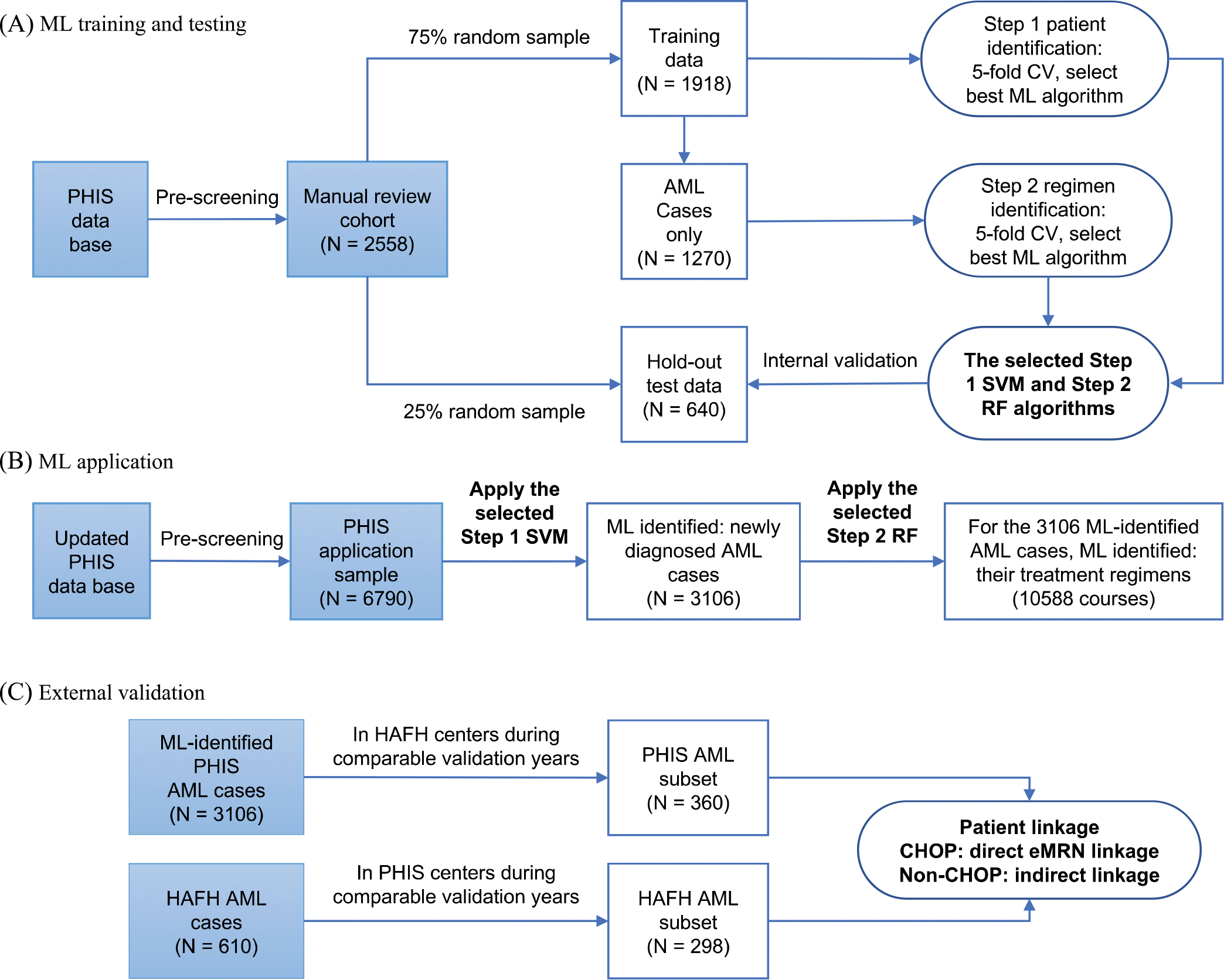
Methods: We utilized a two-step machine learning (ML) method to (i) identify pediatric patients with newly diagnosed AML, and (ii) among the identified AML patients, their chemotherapy courses, in an administrative/billing database. Using 2558 patients previously manually reviewed, multiple ML algorithms were derived from 75% of the study sample, and the selected model was tested in the remaining hold-out sample. The selected model was also applied to assemble a new pediatric AML cohort and further assessed in an external validation, using a standalone cohort established by manual chart abstraction.
Results: For patient identification, the selected Support Vector Machine model yielded a sensitivity of 0.97 and a positive predictive value (PPV) of 0.97 in the hold-out test sample. For course-specific chemotherapy regimen and start date identification, the selected Random Forest model yielded overall PPV greater than or equal to 0.88 and sensitivity greater than or equal to 0.86 across all courses in the test sample. When applied to new cohort assembly, ML identified 3016 AML patients with 10,588 treatment courses. In the external validation subset, PPV was greater than or equal to 0.75 and sensitivity was greater than or equal to 0.82 for patient identification, and PPV was greater than or equal to 0.93 and sensitivity was greater than or equal to 0.94 for regimen identifications.
Conclusion: A carefully designed ML model can accurately identify pediatric AML patients and their chemotherapy courses from administrative databases. This approach may be generalizable to other diseases and databases.
Keywords: acute myeloid leukemia; administrative database; case identification machine learning.
© 2023 Wiley Periodicals LLC.
Conflict of interest statement
CONFLICT OF INTEREST STATEMENT
BTF receives funding from Pfizer, Merck, and Allovir. He also serves on a data safety monitoring board for Astellas. Other authors do not have a conflict of interest to disclose.
Figures
References
Publication types
MeSH terms
Grants and funding
LinkOut - more resources
Full Text Sources
Medical
