. 2023 Apr 3;29(7):1220-1231.
doi: 10.1158/1078-0432.CCR-22-1936.

Application of Genomic Sequencing to Refine Patient Stratification for Adjuvant Therapy in Renal Cell Carcinoma

Affiliations

Application of Genomic Sequencing to Refine Patient Stratification for Adjuvant Therapy in Renal Cell Carcinoma

Naveen S Vasudev et al. Clin Cancer Res. .

Abstract

Purpose: Patients with resected localized clear-cell renal cell carcinoma (ccRCC) remain at variable risk of recurrence. Incorporation of biomarkers may refine risk prediction and inform adjuvant treatment decisions. We explored the role of tumor genomics in this setting, leveraging the largest cohort to date of localized ccRCC tissues subjected to targeted gene sequencing.

Experimental design: The somatic mutation status of 12 genes was determined in 943 ccRCC cases from a multinational cohort of patients, and associations to outcomes were examined in a Discovery (n = 469) and Validation (n = 474) framework.

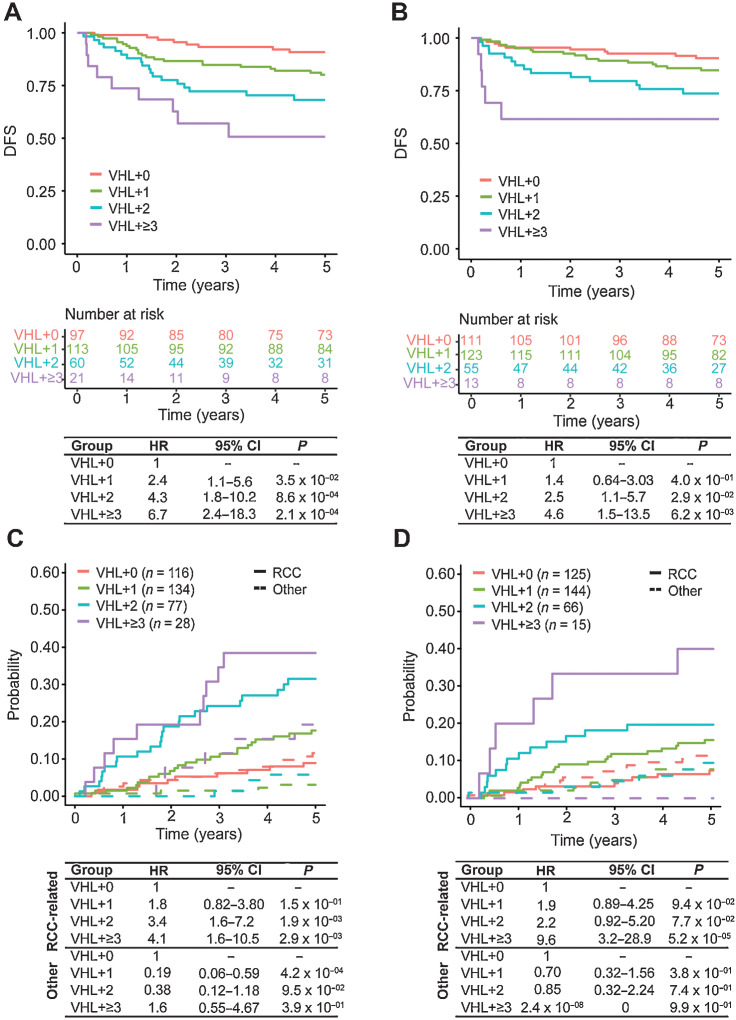
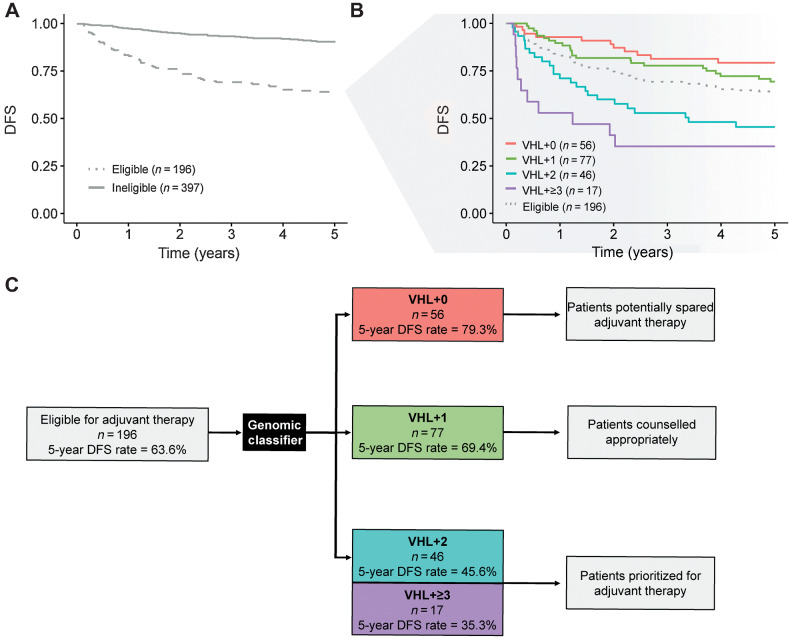
Results: Tumors containing a von-Hippel Lindau (VHL) mutation alone were associated with significantly improved outcomes in comparison with tumors containing a VHL plus additional mutations. Within the Discovery cohort, those with VHL+0, VHL+1, VHL+2, and VHL+≥3 tumors had disease-free survival (DFS) rates of 90.8%, 80.1%, 68.2%, and 50.7% respectively, at 5 years. This trend was replicated in the Validation cohort. Notably, these genomically defined groups were independent of tumor mutational burden. Amongst patients eligible for adjuvant therapy, those with a VHL+0 tumor (29%) had a 5-year DFS rate of 79.3% and could, therefore, potentially be spared further treatment. Conversely, patients with VHL+2 and VHL+≥3 tumors (32%) had equivalent DFS rates of 45.6% and 35.3%, respectively, and should be prioritized for adjuvant therapy.

Conclusions: Genomic characterization of ccRCC identified biologically distinct groups of patients with divergent relapse rates. These groups account for the ∼80% of cases with VHL mutations and could be used to personalize adjuvant treatment discussions with patients as well as inform future adjuvant trial design.


Figures

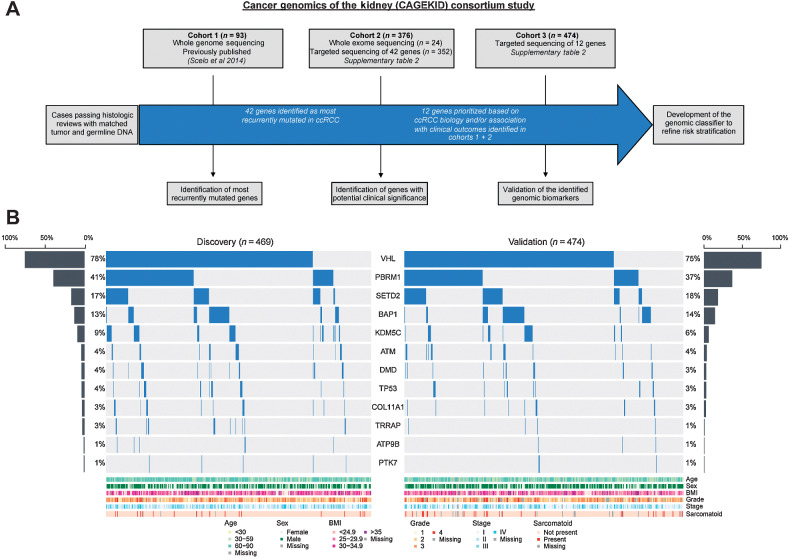
Figure 1. Study summary and mutational profiling of the Discovery and Validation cohorts.
Figure 1.
Study summary (A) and mutational profiling of the Discovery and Validation cohorts (B).
Figure 2. DFS outcomes and Competing Risks Analysis for RCC-related death amongst patient with VHL mutations stratified into genomically defined groups. Kaplan–Meier survival curves comparing DFS amongst VHL+0, VHL+1, VHL+2, and VHL+≥3 groups within the (A) Discovery and (B) Validation cohorts. Cox PH models estimating association between genomically defined groups and 5-year DFS within the Discovery (left) and Validation (right) cohorts. Cumulative incidence functions amongst VHL+0, VHL+1, VHL+2, and VHL+≥3 groups comparing risk of death caused by RCC (solid line) compared with other causes (dotted line) within the (C) Discovery and (D) Validation cohorts. Cox PH models estimating association between genomically defined groups and 5-year RCC-related death compared with death from other causes within the Discovery (left) and Validation (right) cohorts.
Figure 2.
DFS outcomes and Competing Risks Analysis for RCC-related death amongst patients with VHL mutations stratified into genomically defined groups. Kaplan–Meier survival curves comparing DFS amongst VHL+0, VHL+1, VHL+2, and VHL+≥3 groups within the (A) Discovery and (B) Validation cohorts. Cox PH models estimating association between genomically defined groups and 5-year DFS within the Discovery (left) and Validation (right) cohorts. Cumulative incidence functions amongst VHL+0, VHL+1, VHL+2, and VHL+≥3 groups comparing risk of death caused by RCC (solid line) compared with other causes (dotted line) within the (C) Discovery and (D) Validation cohorts. Cox PH models estimating association between genomically defined groups and 5-year RCC-related death compared with death from other causes within the Discovery (left) and Validation (right) cohorts.
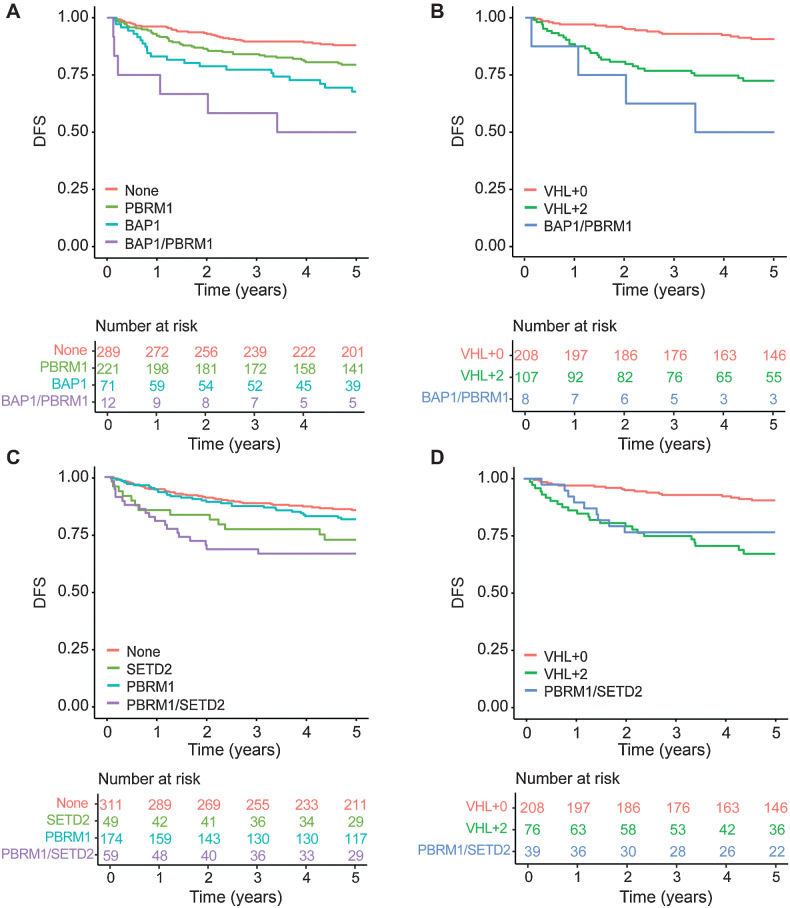
Figure 3. DFS outcomes by BAP1/PBRM1 and PBRM1/SETD2 mutation status. Kaplan–Meier survival curves based on (A) BAP1 and PBRM1 mutation status and (B) VHL+0 tumors, VHL+2 tumors containing both a BAP1 and PBRM1 mutation, and remaining VHL+2 tumors (i.e., those not containing both a BAP1 and PBRM1 mutation). Kaplan–Meier survival curves based on (C) PBRM1 and SETD2 mutation status and (D) VHL+0 tumors, VHL+2 tumors containing both a PBRM1 and SETD2 mutation, and remaining VHL+2 tumors (i.e., those not containing both a PBRM1 and SETD2 mutation).
Figure 3.
DFS outcomes by BAP1/PBRM1 and PBRM1/SETD2 mutation status. Kaplan–Meier survival curves based on (A) BAP1 and PBRM1 mutation status and (B) VHL+0 tumors, VHL+2 tumors containing both a BAP1 and PBRM1 mutation, and remaining VHL+2 tumors (i.e., those not containing both a BAP1 and PBRM1 mutation). Kaplan–Meier survival curves based on (C) PBRM1 and SETD2 mutation status and (D) VHL+0 tumors, VHL+2 tumors containing both a PBRM1 and SETD2 mutation, and remaining VHL+2 tumors (i.e., those not containing both a PBRM1 and SETD2 mutation).
Figure 4. Patients eligible for adjuvant therapy stratified by the genomic classifier. A, DFS amongst patients considered eligible (pT2 grade 3–4; pT3 or pT4 (any grade); any pT, any grade, N+) versus ineligible (pT1 (any grade); pT2 grade 1–2) for adjuvant therapy; (B) DFS by VHL+0, VHL+1, VHL+2 and VHL+≥3 groups amongst patients considered eligible for adjuvant therapy; (C) Flow diagram demonstrating potential clinical application. Application of the genomic classifier to patients typically considered eligible for adjuvant therapy allows sub-stratification of patients into groups with highly divergent risk of relapse. This information could usefully inform individual patient discussions around the benefit versus risks of adjuvant therapy.
Figure 4.
Patients eligible for adjuvant therapy stratified by the genomic classifier. A, DFS amongst patients considered eligible [pT2 grade 3–4; pT3 or pT4 (any grade); any pT, any grade, N+] versus ineligible [pT1 (any grade); pT2 grade 1–2] for adjuvant therapy. B, DFS by VHL+0, VHL+1, VHL+2, and VHL+≥3 groups amongst patients considered eligible for adjuvant therapy. C, Flow diagram demonstrating potential clinical application. Application of the genomic classifier to patients typically considered eligible for adjuvant therapy allows sub-stratification of patients into groups with highly divergent risk of relapse. This information could usefully inform individual patient discussions around the benefit versus risks of adjuvant therapy.

Comment in

References

    1. Sung H, Ferlay J, Siegel RL, Laversanne M, Soerjomataram I, Jemal A, et al. Global cancer statistics 2020: GLOBOCAN estimates of incidence and mortality worldwide for 36 cancers in 185 countries. CA Cancer J Clin 2021;71:209–49. - PubMed
    1. Znaor A, Lortet-Tieulent J, Laversanne M, Jemal A, Bray F. International variations and trends in renal cell carcinoma incidence and mortality. Eur Urol 2015;67:519–30. - PubMed
    1. Dabestani S, Beisland C, Stewart GD, Bensalah K, Gudmundsson E, Lam TB, et al. Long-term outcomes of follow-up for initially localized clear- cell renal cell carcinoma: RECUR database analysis. Eur Urol Focus 2019;5:857–66. - PubMed
    1. Larroquette M, Peyraud F, Domblides C, Lefort F, Bernhard JC, Ravaud A, et al. Adjuvant therapy in renal cell carcinoma: current knowledge and future perspectives. Cancer Treat Rev 2021;97:102207. - PubMed
    1. Choueiri TK, Tomczak P, Park SH, Venugopal B, Ferguson T, Chang YH, et al. Adjuvant pembrolizumab after nephrectomy in renal cell carcinoma. N Engl J Med 2021;385:683–94. - PubMed

MeSH terms

Substances