


High fibrinogen and mixed proximal and distal thrombosis are associated with the risk of residual venous thrombosis in patients with posttraumatic deep vein thrombosis
- PMID: 36818330
- PMCID: PMC9928750
- DOI: 10.3389/fcvm.2023.1003197
High fibrinogen and mixed proximal and distal thrombosis are associated with the risk of residual venous thrombosis in patients with posttraumatic deep vein thrombosis
Abstract
Background: The risk factors for residual venous thrombosis (RVT) in patients with post-trauma deep vein thrombosis (DVT) are unknown.
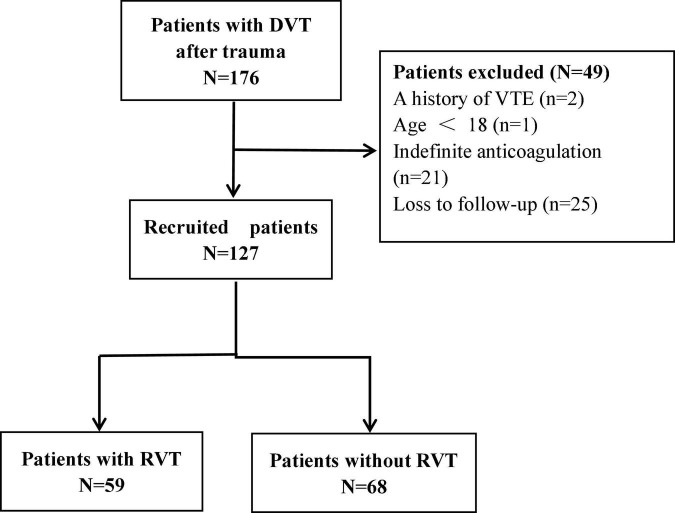
Methods: We evaluated 127 patients with DVT after trauma, all of whom were treated with conventional anticoagulation and assessed for the presence of RVT with venous compression ultrasound (CUS), using an internal diameter of the venous lumen ≥ 4 mm after compression as the criterion.
Results: RVT was present in 59 (46%) patients, and complete thrombus dissolution was present in 68 (54%) patients. Among them, mixed proximal and distal thrombosis (OR, 4.292; 95% CI, 1.253-14.707), diabetes (OR, 6.345; 95% CI, 1.125-35.786), fibrinogen > 4.145 g/L (OR, 2.858; 95% CI, 1.034-7.897), the time between detection of thrombus and initiation of antithrombotic therapy > 2.5 days (OR, 3.470; 95% CI, 1.085-11.094) was an independent risk factor for RVT in patients with posttraumatic DVT.
Conclusion: A mixed proximal and distal thrombosis, diabetes mellitus, late initiation of antithrombotic therapy, and high fibrinogen levels increase the risk of RVT in patients with posttraumatic DVT. Therefore, treatment regimens for patients with posttraumatic DVT can be adjusted according to the site of thrombosis, the presence of diabetes mellitus, and the level of fibrinogen, and antithrombotic therapy can be started as early as possible after the detection of thrombosis to prevent the development of RVT and its serious complications.
Keywords: anticoagulation; deep vein thrombosis (DVT); diabetes mellitus; fibrinogen (FBG); residual venous thrombosis; trauma.
Copyright © 2023 Liu, Deng, Zhu, Zhu and Wang.
Conflict of interest statement
The authors declare that the research was conducted in the absence of any commercial or financial relationships that could be construed as a potential conflict of interest.
Figures
References
-
- Prandoni P, Prins MH, Lensing AW, Ghirarduzzi A, Ageno W, Imberti D, et al. Residual thrombosis on ultrasonography to guide the duration of anticoagulation in patients with deep venous thrombosis: a randomized trial. Ann Intern Med. (2009) 150:577–85. 10.7326/0003-4819-150-9-200905050-00003 - DOI - PubMed
LinkOut - more resources
Full Text Sources
