. 2023 Jan 11;11(1):e11506.
doi: 10.1002/aps3.11506. eCollection 2023 Jan-Feb.

Evaluation of floral volatile patterns in the genus Narcissus using gas chromatography-coupled ion mobility spectrometry

Affiliations

Evaluation of floral volatile patterns in the genus Narcissus using gas chromatography-coupled ion mobility spectrometry

Florian Losch et al. Appl Plant Sci. .

Abstract

Premise: Daffodils (Narcissus, Amaryllidaceae) are iconic ornamentals with a complex floral biology and many fragrant species; however, little is known about floral plant volatile organic compounds (pVOCs) across the genus and additional sampling is desirable. The present study investigates whether the floral scent of 20 species of Narcissus can be characterized using gas chromatography-coupled ion mobility spectrometry (GC-IMS), with the aim of building a comparative pVOC data set for ecological and evolutionary studies.

Methods: We used a commercial GC-IMS equipped with an integrated in-line enrichment system for a fast, sensitive, and automated pVOC analysis. This facilitates qualitative and (semi)-quantitative measurements without sample preparation.

Results: The GC-IMS provided detailed data on floral pVOCs in Narcissus with very short sampling times and without floral enclosure. A wide range of compounds was recorded and partially identified. The retrieved pVOC patterns showed a good agreement with published data, and five "chemotypes" were characterized as characteristic combinations of floral volatiles.

Discussion: The GC-IMS setup can be applied to rapidly generate large amounts of pVOC data with high sensitivity and selectivity. The preliminary data on Narcissus obtained here indicate both considerable pVOC variability and a good correspondence of the pVOC patterns with infrageneric classification, supporting the hypothesis that floral scent could represent a considerable phylogenetic signal.

Keywords: Narcissus; benzyl acetate; ion mobility spectrometry; linalool; ocimene; plant volatile organic compounds.


Figures

Figure 1
Figure 1
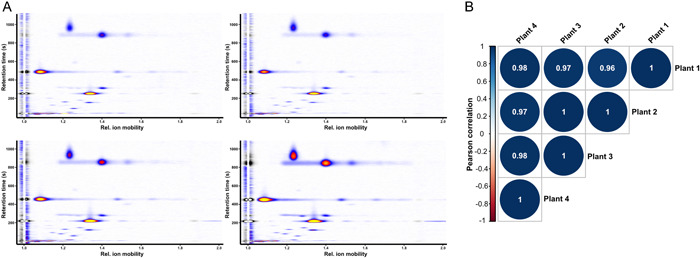
Comparison of the intraspecific pVOC profiles of four individual plants from the species Narcissus fernandesii (section Jonquillae). (A) Heatmap visualization of the detected signals obtained from the GC–IMS measurements, showing the general agreement of emission patterns. The retention time (y‐axis) and relative ion mobility (x‐axis) provide information about the identity of a substance. The signal intensity is color coded, with blue for low intensity, red/orange for medium intensity, and yellow for high intensity. The signal intensity is a semi‐quantitative measure for the abundance of a substance. (B) Correlation matrix (Pearson correlation) of the four individual plants. The similarity between the pVOC profiles is indicated by 1 (dark blue) for a perfect correlation, 0 (white) for no correlation, and −1 (dark red) for a perfect anticorrelation (P = 0.01).
Figure 2
Figure 2
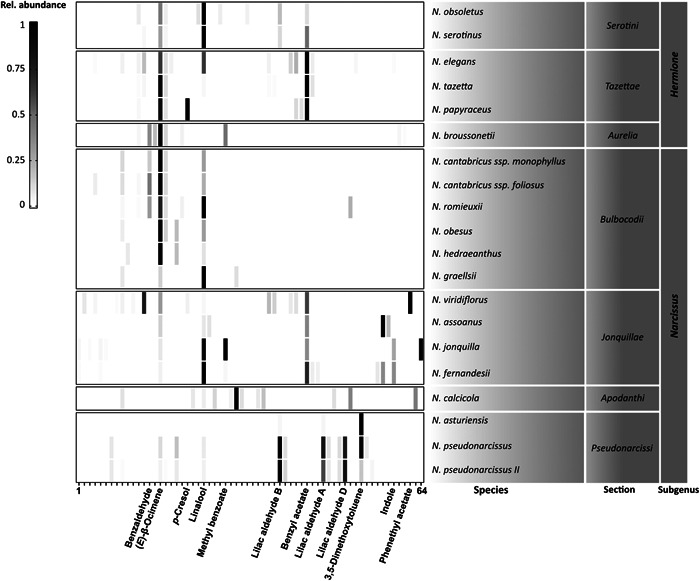
Distribution and relative abundance of the 64 detected signals in the 20 studied taxa of Narcissus. The x‐axis represents the detected signals (ordered by increasing retention time). The main identified compounds are named. The color code represents the abundance of the compound relative to the strongest signal detected in that species, where 1 (black) represents the strongest signal in a species and 0 (white) indicates the absence of a certain signal. The species were grouped based on previous phylogenetic divisions (Fernandes, 1975).
Figure 3
Figure 3
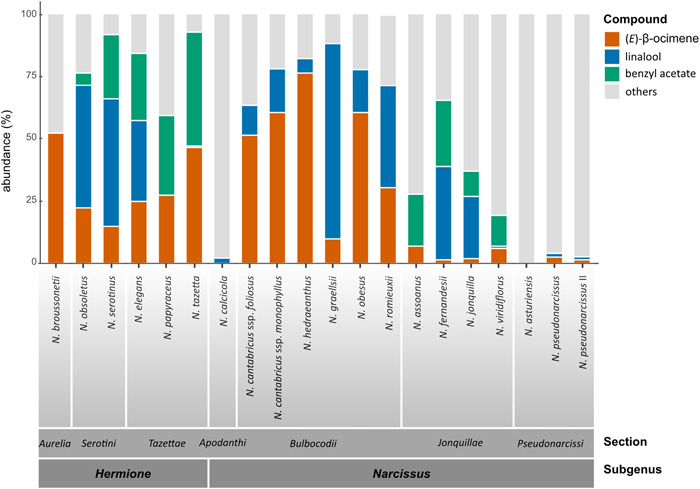
Stacked bar chart of the percentage distribution of the principal compounds among the studied species of Narcissus. The distribution is indicated by different colors for (E)‐β‐ocimene (orange), linalool (blue), benzyl acetate (green), and the sum of other compounds (gray).
Figure 4
Figure 4
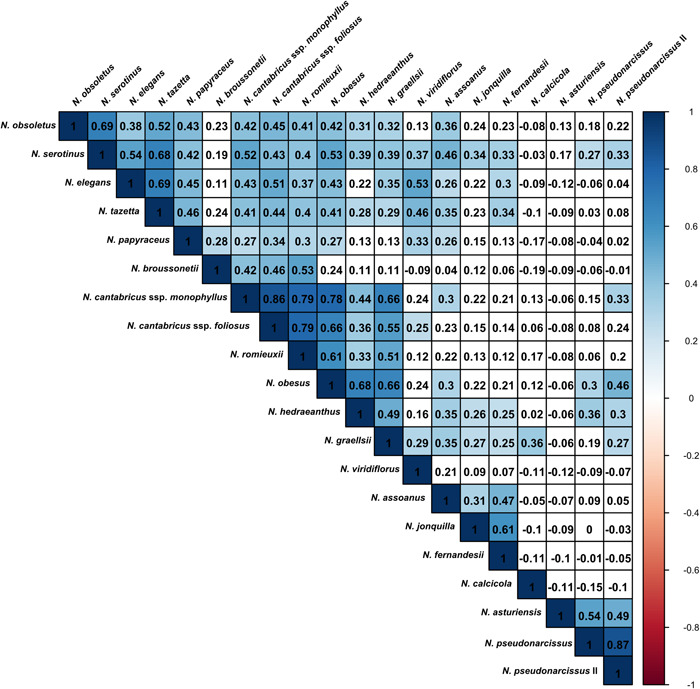
Comparison of the pVOC profiles for each pair of species in a correlation matrix, using Spearman's rank correlation. The similarity between the pVOC profiles is indicated by 1 for a perfect correlation, 0 for no correlation, and −1 for a perfect anticorrelation. The strength of the significant correlations (P = 0.05) is color coded, with blank cells representing no significant correlation. Each cell of the correlation matrix therefore compares the compositions of the detected pVOCs between two species.
Figure 5
Figure 5
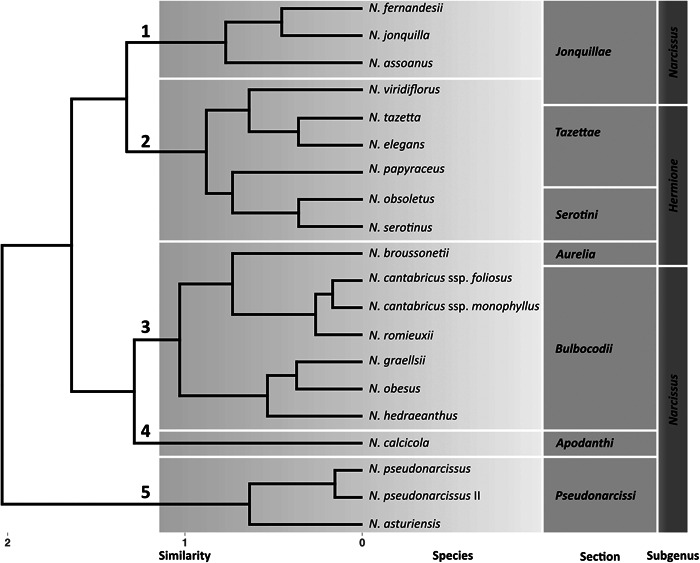
Hierarchical cluster dendrogram of the 20 investigated taxa of Narcissus based on the similarity of their pVOC profiles. The distance matrix is calculated as 1 minus the Spearman's rank correlation (dissimilarity matrix). For the agglomeration, the widely used Ward.D2 algorithm was applied. Five clusters (chemotypes) were retrieved, representing the likeness between the emission patterns.

References

    1. Arroyo, J. , and Dafni A.. 1995. Variations in habitat, season, flower traits and pollinators in dimorphic Narcissus tazetta L. (Amaryllidaceae) in Israel. New Phytologist 129: 135–145. - PubMed
    1. Barrett, S. C. H. , Cole W. W., and Herrera C. M.. 2004. Mating patterns and genetic diversity in the wild daffodil Narcissus longispathus (Amaryllidaceae). Heredity 92(5): 459–465. 10.1038/sj.hdy.6800441 - DOI - PubMed
    1. Barrett, S. C. H. , and Harder L. D.. 2005. The evolution of polymorphic sexual systems in daffodils (Narcissus). New Phytologist 165(1): 45–53. 10.1111/j.1469-8137.2004.01183.x - DOI - PubMed
    1. Bouwmeester, H. , Schuurink R. C., Bleeker P. M., and Schiestl F.. 2019. The role of volatiles in plant communication. Plant Journal 100(5): 892–907. 10.1111/tpj.14496 - DOI - PMC - PubMed
    1. Burkle, L. A. , and Runyon J. B.. 2019. Floral volatiles structure plant–pollinator interactions in a diverse community across the growing season. Functional Ecology 33(11): 2116–2129. 10.1111/1365-2435.13424 - DOI

LinkOut - more resources