


Higher diet quality is associated with short and long-term benefits on SF-6D health state utilities: a 5-year cohort study in an international sample of people with multiple sclerosis
- PMID: 36821020
- PMCID: PMC10241689
- DOI: 10.1007/s11136-023-03361-w
Higher diet quality is associated with short and long-term benefits on SF-6D health state utilities: a 5-year cohort study in an international sample of people with multiple sclerosis
Abstract
Background/purpose: Health state utilities (HSU) are a subjective measure of an individual's health-related quality of life (HRQoL), adjusted by societal or patient relative preference weights for living in different states of health-related quality of life (HRQoL), derived from patient-reported responses to multi-attribute utility instrument (MAUI), and can be used as inputs for cost-utility analyses and in clinical assessment. This research assessed associations of diet with subsequent HSU in a large international cohort of people living with multiple sclerosis (MS), a progressive autoimmune condition of the central nervous system.
Methods: HSUs were generated from responses to Short-Form Six-Dimension (SF-6D) MAUI, and quality-of-the-diet by Diet Habits Questionnaire (DHQ). Cross-sectional, and short- and long-term prospective associations of DHQ with HSU evaluated by linear regression at 2.5- and 5-years. Pooled prospective associations between DHQ and HSU evaluated using linear and quantile regression. Analyses adjusted for relevant demographic and clinical covariates.
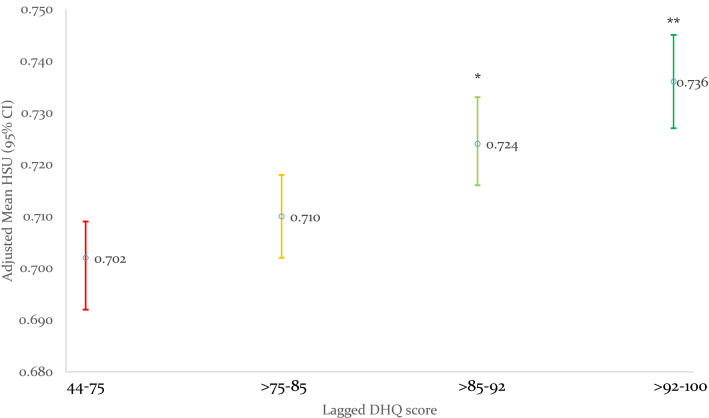
Results: Among 839 participants, baseline DHQ scores showed short- and long-term associations with subsequent HSU, each 10-unit increase in total DHQ score associated with 0.008-0.012 higher HSU (out of 1.00). These associations were dose-dependent, those in the top two quartiles of baseline DHQ scores having 0.01-0.03 higher HSU at follow-up, 0.03 being the threshold for a minimally clinically important difference. Fat, fiber, and fruit/vegetable DHQ subscores were most strongly and consistently associated with better HSU outcomes. However, baseline meat and dairy consumption were associated with 0.01-0.02 lower HSU at subsequent follow-up.
Conclusions: A higher quality-of-the-diet showed robust prospective relationships with higher HSUs 2.5- and 5-years later, substantiating previous cross-sectional relationships in this cohort. Subject to replication, these results suggest interventions to improve the quality-of-the-diet may be effective to improve HRQoL in people living with MS.
Keywords: Diet; Epidemiology; Health state utility; Multiple sclerosis.
© 2023. The Author(s).
Conflict of interest statement
GJ receives royalties for his books, Overcoming Multiple Sclerosis and Recovering from Multiple Sclerosis and GJ and SN receive royalties from their book, Overcoming Multiple Sclerosis: Roadmap to Good Health and have previously received remuneration for conducting educational workshops for people with MS.
Figures


References
-
- Compston A, McDonald I, Noseworthy JH, Lassmann H, Miller D, Smith K, Wekerle H, Confavreux C. McAlpine's Multiple Sclerosis. 4. Churchill Livingston; 2005.
-
- McCabe MP, McKern S. Quality of life and multiple sclerosis: Comparison between people with multiple sclerosis and people from the general population. Journal of Clinical Psychology in Medical Settings. 2002;9(4):287–295. doi: 10.1023/A:1020734901150. - DOI
-
- Benedict RH, Wahlig E, Bakshi R, Fishman I, Munschauer F, Zivadinov R, Weinstock-Guttman B. Predicting quality of life in multiple sclerosis: Accounting for physical disability, fatigue, cognition, mood disorder, personality, and behavior change. Journal of the Neurological Sciences. 2005;231(1–2):29–34. doi: 10.1016/j.jns.2004.12.009. - DOI - PubMed
MeSH terms
LinkOut - more resources
Full Text Sources
Medical
