


Outcome prediction by the 2022 European LeukemiaNet genetic-risk classification for adults with acute myeloid leukemia: an Alliance study
- PMID: 36823396
- PMCID: PMC10079544
- DOI: 10.1038/s41375-023-01846-8
Outcome prediction by the 2022 European LeukemiaNet genetic-risk classification for adults with acute myeloid leukemia: an Alliance study
Abstract
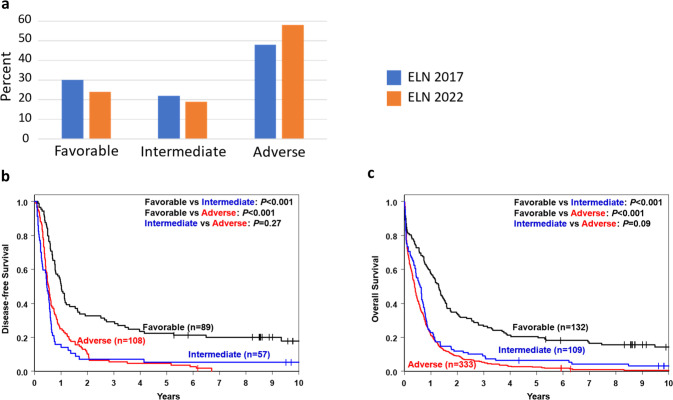
Recently, the European LeukemiaNet (ELN) revised its genetic-risk classification of acute myeloid leukemia (AML). We categorized 1637 adults with AML treated with cytarabine/anthracycline regimens according to the 2022 and 2017 ELN classifications. Compared with the 2017 ELN classification, 2022 favorable group decreased from 40% to 35% and adverse group increased from 37% to 41% of patients. The 2022 genetic-risk groups seemed to accurately reflect treatment outcomes in all patients and patients aged <60 years, but in patients aged ≥60 years, relapse rates, disease-free (DFS) and overall (OS) survival were not significantly different between intermediate and adverse groups. In younger African-American patients, DFS and OS did not differ between intermediate-risk and adverse-risk patients nor did DFS between favorable and intermediate groups. In Hispanic patients, DFS and OS did not differ between favorable and intermediate groups. Outcome prediction abilities of 2022 and 2017 ELN classifications were similar. Among favorable-risk patients, myelodysplasia-related mutations did not affect patients with CEBPAbZIP mutations or core-binding factor AML, but changed risk assignment of NPM1-mutated/FLT3-ITD-negative patients to intermediate. NPM1-mutated patients with adverse-risk cytogenetic abnormalities were closer prognostically to the intermediate than adverse group. Our analyses both confirm and challenge prognostic significance of some of the newly added markers.
Trial registration: ClinicalTrials.gov NCT00048958 NCT00899223 NCT00900224.
© 2023. The Author(s).
Conflict of interest statement
JSB is a consultant for and reported honoraria from KITE, INNATE, AstraZeneca and AbbVie. ASM received research funding from Leukemia and Lymphoma Society’s Beat AML clinical study, Aptevo, Daiichi Sankyo, Glycomemetics, Kartos Pharmaceuticals, Xencor and Genentech; and is a consultant for Aptevo, Abbvie, BMS, Glycomemetics, Jazz Pharmaceuticals, Kura Oncology, and Syndax Pharmaceuticals. BLP is a consultant for Cornerstone Pharmaceuticals and reported research funding from Ambit Biosciences, Cornerstone, Genentech, Hoffman LaRoche, Jazz Pharmaceuticals, Novartis and Pfizer. WGB reported honoraria from Abbvie, Syndax, and AmerisourceBergen and research funding from Celyad Oncology, Nkarta, Xencor, Forma Therapeutics and Leukemia and Lymphoma Society. GLU is a consultant for AbbVie, Agios, Jazz, GlaxoSmithKline, Genentech, and Novartis; reported honoraria from Astellas and research funding from Macrogenics. JCB consults for Astellas, AstraZeneca, Novartis, Pharmacyclics, Syndax and Trillium; receives honoraria from Astellas, AstraZeneca, Novartis, Pharmacyclics, Syndax and Trillium; he is a Chairman of the Scientific Advisory Board of Vincerx Pharmaceuticals and a member of advisory committee of Newave; and is a current equity holder of Vincerx Pharmaceuticals. A-KE is the spouse of Christopher J. Walker who is currently employed by Karyopharm Therapeutics. The remaining authors declare no competing financial interests.
Figures




References
-
- Arthur DC, Berger R, Golomb HM, Swansbury GJ, Reeves BR, Alimena G, et al. The clinical significance of karyotype in acute myelogenous leukemia. Cancer Genet Cytogenet. 1989;40:203–16. - PubMed
-
- Mrózek K, Heinonen K, de la Chapelle A, Bloomfield CD. Clinical significance of cytogenetics in acute myeloid leukemia. Semin Oncol. 1997;24:17–31. - PubMed
-
- Grimwade D, Walker H, Oliver F, Wheatley K, Harrison C, Harrison G, et al. The importance of diagnostic cytogenetics on outcome in AML: analysis of 1,612 patients entered into the MRC AML 10 trial. Blood. 1998;92:2322–33. - PubMed
-
- Slovak ML, Kopecky KJ, Cassileth PA, Harrington DH, Theil KS, Mohamed A, et al. Karyotypic analysis predicts outcome of preremission and postremission therapy in adult acute myeloid leukemia: a Southwest Oncology Group/Eastern Cooperative Oncology Group study. Blood. 2000;96:4075–83. - PubMed
-
- Byrd JC, Mrózek K, Dodge RK, Carroll AJ, Edwards CG, Arthur DC, et al. Pretreatment cytogenetic abnormalities are predictive of induction success, cumulative incidence of relapse, and overall survival in adult patients with de novo acute myeloid leukemia: results from Cancer and Leukemia Group B (CALGB 8461) Blood. 2002;100:4325–36. - PubMed
Publication types
MeSH terms
Substances
Associated data
Grants and funding
- UG1 CA233180/CA/NCI NIH HHS/United States
- U10 CA180821/CA/NCI NIH HHS/United States
- UG1 CA189850/CA/NCI NIH HHS/United States
- P30 CA033572/CA/NCI NIH HHS/United States
- UG1 CA233247/CA/NCI NIH HHS/United States
- R35 CA197734/CA/NCI NIH HHS/United States
- UG1 CA233339/CA/NCI NIH HHS/United States
- P50 CA140158/CA/NCI NIH HHS/United States
- UG1 CA233331/CA/NCI NIH HHS/United States
- U10 CA180882/CA/NCI NIH HHS/United States
- UG1 CA233338/CA/NCI NIH HHS/United States
- U24 CA196171/CA/NCI NIH HHS/United States
- P30 CA016058/CA/NCI NIH HHS/United States
- UG1 CA233327/CA/NCI NIH HHS/United States
LinkOut - more resources
Full Text Sources
Medical
Miscellaneous
