. 2023 Mar;29(3):540-550.
doi: 10.3201/eid2903.220320.

Associations of Anaplasma phagocytophilum Bacteria Variants in Ixodes scapularis Ticks and Humans, New York, USA

Associations of Anaplasma phagocytophilum Bacteria Variants in Ixodes scapularis Ticks and Humans, New York, USA

Melissa Prusinski et al. Emerg Infect Dis. 2023 Mar.

Abstract

Anaplasmosis, caused by the tickborne bacterium Anaplasma phagocytophilum, is an emerging public health threat in the United States. In the northeastern United States, the blacklegged tick (Ixodes scapularis) transmits the human pathogenic genetic variant of A. phagocytophilum (Ap-ha) and a nonpathogenic variant (Ap-V1). New York has recently experienced a rapid and geographically focused increase in cases of anaplasmosis. We analyzed A. phagocytophilum-infected I. scapularis ticks collected across New York during 2008-2020 to differentiate between variants and calculate an entomological risk index (ERI) for each. Ap-ha ERI varied between regions and increased in all regions during the final years of the study. Space-time scan analyses detected expanding clusters of Ap-ha located within documented anaplasmosis hotspots. Ap-ha ERI was more positively correlated with anaplasmosis incidence than non-genotyped A. phagocytophilum ERI. Our findings help elucidate the relationship between the spatial ecology of A. phagocytophilum variants and anaplasmosis.

Keywords: Anaplasma phagocytophilum; Ixodes; New York; O’Connor C; Rose L; Russell A; Sommer J; Suggested citation for this article: Prusinski M; USA. Emerg Infect Dis. 2023 Mar [date cited]. https://doi.org/10.3201/eid2903.220320; United States; White J; anaplasmosis; bacteria; et al. Associations of Anaplasma phagocytophilum bacteria variants in Ixodes scapularis ticks and humans; genetic variants; geographic information systems; population genetics; public health surveillance; space-time clustering; spatiotemporal analysis; ticks; vector-borne infections; zoonoses.


Figures
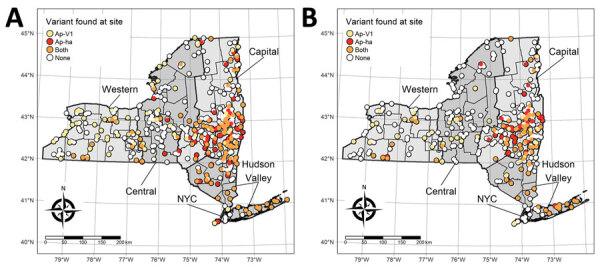
Figure 1
Figure 1
New York State Department of Health (NYSDOH) Ixodes scapularis tick sampling sites categorized by the Anaplasma phagocytophilum genetic variants found at each site, New York, USA. Thick black outlines indicate NYSDOH regions (labeled). A) Adult sampling sites; B) nymph sampling sites.
Figure 6
Figure 6
Equation calculating ERI for I. scapularis nymphs and adults.
Figure 2
Figure 2
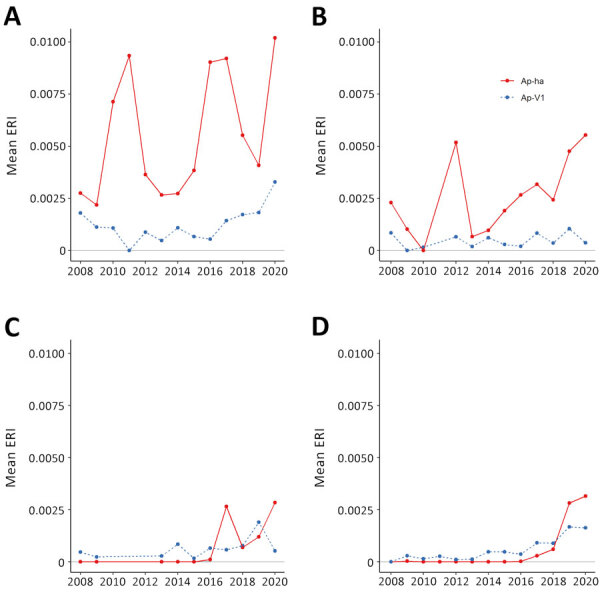
Mean ERI of pathogenic and nonpathogenic genetic variants of Anaplasma phagocytophilum bacteria in adult blacklegged ticks aggregated to regions of New York, 2008–2020. A) Hudson Valley region; B) Capital region; C) Central region; D) Western region. Ap-ha, human pathogenic variant of A. phagocytophilum bacteria; Ap-V1, nonpathogenic variant of A. phagocytophilum; ERI, entomological risk index.
Figure 3
Figure 3
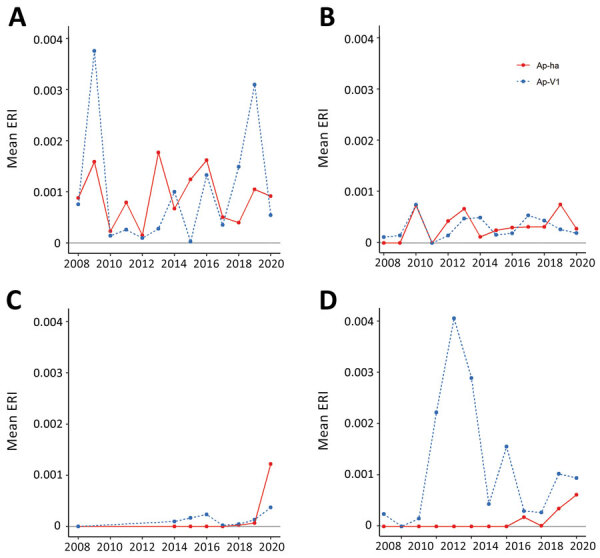
Mean ERI of pathogenic and nonpathogenic genetic variants of Anaplasma phagocytophilum bacteria in nymphal blacklegged ticks aggregated to regions of New York, 2008–2020. A) Hudson Valley region; B) Capital region; C) Central region; D) Western region. Ap-ha, human pathogenic variant of A. phagocytophilum bacteria; Ap-V1, nonpathogenic variant of A. phagocytophilum; ERI, entomological risk index.
Figure 4
Figure 4
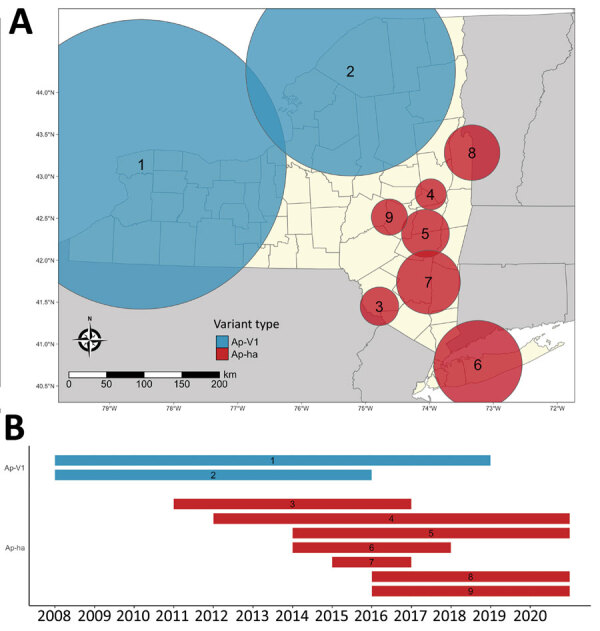
Bernoulli clusters of pathogenic and nonpathogenic genetic variants of Anaplasma phagocytophilum bacteria in adult Ixodes scapularis ticks in New York, 2008–2020. A) Spatial clusters; B) temporal clusters. Ap-ha, pathogenic variant; Ap-V1, nonpathogenic variant.
Figure 5
Figure 5
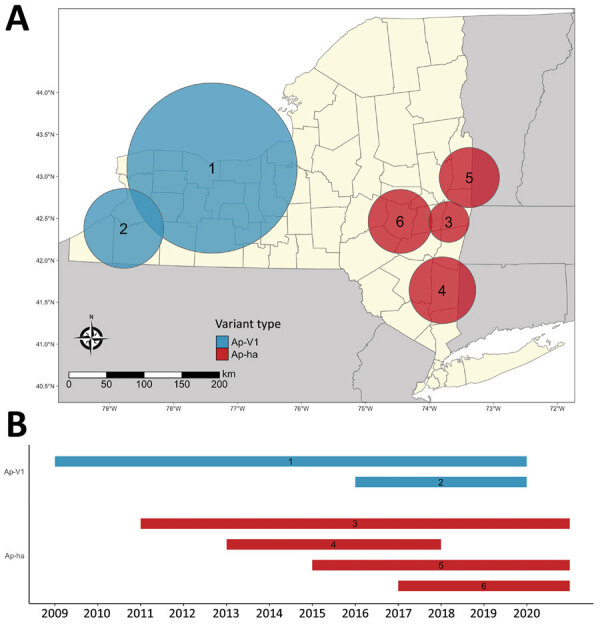
Bernoulli clusters of pathogenic and nonpathogenic genetic variants of Anaplasma phagocytophilum bacteria in nymphal Ixodes scapularis ticks in New York, 2008–2020. A) Spatial clusters; B) temporal clusters. Ap-ha, pathogenic variant; Ap-V1, nonpathogenic variant.

References

    1. Bakken JS, Dumler JS, Chen SM, Eckman MR, Van Etta LL, Walker DH. Human granulocytic ehrlichiosis in the upper Midwest United States. A new species emerging? JAMA. 1994;272:212–8. 10.1001/jama.1994.03520030054028 - DOI - PubMed
    1. Chen SM, Dumler JS, Bakken JS, Walker DH. Identification of a granulocytotropic Ehrlichia species as the etiologic agent of human disease. J Clin Microbiol. 1994;32:589–95. 10.1128/jcm.32.3.589-595.1994 - DOI - PMC - PubMed
    1. Dumler JS, Madigan JE, Pusterla N, Bakken JS. Ehrlichioses in humans: epidemiology, clinical presentation, diagnosis, and treatment. Clin Infect Dis. 2007;45(Suppl 1):S45–51. 10.1086/518146 - DOI - PubMed
    1. Massung RF, Mauel MJ, Owens JH, Allan N, Courtney JW, Stafford KC III, et al. Genetic variants of Ehrlichia phagocytophila, Rhode Island and Connecticut. Emerg Infect Dis. 2002;8:467–72. 10.3201/eid0805.010251 - DOI - PMC - PubMed
    1. Massung RF, Courtney JW, Hiratzka SL, Pitzer VE, Smith G, Dryden RL. Anaplasma phagocytophilum in white-tailed deer. Emerg Infect Dis. 2005;11:1604–6. 10.3201/eid1110.041329 - DOI - PMC - PubMed

Publication types