


Anatomic Distribution of Benign Ovarian Tumors in Perimenopausal and Postmenopausal Women
- PMID: 36824539
- PMCID: PMC9941038
- DOI: 10.7759/cureus.34059
Anatomic Distribution of Benign Ovarian Tumors in Perimenopausal and Postmenopausal Women
Abstract
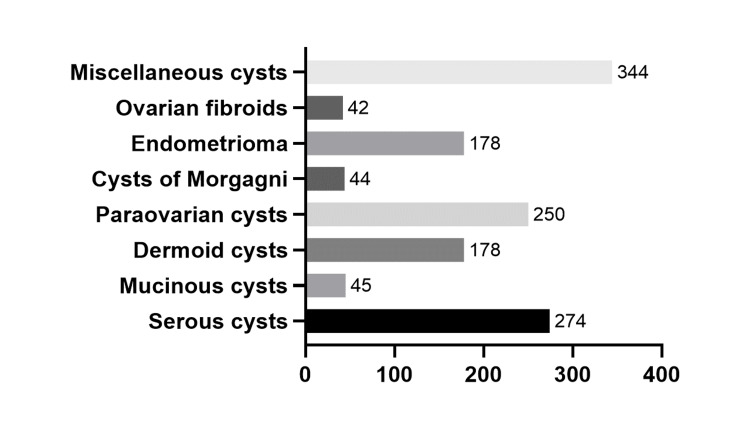
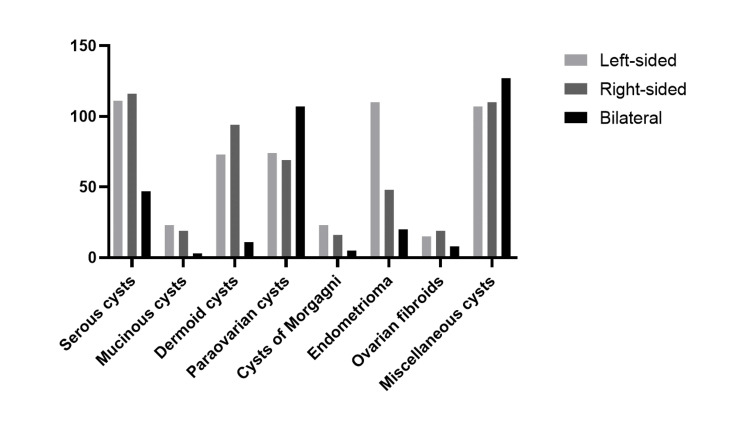
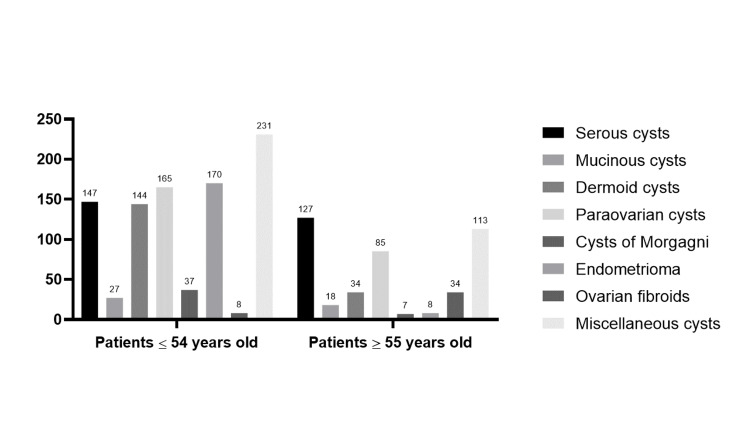
Introduction We aim to report the histotypes and reassess the anatomic distribution of benign ovarian tumors in perimenopausal and postmenopausal women. Methods Medical and pathology reports of women with histologically confirmed benign ovarian pathology were investigated. Data were collected, retrospectively between 2000 and 2020, and analyzed from perimenopausal and postmenopausal women with benign ovarian tumors, after bilateral salpingo-oophorectomy (BSO) with or without total abdominal hysterectomy (TAH). The ovarian masses histology and the distribution of locations were further evaluated. Results The total sample consisted of 1,355 women with benign ovarian tumors; 929 (68.6%) of the perimenopausal and 426 (31.4%) of the postmenopausal age. A dermoid cyst was prominent in the right ovary (52.8%), compared to the left side (41%) (p<0.01). Conversely, in patients with endometriomas and cysts of Morgagni, the observed proportion was more prominent in the left-sided ovary (61.8% vs 27%; p<0.001 and 52.3% vs 36.4%; p<0.01, respectively). Moreover, in the perimenopausal women, we mostly detected endometrioma (18.3%), dermoid cyst (15.5%) and cyst of Morgagni (4%) compared to postmenopausal women, where serous cysts (29.8%) and ovarian fibroids (8%) were the most common tumors. Conclusions Benign ovarian tumors are frequently seen in perimenopausal women and most histotypes present anatomical differences between the left and right ovaries. Serous cysts, followed by paraovarian, dermoid cysts and endometrioma present the commonest ovarian benign masses. Gynecologists should pay special attention to adnexal tumors in the postmenopausal period to choose the right operating setting for women at risk for ovarian cancer.
Keywords: adnexal mass; anatomic distribution; benign ovarian tumors; perimenopause; postmenopause.
Copyright © 2023, Matalliotakis et al.
Conflict of interest statement
The authors have declared that no competing interests exist.
Figures
References
-
- Pathology and classification of ovarian tumors. Chen VW, Ruiz B, Killeen JL, Coté TR, Wu XC, Correa CN. Cancer. 2003;97:2631–2642. - PubMed
-
- Kurman RJ, Carcangiu ML, Herrington CS, Young RH. WHO Classification of Tumours of Female Reproductive Organs. Lyon, France: International Agency for Research on Cancer; 2014. WHO Classification of Tumours of Female Reproductive Organs; p. 307.
-
- Russell P. In: Blaustein’s Pathology of Female Genital Tract. New York, USA: Springer-Verlag; 1994. Surface epithelial-stromal tumors of the ovary; pp. 705–782.
-
- Prevalence and histologic diagnosis of adnexal cysts in postmenopausal women: an autopsy study. Dørum A, Blom GP, Ekerhovd E, Granberg S. Am J Obstet Gynecol. 2005;192:48–54. - PubMed
-
- Inpatient hospitalization for gynecologic disorders in the United States. Whiteman MK, Kuklina E, Jamieson DJ, Hillis SD, Marchbanks PA. Am J Obstet Gynecol. 2010;202:541. - PubMed
LinkOut - more resources
Full Text Sources