


This is a preprint.
CXCR6 promotes dermal CD8+ T cell survival and transition to long-term tissue residence
- PMID: 36824892
- PMCID: PMC9949075
- DOI: 10.1101/2023.02.14.528487
CXCR6 promotes dermal CD8+ T cell survival and transition to long-term tissue residence
Update in
-
CXCR6 promotes dermal CD8+ T cell survival and transition to long-term tissue residence.J Immunol. 2025 Sep 4:vkaf219. doi: 10.1093/jimmun/vkaf219. Online ahead of print. J Immunol. 2025. PMID: 40906897
Abstract
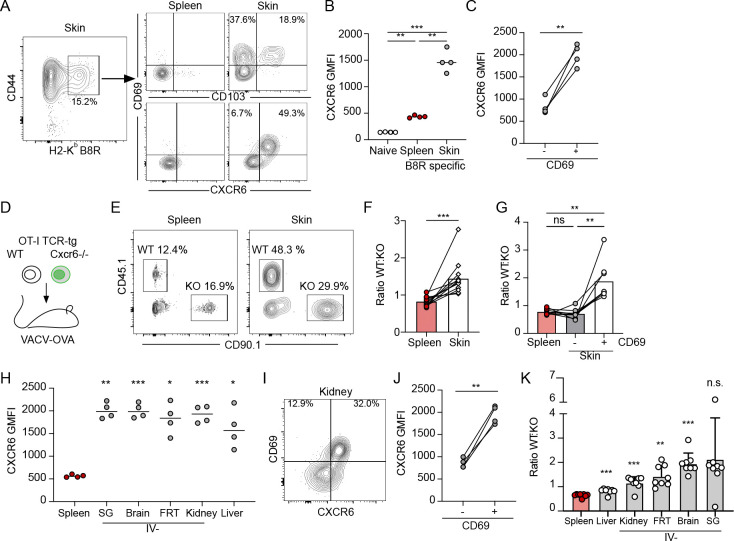
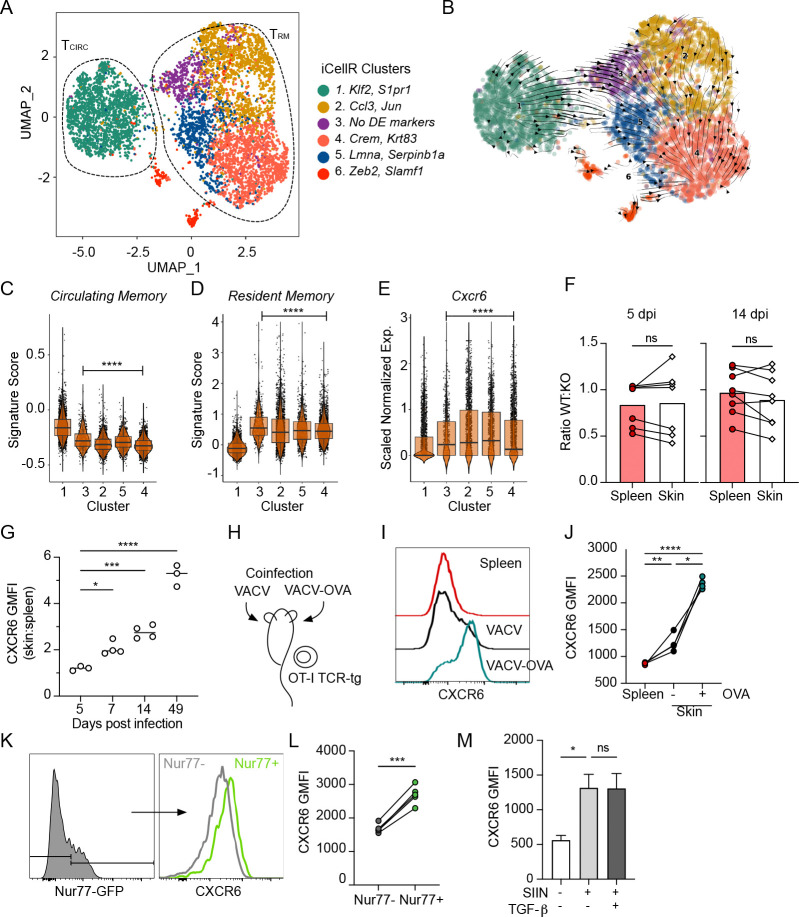
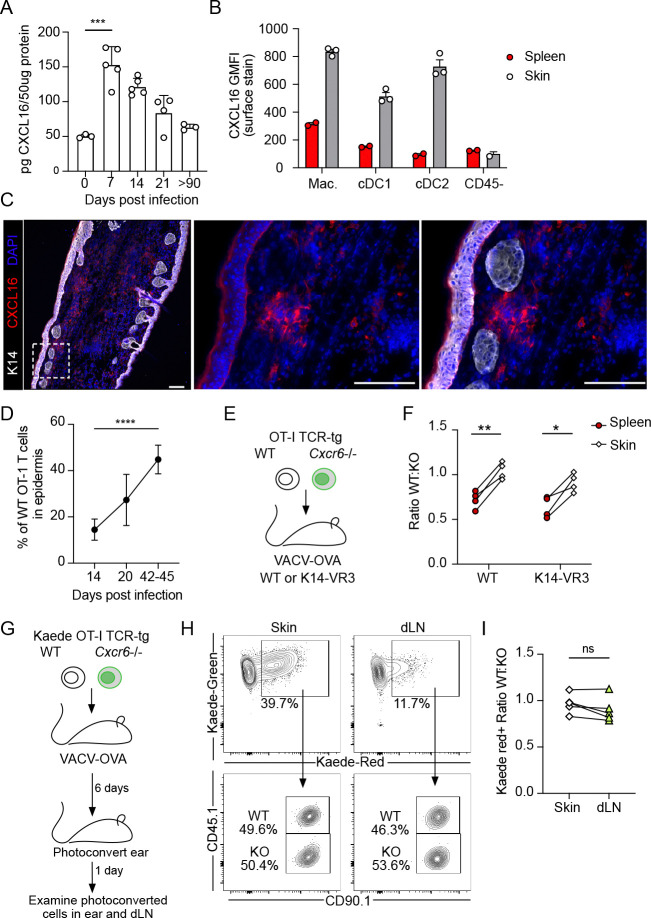
Tissue resident memory T cells (TRM) provide protection against local re-infection, and yet the interstitial signals necessary for their formation and persistence remain incompletely understood. Here we show that antigen-dependent induction of the chemokine receptor, CXCR6, is a conserved adaptation to peripheral tissue infiltration that promotes TRM formation after viral infection. Deficient TRM formation in the absence of CXCR6 was not explained by canonical trafficking as CXCR6 was not required for tissue entry, was dispensable for the early accumulation of antigen-specific CD8+ T cells in skin, and did not restrain their exit. Further, single cell sequencing indicated that Cxcr6 -/- CD8+ T cells were competent to acquire a transcriptional program of residence and TRM that formed were equally functional compared to their WT counterparts when reactivated greater than 100 days post primary infection. The reduced numbers observed at memory time points, where instead found to associate with impaired redox homeostasis and antioxidant capacity during the transition from effector to memory states. As such, Cxcr6 -/- CD8+ T cells exhibited increased rates of apoptosis in the dermis relative to controls, which led to reduced numbers of TRM in the epidermis at memory. CXCR6 therefore promotes the metabolic adaptation of T cells as they engage antigen in tissue to increase the probability of memory differentiation and long-term residence.
Conflict of interest statement
Competing interests: AWL reports consulting services for AGS Therapeutics. All other authors declare that they have no competing interests.
Figures


References
-
- Mackay L. K., Rahimpour A., Ma J. Z., Collins N., Stock A. T., Hafon M.-L., Vega-Ramos J., Lauzurica P., Mueller S. N., Stefanovic T., Tscharke D. C., Heath W. R., Inouye M., Carbone F. R., and Gebhardt T.. 2013. The developmental pathway for CD103+CD8+ tissue-resident memory T cells of skin. Nat. Immunol. 14: 1294–1301. - PubMed
-
- Mackay L. K., Braun A., Macleod B. L., Collins N., Tebartz C., Bedoui S., Carbone F. R., and Gebhardt T.. 2015. Cutting edge: CD69 interference with sphingosine-1-phosphate receptor function regulates peripheral T cell retention. J. Immunol. Baltim. Md 1950 194: 2059–2063. - PubMed
-
- Kumar B. V., Ma W., Miron M., Granot T., Guyer R. S., Carpenter D. J., Senda T., Sun X., Ho S.-H., Lerner H., Friedman A. L., Shen Y., and Farber D. L.. 2017. Human Tissue-Resident Memory T Cells Are Defined by Core Transcriptional and Functional Signatures in Lymphoid and Mucosal Sites. Cell Rep. 20: 2921–2934. - PMC - PubMed
Publication types
Grants and funding
LinkOut - more resources
Full Text Sources
Molecular Biology Databases
Research Materials
