[Preprint]. 2023 Feb 15:rs.3.rs-2535247.
doi: 10.21203/rs.3.rs-2535247/v1.

Pro-phagocytic function and structural basis of GPR84 signaling

Affiliations

Pro-phagocytic function and structural basis of GPR84 signaling

Xuan Zhang et al. Res Sq. .

Update in

  • Pro-phagocytic function and structural basis of GPR84 signaling.
    Zhang X, Wang Y, Supekar S, Cao X, Zhou J, Dang J, Chen S, Jenkins L, Marsango S, Li X, Liu G, Milligan G, Feng M, Fan H, Gong W, Zhang C. Zhang X, et al. Nat Commun. 2023 Sep 14;14(1):5706. doi: 10.1038/s41467-023-41201-0. Nat Commun. 2023. PMID: 37709767 Free PMC article.

Abstract

GPR84 is a unique orphan G protein-coupled receptor (GPCR) that can be activated by endogenous medium-chain fatty acids (MCFAs). The signaling of GPR84 is largely pro-inflammatory, which can augment inflammatory response, and GPR84 also functions as a pro-phagocytic receptor to enhance the phagocytic activities of macrophages. In this study, we first showed that the activation of GPR84 by the synthetic agonist 6-OAU could synergize with the blockade of CD47 on cancer cells to induce phagocytosis of cancer cells by macrophages. Then, we determined a high-resolution structure of the GPR84-Gi signaling complex with 6-OAU. This structure revealed a completely occluded binding pocket for 6-OAU, the molecular basis of receptor activation involving non-conserved structural motifs of GPR84, and an unusual Gi-coupling interface. Together with computational docking and simulations studies, our structure also suggested the mechanism for the high selectivity of GPR84 for MCFAs and the potential routes of ligand binding and dissociation. Our results provide a framework for understanding GPR84 signaling and developing new drugs targeting GPR84.


Conflict of interest statement

Additional Declarations: There is NO Competing Interest.

DECLARATION OF INTERESTS

No conflicts of interests are declared for all authors.

Figures
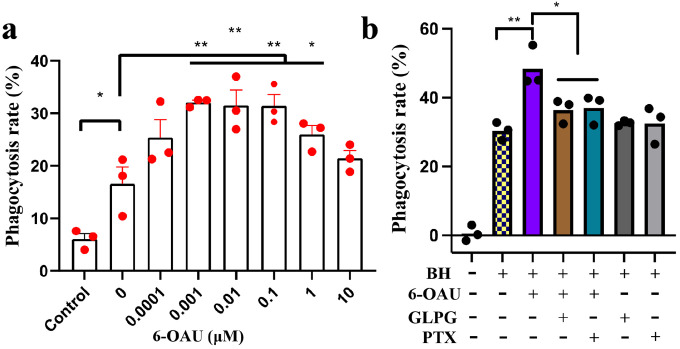
Figure 1.
Figure 1.. GPR84-Gi signaling facilitates cancer cell phagocytosis.
(a) Dose-dependent pro-phagocytic effect of 6-OAU. (b) GLPG1205 and pertussis toxin (PTX) abolished the pro-phagocytic effect of 6-OAU. BH means B6H12, the CD47 blocking antibody. PTX means pertussis toxin. Each data point represents SD of data from 3 independent experiments (n=3) taken from distinct samples. *p<0.05 and **p<0.01.
Figure 2.
Figure 2.. Overall structure of the 6-OAU-GPR84-Gi complex.
The left and right panels show the cryo-EM density map and the overall structure, respectively. The chemical structures of capric acid and 6-OAU and the cryo-EM density are shown in the middle. GPR84 is colored in blue. Gαi, Gβ and Gγ subunits are colored in cyan, pink and light blue, respectively. ScFv16 is colored in grey.
Figure 3.
Figure 3.. 6-OAU binding in GPR84.
(a) Occluded binding pocket for 6-OAU covered by ECL2. (b) Charge potential of the 6-OAU binding pocket. The bar shows the levels of negative (red) and positive (blue) charge potential. (c) Interactions between 6-OAU and GPR84. The polar interactions are shown as dashed lines. (d) Mutagenesis data using GTPγS incorporation assays. Data represent mean ± SEM from at least 3 independent experiments. 6-OAU is shown as orange sticks in all figures.
Figure 4.
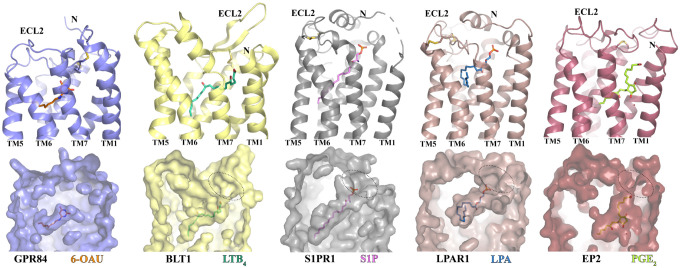
Figure 4.. Comparison of the ligand binding pockets in GPR84 and four other lipid GPCRs.
BLT1, S1PR1, LPAR1, and EP2 are receptors of LTB4, S1P, LPA, and PGE2, respectively. The structures of GPR84, BLT1 (PDB ID 7VKT), S1PR1 (PDB ID 7TD3), LPAR1 (PDB ID 7TD0), and EP2 (PDB ID 7CX2) are colored slate, light yellow, grey, brown, and dark red, respectively. All ligands are shown in sticks.
Figure 5.
Figure 5.. Docking of GPR84 agonists and MD simulations of 6-OAU-bound GPR84.
(a) Interactions of docked embelin (light yellow), capric acid (pink), and 2-hydroxyl capric acid (lime) with GPR84 (slate). Hydrogen bonds are shown as black dashed lines. (b) Exit routes of 6-OAU in MD simulations. The 6-OAU movement during the simulations is shown as density in white grid. Red arrows indicate possible ligand exit routes via metastable sites S1, S2 or S3. 6-OAU is shown as cyan spheres and GPR84 is shown in orange.
Figure 6.
Figure 6.. Active conformation of GPR84.
(a) Superimposition of the active GPR84 structure (blue) to the Alphafold predicted inactive GPR84 structure (green). The extracellular and intracellular regions are shown in the left upper and lower panels, respectively. The red arrows indicate conformational changes of TMs. (b) Residues involved in the receptor activation at the core region of GPR84.
Figure 7.
Figure 7.. Gi-coupling to GPR84.
(a) Interactions between GPR84 (blue) and the α5 of Gαi (cyan). (b) Interactions between GPR84 (blue) and Gβ (salmon). (c) Interactions between the C-terminal end of TM5 of GPR84 (blue) and Gαi (cyan). All polar interactions are shown as dashed lines.

References

    1. Stoddart L. A., Smith N. J. & Milligan G. International Union of Pharmacology. LXXI. Free fatty acid receptors FFA1, −2, and −3: pharmacology and pathophysiological functions. Pharmacol Rev 60, 405–417, doi:10.1124/pr.108.00802 (2008). - DOI - PubMed
    1. Kimura I., Ichimura A., Ohue-Kitano R. & Igarashi M. Free Fatty Acid Receptors in Health and Disease. Physiol Rev 100, 171–210, doi:10.1152/physrev.00041.2018 (2020). - DOI - PubMed
    1. Bergman R. N. & Ader M. Free fatty acids and pathogenesis of type 2 diabetes mellitus. Trends Endocrinol Metab 11, 351–356, doi:10.1016/s1043-2760(00)00323-4 (2000). - DOI - PubMed
    1. Boden G. Obesity and free fatty acids. Endocrinol Metab Clin North Am 37, 635–646, viii–ix, doi:10.1016/j.ecl.2008.06.007 (2008). - DOI - PMC - PubMed
    1. Alvarez-Curto E. & Milligan G. Metabolism meets immunity: The role of free fatty acid receptors in the immune system. Biochem Pharmacol 114, 3–13, doi:10.1016/j.bcp.2016.03.017 (2016). - DOI - PubMed

Publication types