


Prediction and Analysis of Heart Failure Decompensation Events Based on Telemonitored Data and Artificial Intelligence Methods
- PMID: 36826544
- PMCID: PMC9958752
- DOI: 10.3390/jcdd10020048
Prediction and Analysis of Heart Failure Decompensation Events Based on Telemonitored Data and Artificial Intelligence Methods
Abstract
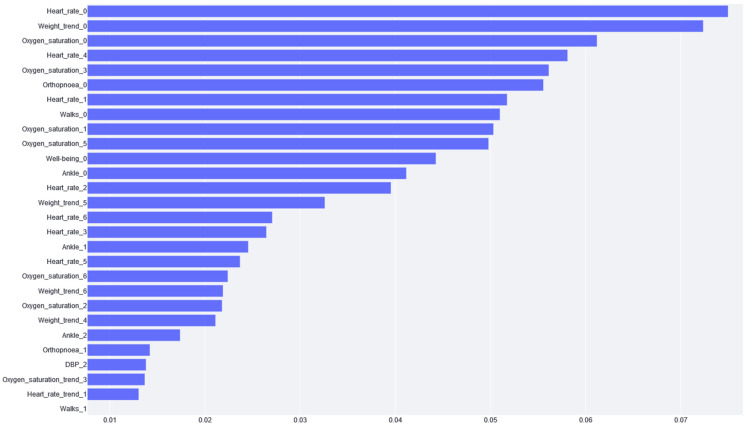
Cardiovascular diseases are the leading cause of death globally, taking an estimated 17.9 million lives each year. Heart failure (HF) occurs when the heart is not able to pump enough blood to satisfy metabolic needs. People diagnosed with chronic HF may suffer from cardiac decompensation events (CDEs), which cause patients' worsening. Being able to intervene before decompensation occurs is the major challenge addressed in this study. The aim of this study is to exploit available patient data to develop an artificial intelligence (AI) model capable of predicting the risk of CDEs timely and accurately. Materials and Methods: The vital variables of patients (n = 488) diagnosed with chronic heart failure were monitored between 2014 and 2022. Several supervised classification models were trained with these monitoring data to predict CDEs, using clinicians' annotations as the gold standard. Feature extraction methods were applied to identify significant variables. Results: The XGBoost classifier achieved an AUC of 0.72 in the cross-validation process and 0.69 in the testing set. The most predictive physiological variables for CAE decompensations are weight gain, oxygen saturation in the final days, and heart rate. Additionally, the answers to questionnaires on wellbeing, orthopnoea, and ankles are strongly significant predictors.
Keywords: XGBoost; decompensation; heart failure; logistic regression; machine learning; monitoring; supervised classification.
Conflict of interest statement
The authors declare no conflict of interest.
Figures




References
-
- Ponikowski P., Voors A.A., Anker S.D., Bueno H., Cleland J.G.F., Coats A.J.S., Falk V., González-Juanatey J.R., Harjola V.-P., Jankowska E.A., et al. 2016 ESC Guidelines for the diagnosis and treatment of acute and chronic heart failure: The Task Force for the diagnosis and treatment of acute and chronic heart failure of the European Society of Cardiology (ESC)Developed with the special contribution of the Heart Failure Association (HFA) of the ESC. Eur. Heart J. 2016;37:2129–2200. doi: 10.1093/eurheartj/ehw128. - DOI - PubMed
-
- Stehlik J., Schmalfuss C., Bozkurt B., Nativi-Nicolau J., Wohlfahrt P., Wegerich S., Rose K., Ray R., Schofield R., Deswal A. Continuous wearable monitoring analytics predict heart failure hospitalization: The LINK-HF multicenter study. Circ. Heart Fail. 2020;13:e006513. doi: 10.1161/CIRCHEARTFAILURE.119.006513. - DOI - PubMed
LinkOut - more resources
Full Text Sources
Other Literature Sources
Research Materials
Miscellaneous
