


Sarcopenia of kidney transplant recipients as a predictive marker for reduced graft function and graft survival after kidney transplantation
- PMID: 36826595
- PMCID: PMC9958183
- DOI: 10.1007/s00423-023-02836-1
Sarcopenia of kidney transplant recipients as a predictive marker for reduced graft function and graft survival after kidney transplantation
Abstract
Purpose: The association between sarcopenia of kidney transplant recipients and outcome after kidney transplantation (KT) has not yet been fully understood and is still considered controversial. The aim of our study was to analyze the impact of pre-transplant sarcopenia on graft function, postoperative complication rates, and survival of the patients after renal transplantation.
Methods: In this retrospective single-center study, all patients who underwent KT (01/2013-12/2017) were included. Demographic data, rejection rates, delayed graft function, and graft and patient survival rates were analyzed. Sarcopenia was measured in computed tomography images by the sex-adjusted Hounsfield unit average calculation (HUAC).
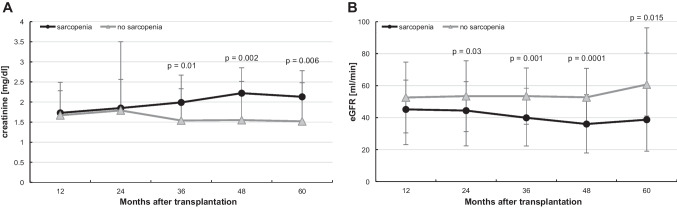
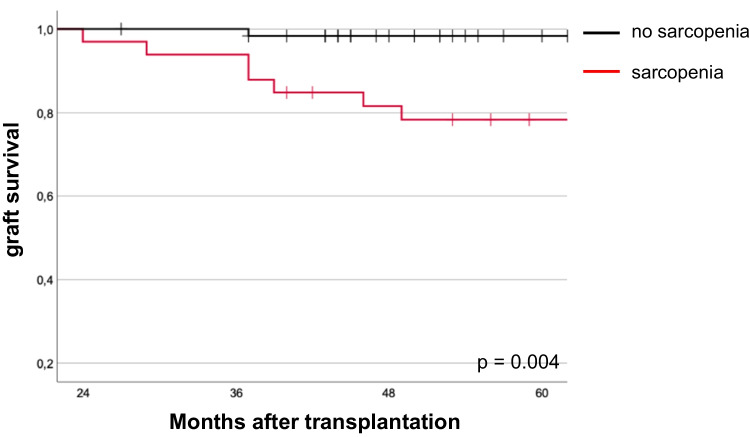
Results: During the study period, 111 single KTs (38 women and 73 men) were performed. Living donor kidney transplants were performed in 48.6%. In total, 32.4% patients had sarcopenia. Sarcopenic patients were significantly older (59.6 years vs. 49.8 years; p < 0.001), had a higher body mass index (BMI = 27.6 kg/m2 vs. 25.0 kg/m2; p = 0.002), and were more likely to receive deceased donor kidneys (72.2% vs. 41.3%; p = 0.002). Interestingly, 3 years after KT, the creatinine serum levels were significantly higher (2.0 mg/dl vs. 1.5 mg/dl; p = 0.001), whereas eGFR (39.9 ml/min vs. 53.4 ml/min; p = 0.001) and graft survival were significantly lower (p = 0.004) in sarcopenic transplant recipients. Sarcopenic patients stayed in hospital significantly longer postoperatively than those who were non-sarcopenic.
Conclusions: At the time of kidney transplantation, sarcopenia was found to predict reduced long-term graft function and diminished graft survival after KT. The early identification of sarcopenic patients can not only enable an optimized selection of recipients, but also the initiation of pre-habilitation programs during the waiting period.
Keywords: Graft survival; HUAC; Kidney function; Kidney transplantation; Sarcopenia.
© 2023. The Author(s).
Conflict of interest statement
The authors declare no competing interests.
Figures
References
-
- Wolfe RA, Ashby VB, Milford EL, Ojo AO, Ettenger RE, Agodoa LY, et al. Comparison of mortality in all patients on dialysis, patients on dialysis awaiting transplantation, and recipients of a first cadaveric transplant. N Engl J Med. 1999;341(23):1725–1730. doi: 10.1056/NEJM199912023412303. - DOI - PubMed
MeSH terms
LinkOut - more resources
Full Text Sources
Medical
Research Materials
Miscellaneous
