


Fecal Microbiota Transplantation in Reducing Uremic Toxins Accumulation in Kidney Disease: Current Understanding and Future Perspectives
- PMID: 36828429
- PMCID: PMC9965504
- DOI: 10.3390/toxins15020115
Fecal Microbiota Transplantation in Reducing Uremic Toxins Accumulation in Kidney Disease: Current Understanding and Future Perspectives
Abstract
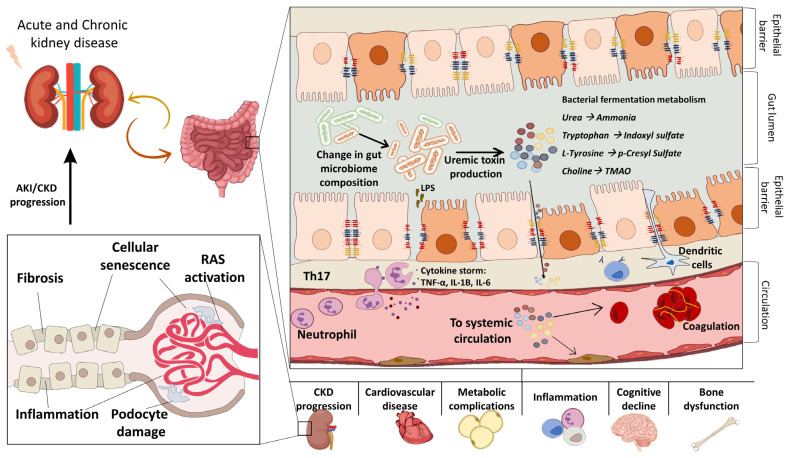
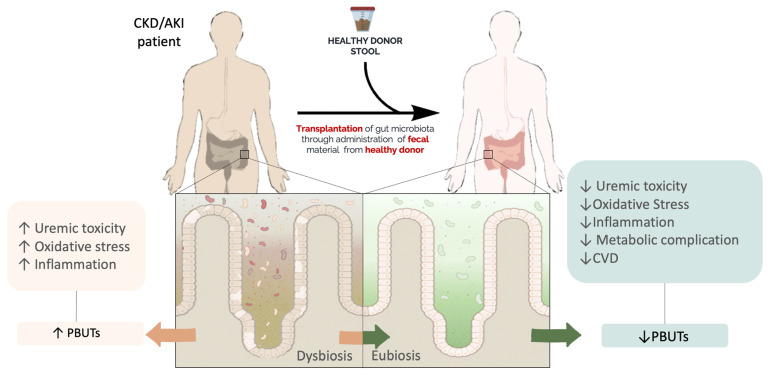
During the past decades, the gut microbiome emerged as a key player in kidney disease. Dysbiosis-related uremic toxins together with pro-inflammatory mediators are the main factors in a deteriorating kidney function. The toxicity of uremic compounds has been well-documented in a plethora of pathophysiological mechanisms in kidney disease, such as cardiovascular injury (CVI), metabolic dysfunction, and inflammation. Accumulating data on the detrimental effect of uremic solutes in kidney disease supported the development of many strategies to restore eubiosis. Fecal microbiota transplantation (FMT) spread as an encouraging treatment for different dysbiosis-associated disorders. In this scenario, flourishing studies indicate that fecal transplantation could represent a novel treatment to reduce the uremic toxins accumulation. Here, we present the state-of-the-art concerning the application of FMT on kidney disease to restore eubiosis and reverse the retention of uremic toxins.
Keywords: PBUTs; acute kidney injury; chronic kidney disease; fecal microbiota transplantation; kidney transplantation; oral FMT; uremic toxins.
Conflict of interest statement
The authors declare no conflict of interest.
Figures
References
-
- Park J., Kato K., Murakami H., Hosomi K., Tanisawa K., Nakagata T., Ohno H., Konishi K., Kawashima H., Chen Y.-A., et al. Comprehensive Analysis of Gut Microbiota of a Healthy Population and Covariates Affecting Microbial Variation in Two Large Japanese Cohorts. BMC Microbiol. 2021;21:151. doi: 10.1186/s12866-021-02215-0. - DOI - PMC - PubMed
-
- King C.H., Desai H., Sylvetsky A.C., LoTempio J., Ayanyan S., Carrie J., Crandall K.A., Fochtman B.C., Gasparyan L., Gulzar N., et al. Baseline Human Gut Microbiota Profile in Healthy People and Standard Reporting Template. PLoS ONE. 2019;14:e0206484. doi: 10.1371/journal.pone.0206484. - DOI - PMC - PubMed
Publication types
MeSH terms
Substances
LinkOut - more resources
Full Text Sources
Medical
Miscellaneous
