Review
. 2023 Jan 19;12(2):155.
doi: 10.3390/biology12020155.

The Synucleins and the Astrocyte

Affiliations
Review

The Synucleins and the Astrocyte

Abigail J Myers et al. Biology (Basel). .

Abstract

Synucleins consist of three proteins exclusively expressed in vertebrates. α-Synuclein (αS) has been identified as the main proteinaceous aggregate in Lewy bodies, a pathological hallmark of many neurodegenerative diseases. Less is understood about β-synuclein (βS) and γ-synuclein (γS), although it is known βS can interact with αS in vivo to inhibit aggregation. Likewise, both γS and βS can inhibit αS's propensity to aggregate in vitro. In the central nervous system, βS and αS, and to a lesser extent γS, are highly expressed in the neural presynaptic terminal, although they are not strictly located there, and emerging data have shown a more complex expression profile. Synapse loss and astrocyte atrophy are early aspects of degenerative diseases of the brain and correlate with disease progression. Synucleins appear to be involved in synaptic transmission, and astrocytes coordinate and organize synaptic function, with excess αS degraded by astrocytes and microglia adjacent to the synapse. βS and γS have also been observed in the astrocyte and may provide beneficial roles. The astrocytic responsibility for degradation of αS as well as emerging evidence on possible astrocytic functions of βS and γS, warrant closer inspection on astrocyte-synuclein interactions at the synapse.

Keywords: astrocyte; dementia; neurodegenerative disease; synapse; α-synuclein; β-synuclein; γ-synuclein.


Conflict of interest statement

The authors declare no conflict of interest.

Figures

Figure 1
Figure 1
αS’s structure consists of an amphipathic membrane-binding N-terminus sequence that contains 7 repeats with the consensus KTKEGV sequence, a non-amyloid-β component (NAC) domain responsible for its aggregation potential, and a calcium binding C-terminus. In A, the astrocyte can degrade αS monomers and oligomers through the endolysosomal pathway. In B, interaction with αS monomers and oligomers can cause astrocyte reactivity resulting in the release of cytokines, chemokines and growth factors, and cause microglial activation, although the level of monomeric αS to induce broad effects is uncertain. In the event of astrodegeneration or astrocyte dysfunction, αS can misfold, aggregate and spread from cell to cell, causing toxic fibril formation, which can also then cause native αS to misfold as well.
Figure 2
Figure 2
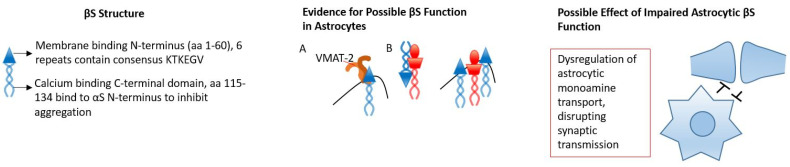
βS only contains 6 repeated sequences with the consensus of KTKEGV in the N-terminus. βS’s calcium-binding C-terminus is also responsible for the inhibition of αS aggregation by interacting with the N-terminus of αS. In A, it has been shown in neurons that βS facilitates monoamine transport through VMAT-2, which would likely result in this function in astrocytes. In B, βS inhibits detrimental αS aggregation through two methods, the C-terminus region binding with the αS N-terminus to form heterodimers and inhibit aggregation, and βS competing with αS for membrane binding. The likely effect of impaired βS functioning in astrocytes would be dysregulation of astrocytic monoamine transport from the synapse and within the astrocyte for release.
Figure 3
Figure 3
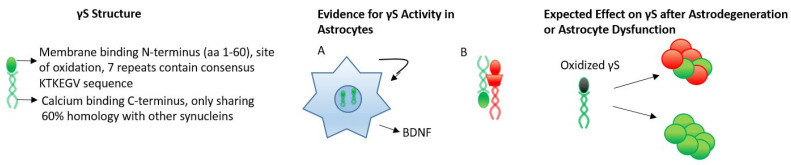
γS differs the most in sequence to the synucleins, sharing only 60% homology with αS due to its highly variable C-terminal region. Like αS, γS has 7 repeats with the KTKEGV consensus sequence in the N-terminal region. In A, it has been shown that γS is capable of inducing astrogenesis and astroprotection through increased expression and release of BDNF. Similarly, knockdown of γS in astrocytes results in a mitotic catastrophe and apoptosis. In B, it has been shown that γS can inhibit αS aggregation, which has not been studied in vivo, and could possibly occur in astrocytes, where it is expressed. Oxidation of γS results in toxic aggregations of γS itself, influencing the aggregation of αS. As reactive oxygen species’ production is a hallmark of astrocyte dysfunction or astrodegeneration, detrimental oxidized γS would likely be a byproduct.

References

    1. George J.M. The Synucleins. Genome Biol. 2002;3:reviews3002.1. - PMC - PubMed
    1. Lavedan C. The Synuclein Family. Genome Res. 1998;26:871–880. doi: 10.1101/gr.8.9.871. - DOI - PubMed
    1. Maroteaux L., Scheller R.H. The Rat Brain Synucleins; Family of Proteins Transiently Associated with Neuronal Membrane. Brain Res. Mol. Brain Res. 1991;11:335–343. doi: 10.1016/0169-328X(91)90043-W. - DOI - PubMed
    1. Maroteaux L., Campanelli J.T., Scheller R.H. Synuclein: A Neuron-Specific Protein Localized to the Nucleus and Presynaptic Nerve Terminal. J. Neurosci. 1988;8:2804–2815. doi: 10.1523/JNEUROSCI.08-08-02804.1988. - DOI - PMC - PubMed
    1. Nakajo S., Tsukada K., Omata K., Nakamura Y., Nakaya K. A New Brain-Specific 14-KDa Protein Is a Phosphoprotein. Its Complete Amino Acid Sequence and Evidence for Phosphorylation. Eur. J. Biochem. 1993;217:1057–1063. doi: 10.1111/j.1432-1033.1993.tb18337.x. - DOI - PubMed