Review
. 2023 Jan 21;12(2):172.
doi: 10.3390/biology12020172.

Viroids: Non-Coding Circular RNAs Able to Autonomously Replicate and Infect Higher Plants

Affiliations
Review

Viroids: Non-Coding Circular RNAs Able to Autonomously Replicate and Infect Higher Plants

Beltrán Ortolá et al. Biology (Basel). .

Abstract

Viroids are a unique type of infectious agent, exclusively composed of a relatively small (246-430 nt), highly base-paired, circular, non-coding RNA. Despite the small size and non-coding nature, the more-than-thirty currently known viroid species infectious of higher plants are able to autonomously replicate and move systemically through the host, thereby inducing disease in some plants. After recalling viroid discovery back in the late 60s and early 70s of last century and discussing current hypotheses about their evolutionary origin, this article reviews our current knowledge about these peculiar infectious agents. We describe the highly base-paired viroid molecules that fold in rod-like or branched structures and viroid taxonomic classification in two families, Pospiviroidae and Avsunviroidae, likely gathering nuclear and chloroplastic viroids, respectively. We review current knowledge about viroid replication through RNA-to-RNA rolling-circle mechanisms in which host factors, notably RNA transporters, RNA polymerases, RNases, and RNA ligases, are involved. Systemic movement through the infected plant, plant-to-plant transmission and host range are also discussed. Finally, we focus on the mechanisms of viroid pathogenesis, in which RNA silencing has acquired remarkable importance, and also for the initiation of potential biotechnological applications of viroid molecules.

Keywords: RNA silencing; circular RNA; hammerhead ribozyme; host plant; infectious agent; non-coding RNA; rolling-circle replication.


Conflict of interest statement

The authors declare no conflict of interest.

Figures
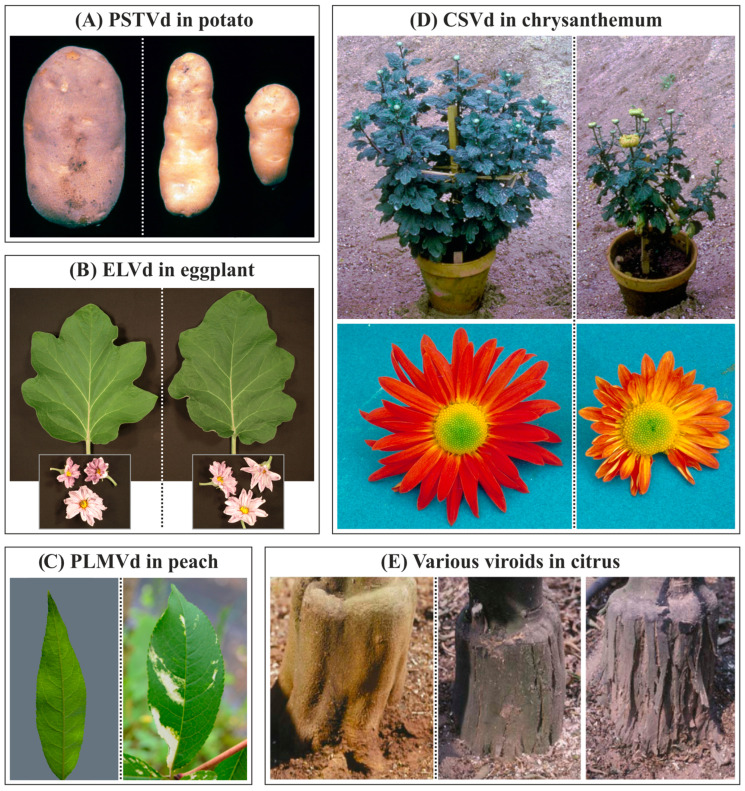
Figure 4
Figure 4
Typical symptoms of viroid infection in various crops. In all cases, mock-inoculated or symptomless plants are on the left, and viroid-infected plants are in the center and/or on the right. (A) PSTVd induces potato tuber malformations (image modified from original credited to William M. Brown Jr., Bugwood.org, accessed on 16 January 2023). (B) Symptomless infections induced by ELVd in eggplant (cv. Black Beauty). (C) Peach calico-inducing variants of PLMVd induce severe chlorosis in peach leaves (left image adapted from https://doi.org/10.3389/fpls.2012.00288, accessed on 16 January 2023; right image modified from original credited to H.J. Larsen, Bugwood.org). (D) CSVd infection induces stunting and earlier blooming in chrysanthemum (top), resulting in flower breaking and deformation (bottom) (top image modified from original credited to J. Dunez, Bugwood.org, accessed on 16 January 2023; bottom image modified from original credited to European and Mediterranean Plant Protection Organization, Bugwood.org, accessed on 16 January 2023. (E) Co-inoculation of citrus trees with CBLVd and CDVd induces symptomless infections in trees (left), while co-inoculation of CEVd and CBCVd induces bark scaling characteristic of CEVd infection (center) or severe bark cracking characteristic of CBCVd infection (right). Parts of this figures have been adapted from [144,183,184,185].
Figure 1
Figure 1
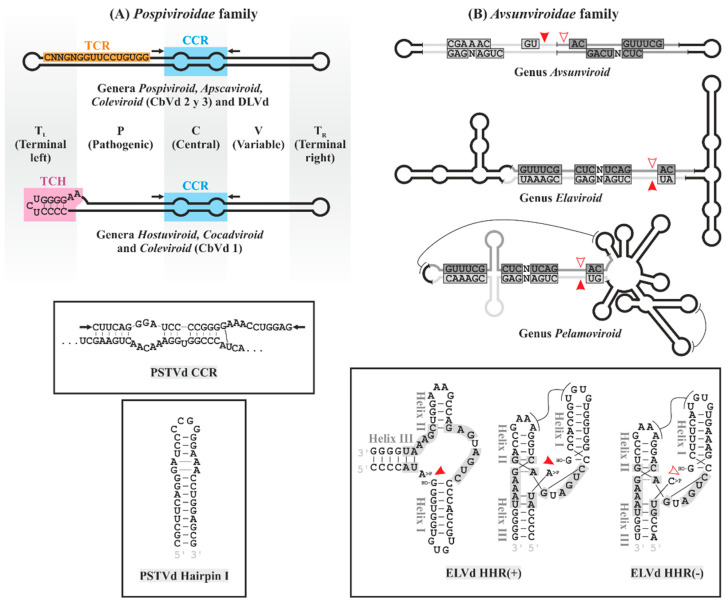
Structural characteristics of the viroids in the families Pospiviroidae and Avsunviroidae. (A) Members of the family Pospiviroidae adopt a rod-shaped secondary structure that has been functionally separated into five domains (TL, P, C, V and TR; differentially shaded). They contain conserved motifs: the features of the CCR (blue box) and the presence of TCR or TCH (orange and pink boxes, respectively) define the characteristics of each genus, as indicated. Together with the conserved sequence of the upper strand of the CCR, the flanking variable nucleotides (indicated by arrows) form an imperfect hairpin (hairpin I). Both the characteristic CCR sequence of PSTVd and the hairpin that forms are shown in the upper and lower inserts, respectively. (B) Avsunviroidae viroids adopt rod-shaped, branched or semibranched secondary structures (genus Avsunviroid, Pelamoviroid and Elaviroid, respectively). They contain conserved sequences of hammerhead ribozymes (HHR) that are functional in positive and negative strands (light and dark gray boxes, respectively, with the self-cleavage sites indicated by solid or empty arrowheads, respectively). In PLMVd, ‘kissing-loops’ tertiary interactions are indicated by lines. The insert includes the sequence of the HHR of ELVd with the classic representation that gives name to these ribozymes (left) next to the same HHR in both polarities according to the data of X-ray crystallography and NMR. Tertiary interactions between loops 1 and 2 are shown with lines. HO- and >P, 5′-hydroxyl and 2′,3′-phosphodiester groups, respectively; CCR, central conserved region; HHR, hammerhead ribozyme; N, any nucleotide; TCR, terminal conserved region; and TCH, terminal conserved hairpin.
Figure 2
Figure 2
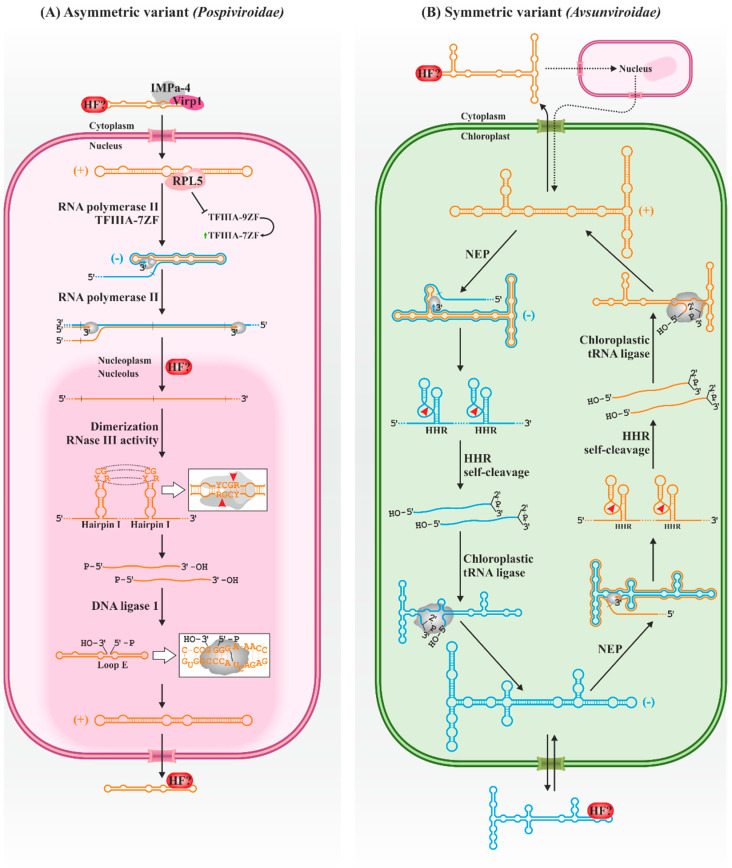
The rolling-circle mechanism in its (A) asymmetric and (B) symmetric variants is proposed for the replication of viroids of the families Pospiviroidae in the nucleus and Avsunviroidae in chloroplasts, respectively. In both cases, the positive and negative viroid RNA polarities are represented in orange and blue, respectively. Host proteins and viroid RNA motifs involved in the replicative cycle are indicated. Arrowheads indicate RNA cleavage sites. -P, -OH and >P, 5′-phosphate, 5′-hydroxyl and 2′,3′-phosphodiester groups, respectively; HF?, unknown host factor; HHR, hammerhead ribozyme; IMPa-4, importin alpha-4; NEP, nuclear-encoded chloroplastic DNA-dependent RNA polymerase; RPL5, ribosomal protein L5; TFIIIA-7ZF/-9ZF, transcription factor IIIA splicing variants with seven or nine zinc fingers, respectively; and Virp-1, bromodomain-containing protein 1.
Figure 3
Figure 3
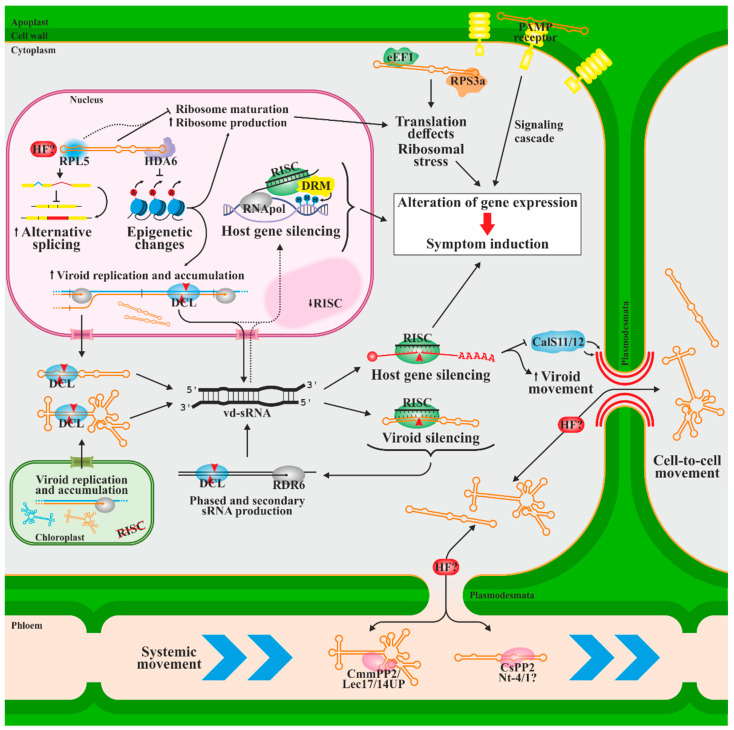
Proposed mechanisms of host defense responses, viroid pathogenesis and intercellular movement. Plant RNAi response is responsible for much of the viroid symptoms. dsRNA replicative intermediates and the cytoplasmic passage of viroids triggers the production of vd-sRNAs in plant cells. vd-sRNA-loaded RISC targets viroids and inhibits the expression of host genes containing complementary sequences post-transcriptionally by mRNA degradation and translation inhibition and possibly transcriptionally via RNA-directed DNA methylation. RDRs may transform sRNA fragments into additional DCL and RISC substrates. Viroid may also be recognized by cell membrane PAMP receptors stimulating plant innate immunity, resulting in the alteration of host gene expression. Additional interactions with proteins and host factors are responsible for global epigenetic changes, alternative splicing and interference with translational machinery, thus, are also involved in the development of symptoms. Viroids use plasmodesmata for proximal movement and phloem for systemic transport, likely interacting with specific (and in some cases unknown) host factors. RNAi response genes can increase intercellular movement. CalS11/CalS12, callose synthase 11 and 12, respectively; CmmPP2/Lec17/14UP, Cucumis melo phloem protein 2, phloem lectin 17 and uncharacterized protein of 14 kDa, respectively; DCL, Dicer-like protein; DRM, domains rearranged methylase; eEF1, eukaryotic elongation factor 1; HDA6, histone deacetylase; HF?, unknown host factor; Nt-4/1, Nicotiana tabacum 4/1 protein; PAMP, pathogen-associated molecular pattern; RISC, RNA-induced silencing complex; RDR6, RNA-dependent RNA polymerase 6; RNApol, RNA polymerase; RPL5, ribosomal protein L5; RPS3a, ribosomal protein S3a; and vd-sRNA, viroid-derived small RNAs.
Figure 5
Figure 5
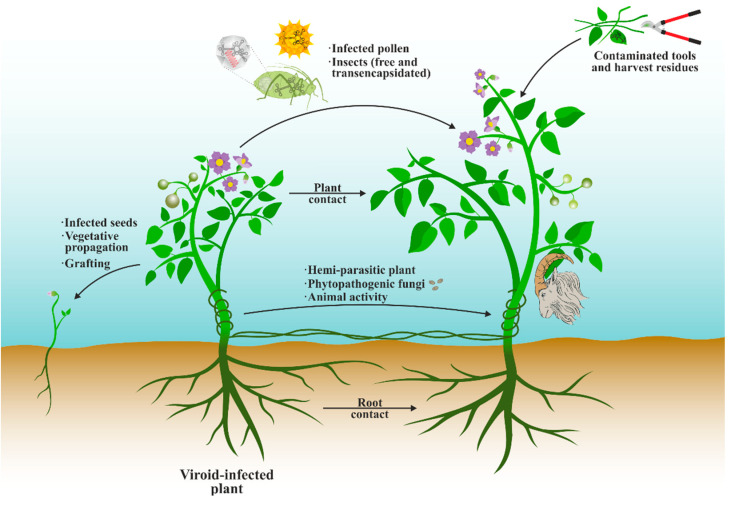
Some mechanisms of viroid transmission between plants.

References

    1. Martin W.H. Hints: To Potato Growers. Volume 3. New Jersey State Potato Association; East Windsor, NJ, USA: 1922. “Spindle Tuber”, a New Potato Trouble; p. 8.
    1. Schultz E.S., Folsom D. Transmission, Variation, and Control of Certain Degeneration Diseases of Irish Potatoes. J. Agric. Res. 1923;25:43–118.
    1. Diener T.O., Raymer W.B. Potato Spindle Tuber Virus: A Plant Virus with Properties of a Free Nucleic Acid. Science. 1967;158:378–381. doi: 10.1126/science.158.3799.378. - DOI - PubMed
    1. Singh R.P., Bagnall R.H. Infectious Nucleic Acid from Host Tissues Infected with the Potato Spindle Tuber Virus. Phytopathology. 1968;58:696–699.
    1. Diener T. Potato Spindle Tuber “Virus”: IV. A Replicating, Low Molecular Weight RNA. Virology. 1971;45:411–428. doi: 10.1016/0042-6822(71)90342-4. - DOI - PubMed