Review
. 2023 Jan 28;12(2):204.
doi: 10.3390/biology12020204.

The Multifaceted Role of Connexins in Tumor Microenvironment Initiation and Maintenance

Affiliations
Review

The Multifaceted Role of Connexins in Tumor Microenvironment Initiation and Maintenance

Olga M Kutova et al. Biology (Basel). .

Abstract

Today's research on the processes of carcinogenesis and the vital activity of tumor tissues implies more attention be paid to constituents of the tumor microenvironment and their interactions. These interactions between cells in the tumor microenvironment can be mediated via different types of protein junctions. Connexins are one of the major contributors to intercellular communication. They form the gap junctions responsible for the transfer of ions, metabolites, peptides, miRNA, etc., between neighboring tumor cells as well as between tumor and stromal cells. Connexin hemichannels mediate purinergic signaling and bidirectional molecular transport with the extracellular environment. Additionally, connexins have been reported to localize in tumor-derived exosomes and facilitate the release of their cargo. A large body of evidence implies that the role of connexins in cancer is multifaceted. The pro- or anti-tumorigenic properties of connexins are determined by their abundance, localization, and functionality as well as their channel assembly and non-channel functions. In this review, we have summarized the data on the contribution of connexins to the formation of the tumor microenvironment and to cancer initiation and progression.

Keywords: carcinogenesis; cell–cell contacts; connexins; metastasis; tumor development; tumor microenvironment; tumor stroma.


Conflict of interest statement

The authors declare no conflict of interest.

Figures
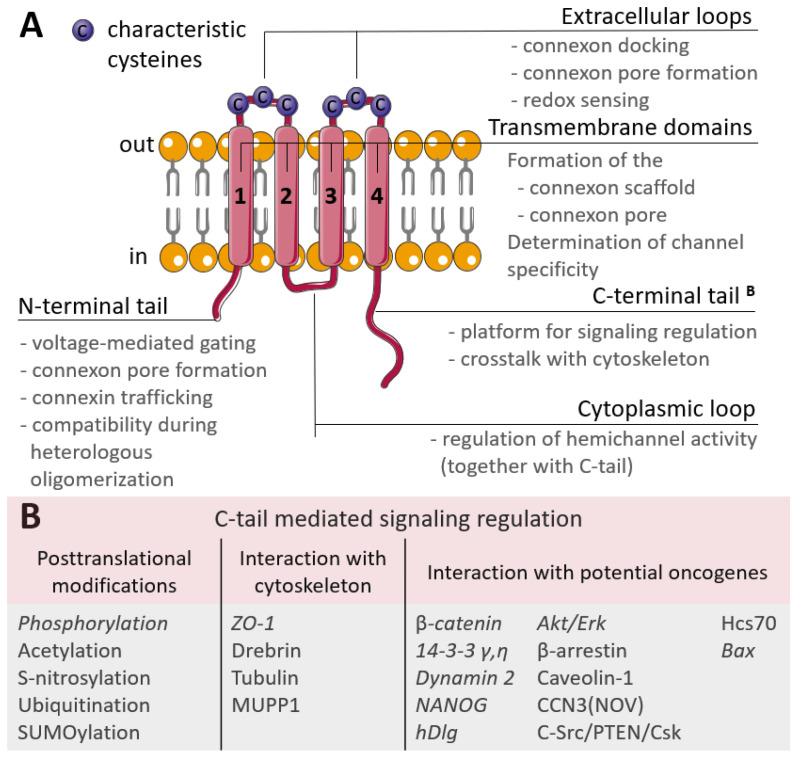
Figure 1
Figure 1
(A) Scheme of the connexin structure. Connexin is a tetraspan molecule which contains four transmembrane α-helices (1-4), two extracellular loops and one cytoplasmic loop; the amino- and carboxy-termini are located inside the cell. Transmembrane domains participate in the formation of the connexon scaffold and pore formation; extracellular loops are responsible for channel docking; the cytoplasmic loop and the N- and C-tails are the platform for the regulation of connexin functioning. (B) Participation of the connexin C-tail in regulation. The reported cancer-related signaling is represented in italic (explanations are in the text).
Figure 2
Figure 2
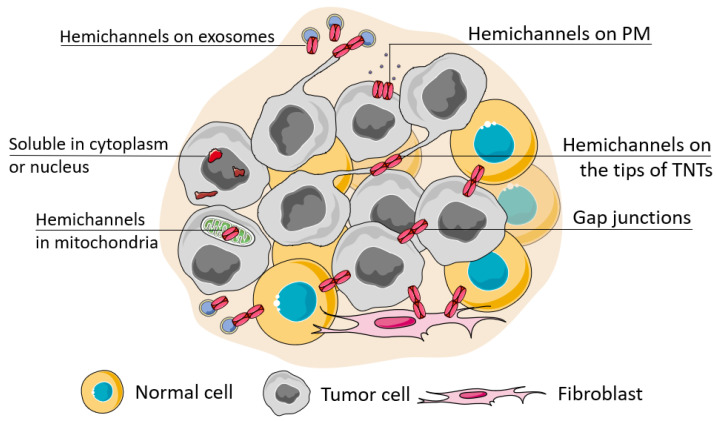
Possible localization of connexins in the cell. The localization of connexins in the cell can be attributed to its soluble forms (located in the nucleus or cytoplasm) or membrane-bound forms which can be observed during its trafficking, ultimately represented as a functional connexin residing in the cell membrane in the hemichannel or channel state (when docked with a connexin of a neighboring cell). The localization of connexin channels at the membrane can be considered relatively to their localization to the basal membrane (cell polarity), attributed to cell protrusions (e.g., tunneling nanotubes, TNTs) or extracellular vesicles (e.g., exosomes). Connexins can be also transferred to the inner membrane of mitochondria.
Figure 3
Figure 3
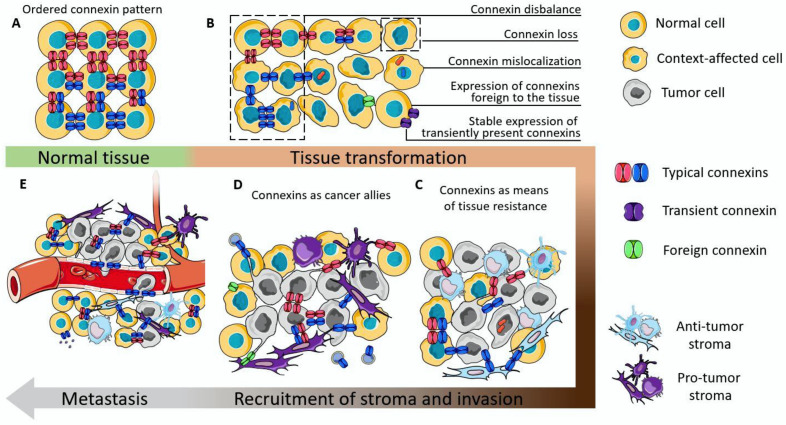
The proposed scheme of connexin participation in the initiation and development of cancer. (A) The schematic representation of the ordered connexin pattern in normal tissue. (B) Examples of connexin dysregulation which can contribute to the disruption of tissue orderliness. (C) Connexins as integrators of tumor parenchyma with the stromal cells which suppress tumor aggressiveness. (D) Connexins as integrators of tumor tissue, contributing to its progression. (E) Connexins as a means to perform and facilitate metastasis.

References

    1. Brücher B.L., Jamall I.S. Somatic Mutation Theory—Why it’s Wrong for Most Cancers. Cell. Physiol. Biochem. Int. J. Exp. Cell. Physiol. Biochem. Pharmacol. 2016;38:1663–1680. doi: 10.1159/000443106. - DOI - PubMed
    1. Soto A.M., Sonnenschein C. The tissue organization field theory of cancer: A testable replacement for the somatic mutation theory. BioEssays News Rev. Mol. Cell. Dev. Biol. 2011;33:332–340. doi: 10.1002/bies.201100025. - DOI - PMC - PubMed
    1. Sonnenschein C., Soto A.M. Over a century of cancer research: Inconvenient truths and promising leads. PLoS Biol. 2020;18:e3000670. doi: 10.1371/journal.pbio.3000670. - DOI - PMC - PubMed
    1. Anderson N.M., Simon M.C. The tumor microenvironment. Curr. Biol. 2020;30:R921–R925. doi: 10.1016/j.cub.2020.06.081. - DOI - PMC - PubMed
    1. Zefferino R., Piccoli C., Di Gioia S., Capitanio N., Conese M. How Cells Communicate with Each Other in the Tumor Microenvironment: Suggestions to Design Novel Therapeutic Strategies in Cancer Disease. Int. J. Mol. Sci. 2021;22:2550. doi: 10.3390/ijms22052550. - DOI - PMC - PubMed

LinkOut - more resources