


Multimodal Approach for Characterizing the Quality of Parent-Child Interaction: A Single Synchronization Source May Not Tell the Whole Story
- PMID: 36829518
- PMCID: PMC9952901
- DOI: 10.3390/biology12020241
Multimodal Approach for Characterizing the Quality of Parent-Child Interaction: A Single Synchronization Source May Not Tell the Whole Story
Abstract
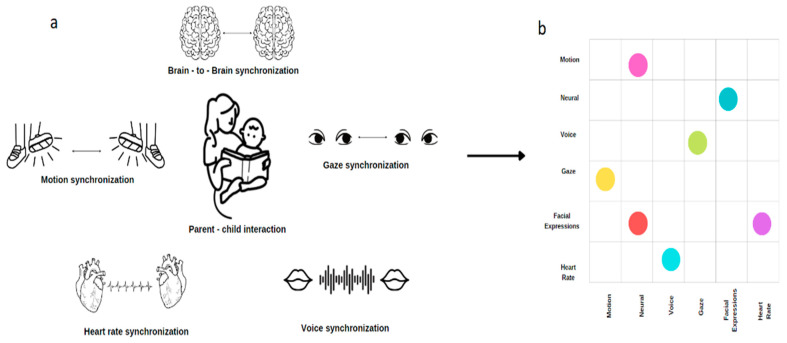
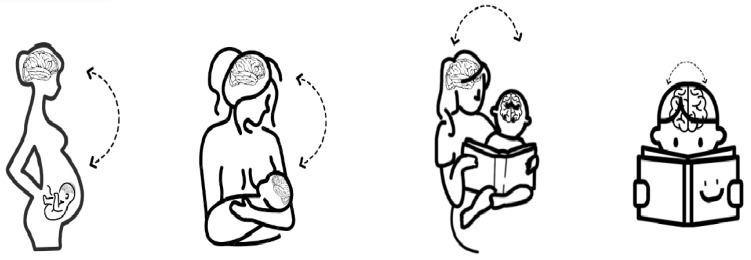
The interaction between the parent and child is essential for the child's cognitive and emotional development and sets the path for future well-being. These interactions, starting from birth, are necessary for providing the sensory stimulation the child needs in the critical time window of brain development. The characterization of parent-child interactions is traditionally performed by human decoding. This approach is considered the leading and most accurate way of characterizing the quality of these interactions. However, the development of computational tools and especially the concept of parent-child synchronization opened up an additional source of data characterizing these interactions in an objective, less human-labor manner. Such sources include brain-to-brain, voice/speech, eye contact, motor, and heart-rate synchronization. However, can a single source synchronization dataset accurately represent parent-child interaction? Will attending to the same stimulation, often resulting in a higher brain-to-brain synchronization, be considered an interactive condition? In this perspective, we will try to convey a new concept of the child-parent interaction synchronization (CHIPS) matrix, which includes the different sources of signals generated during an interaction. Such a model may assist in explaining the source of interaction alterations in the case of child/parent developmental/emotional or sensory deficits and may open up new ways of assessing interventions and changes in parent-child interactions along development. We will discuss this interaction during one of the parent-child joint activities providing opportunities for interaction, i.e., storytelling.
Keywords: hyperscanning; interaction matrix; parent–child interaction; synchronization.
Conflict of interest statement
The authors declare no conflict of interest.
Figures
Similar articles
-
Studying parent-child interaction with hyperscanning.Prog Brain Res. 2020;254:1-24. doi: 10.1016/bs.pbr.2020.05.003. Epub 2020 Jun 10. Prog Brain Res. 2020. PMID: 32859283 Review.
-
Expectations and experiences of parents taking part in parent-child interaction programmes to promote child language: a qualitative interview study.Int J Lang Commun Disord. 2020 Jul;55(4):603-617. doi: 10.1111/1460-6984.12543. Epub 2020 Jun 11. Int J Lang Commun Disord. 2020. PMID: 32525603
-
Brain-to-brain synchrony in parent-child dyads and the relationship with emotion regulation revealed by fNIRS-based hyperscanning.Neuroimage. 2018 Sep;178:493-502. doi: 10.1016/j.neuroimage.2018.05.060. Epub 2018 May 26. Neuroimage. 2018. PMID: 29807152
-
Family pediatrics: report of the Task Force on the Family.Pediatrics. 2003 Jun;111(6 Pt 2):1541-71. Pediatrics. 2003. PMID: 12777595
-
In sync with your child: The potential of parent-child electroencephalography in developmental research.Dev Psychobiol. 2022 Mar;64(3):e22221. doi: 10.1002/dev.22221. Dev Psychobiol. 2022. PMID: 35312051 Review.
Cited by
-
Multimodal analysis of mother-child interaction using hyperscanning and diffusion maps.Sci Rep. 2025 Feb 13;15(1):5431. doi: 10.1038/s41598-025-90310-x. Sci Rep. 2025. PMID: 39948429 Free PMC article.
References
-
- Mate K.K. Effects of Visual, Auditory, and Combined Cues on Human Movement and Brain Regions Involved in Perception Action. McGill J. Med. 2022;20 doi: 10.26443/mjm.v20i2.928. - DOI
LinkOut - more resources
Full Text Sources
