


Air-Frying Is a Better Thermal Processing Choice for Improving Antioxidant Properties of Brassica Vegetables
- PMID: 36830048
- PMCID: PMC9952021
- DOI: 10.3390/antiox12020490
Air-Frying Is a Better Thermal Processing Choice for Improving Antioxidant Properties of Brassica Vegetables
Abstract
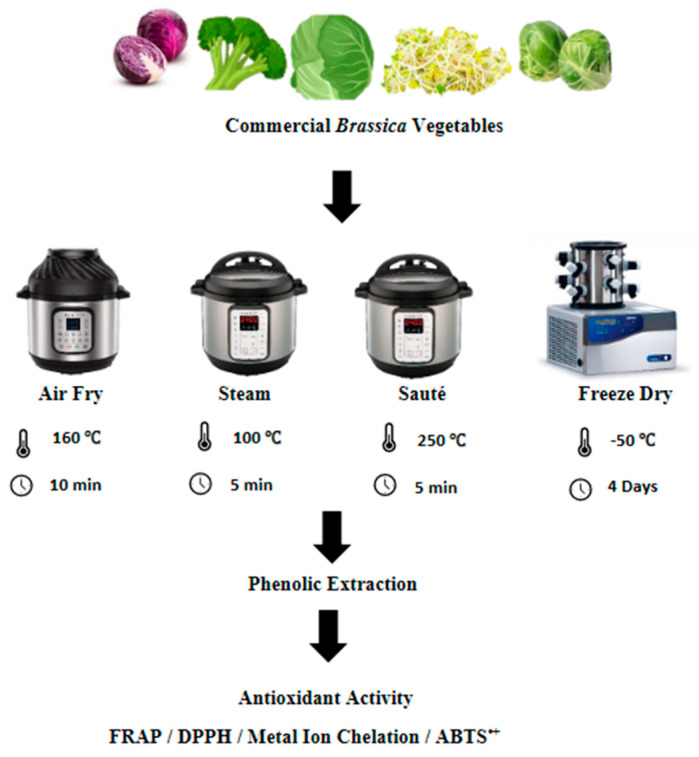
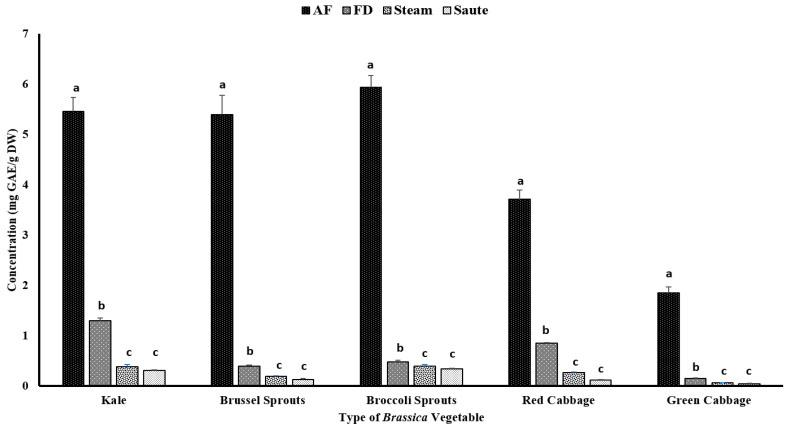
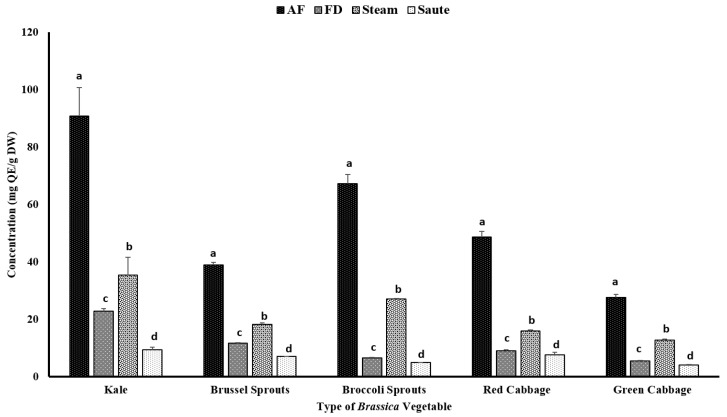
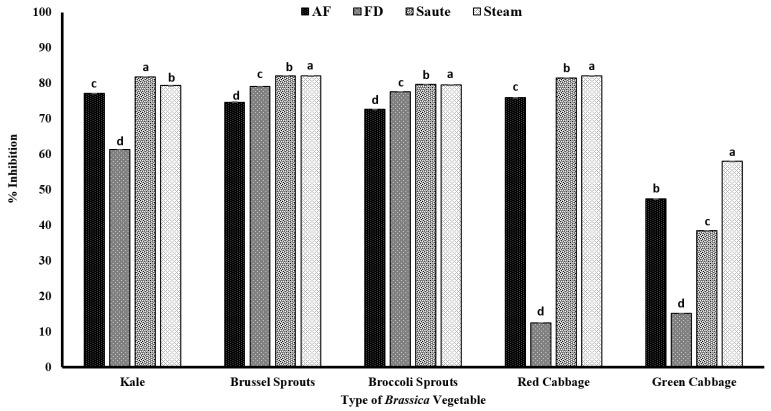
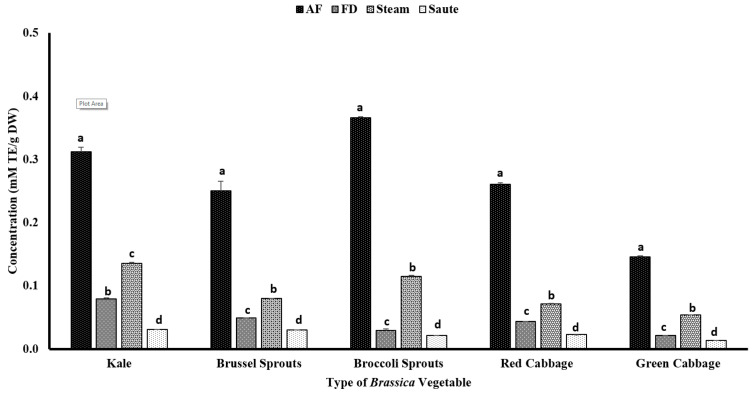
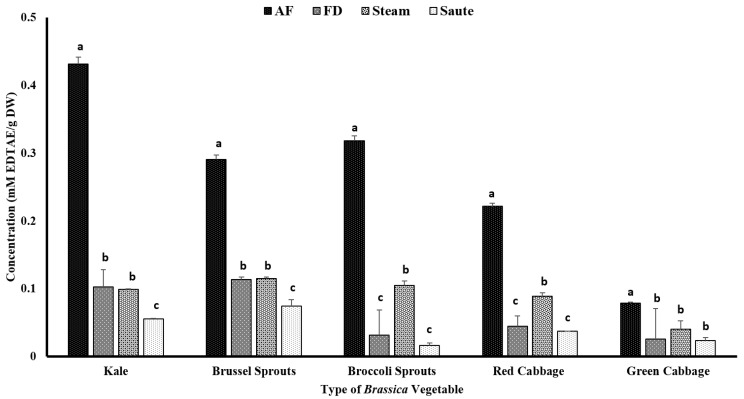
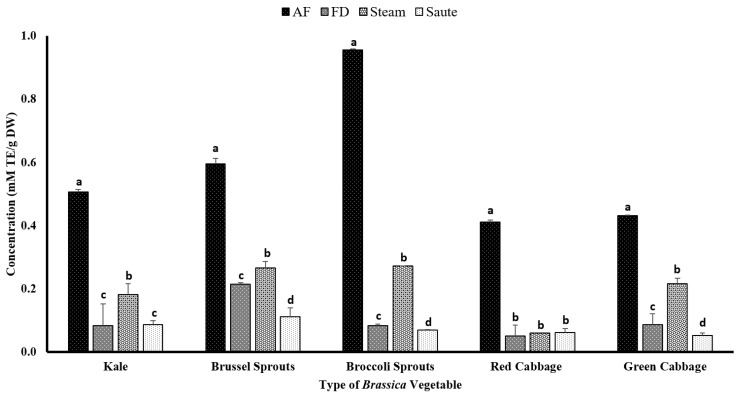
Brassica vegetables have demonstrated many health benefits over the years due to their composition of phenolic, flavonoid, and glucosinolate contents. However, these bioactive molecules can be easily depleted during gastronomic operations. Therefore, a sustainable method that improves their phenolic content and antioxidant activity is required for both the processors and consumers. Thermal processing has been demonstrated as a method to improve the phenolic content and antioxidant status of Brassica vegetables. In the current study, four different thermal processing methods, including freeze-drying, sautéing, steaming, and air-frying, were employed for five different Brassica vegetables, including kale, broccoli sprouts, Brussels sprouts, red cabbage, and green cabbage. The total phenolic content (TPC), total flavonoid content (TFC), and antioxidant activities were assessed using radical scavenging activity (DPPH and ABTS•+), reducing power (FRAP), and the chelating ability of metal ions. Among the methods tested, air-frying at 160 °C for 10 min showed the highest TPC, TFC, and antioxidant activity of the Brassica vegetables, while sautéing showed the lowest. The steam treatments were preferred over the freeze-drying treatments. Within the vegetables tested, both kale and broccoli sprouts contained higher antioxidant properties in most of the employed processing treatments. The results also indicated that there is a strong correlation between the TPC, TFC, and antioxidant activity (p < 0.05). This study indicates that air-frying could be used as a sustainable thermal processing method for improving biomolecules in Brassica vegetables.
Keywords: Brassica vegetables; air-frying; antioxidants; broccoli sprouts; kale; thermal processing.
Conflict of interest statement
All authors read, edited, and approved the final version of the manuscript. The authors declare that there are no conflict of interest.
Figures
References
-
- Nagata N., Xu L., Kohno S., Ushida Y., Aoki Y., Umeda R., Fuke N., Zhuge F., Ni Y., Nagashimada M., et al. Glucoraphanin Ameliorates Obesity and Insulin Resistance Through Adipose Tissue Browning and Reduction of Metabolic Endotoxemia in Mice. Diabetes. 2017;66:1222–1236. doi: 10.2337/db16-0662. - DOI - PubMed
-
- Tanongkankit Y., Chiewchan N., Devahastin S. Effect of Processing on Antioxidants and Their Activity in Dietary Fiber Powder from Cabbage Outer Leaves. Dry. Technol. 2010;28:1063–1071. doi: 10.1080/07373937.2010.505543. - DOI
-
- Elżbieta S. Bodziarczyk Izabela Composition and Antioxidant Activity of Kale (Brassica oleracea L. Var. Acephala) Raw and Cooked-PubMed. [(accessed on 12 December 2022)]; Available online: https://pubmed.ncbi.nlm.nih.gov/22744944/ - PubMed
Grants and funding
LinkOut - more resources
Full Text Sources
Miscellaneous
