


Antibiotic Prescription Patterns for Acute Respiratory Infections in Rural Primary Healthcare Settings in Guangdong, China: Analysis of 162,742 Outpatient Prescriptions
- PMID: 36830207
- PMCID: PMC9952100
- DOI: 10.3390/antibiotics12020297
Antibiotic Prescription Patterns for Acute Respiratory Infections in Rural Primary Healthcare Settings in Guangdong, China: Analysis of 162,742 Outpatient Prescriptions
Abstract
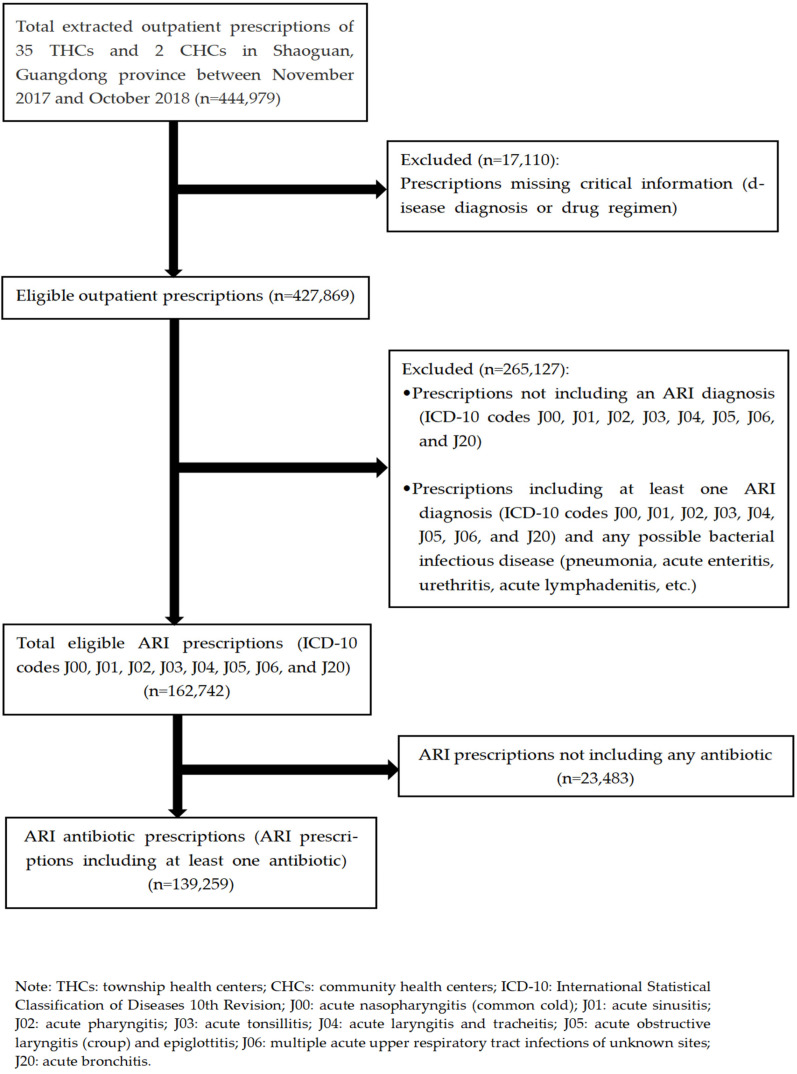
Overuse and inappropriate use of antibiotics are important contributors to bacterial antimicrobial resistance (AMR), especially in ambulatory primary healthcare (PHC) settings in low- and middle-income countries. This study aimed to investigate antibiotic prescription patterns among patients with acute respiratory infections (ARIs) in rural PHC facilities in the Guangdong Province, China. A total of 444,979 outpatient prescriptions were extracted from the electronic medical record system of 35 township health centers (THCs) and 2 community health centers (CHCs) between November 2017 and October 2018. We used the chi-square test to analyze the antibiotic prescription patterns and binary logistic regression to explore patient-related factors associated with antibiotic prescriptions. Of the 162,742 ARI prescriptions, 85.57% (n = 139,259) included at least one antibiotic. Among the 139,259 prescriptions with antibiotics, 37.82% (n = 52,666) included two or more antibiotics, 55.29% (n = 76,993) included parenteral antibiotics, and 56.62% (n = 78,852) included Watch group antibiotics. The binary logistic regression indicated that (1) female patients were slightly less likely to be prescribed antibiotics than males (adjusted odds ratio (OR) = 0.954, 95% confidence interval [CI] [0.928-0.981]; p = 0.001); and (2) compared to patients aged ≤5 years, those who were 6-15 years old (adjusted OR = 1.907, 95% CI [1.840-1.978]; p < 0.001), 16-60 years old (adjusted OR = 1.849, 95% CI [1.785-1.916]; p < 0.001), and >60 years old (adjusted OR = 1.915, 95% CI [1.810-2.026]; p < 0.001) were more likely to be prescribed antibiotics. The overuse and irrational use of antibiotics in PHC settings remain major healthcare challenges in rural Guangdong. Thus, it is imperative to implement targeted antimicrobial stewardship (AMS) policies to address this problem.
Keywords: China; acute respiratory infections; antibiotic prescriptions; antimicrobial resistance; antimicrobial stewardship; primary healthcare; rural area.
Conflict of interest statement
The authors declare no conflict of interest.
Figures
References
-
- World Health Organization Ten Threats to Global Health in 2019. 2019. [(accessed on 5 August 2022)]. Available online: https://www.who.int/vietnam/news/feature-stories/detail/ten-threats-to-g....
-
- World Bank Group . Drug-Resistant Infections: A Threat to Our Economic Future: Final Report. Vol. 2. World Bank Group; Washington, DC, USA: 2017. [(accessed on 29 July 2022)]. Available online: https://documents1.worldbank.org/curated/en/323311493396993758/pdf/final....
Grants and funding
- 02-410-2206/the Discipline Construction Fund for Department of Infectious Disease of Guangzhou Medical University
- 20&ZD122/the National Social Science Foundation of China
- C2019126/the Guangdong Provincial Medical Science and Technology Research Fund
- managed through a third party, the Beijing Life Oasis Public Service Center/the China Primary Care Foundation
LinkOut - more resources
Full Text Sources
