. 2023 Feb 16;13(4):696.
doi: 10.3390/ani13040696.

Listening to Their Nights: Sleep Disruptions in Captive Housed Chimpanzees Affect Their Daytime Behavior

Affiliations

Listening to Their Nights: Sleep Disruptions in Captive Housed Chimpanzees Affect Their Daytime Behavior

Pablo R Ayuso et al. Animals (Basel). .

Abstract

Chimpanzee's nocturnal sleep is a dynamic and complex process, still not fully understood. As in humans, not getting enough quality sleep due to frequent or lasting disruptions may affect their physical and mental health, hence wellbeing, which may be reflected in their daytime behavior. This study aims to understand the impact of abiotic factors, such as temperature and humidity on the nocturnal activity as well as the impact of nocturnal awakening events on daytime behavior in sanctuary-housed chimpanzees. We monitored noisy nocturnal activity through audio recordings for one year, documenting the number and duration of sound events produced by chimpanzees to indicate sleep fragmentation and disruption intensity, respectively. Our results indicate that indoor temperature and humidity indeed influence the chimpanzee's nocturnal activity. Furthermore, sleep fragmentation and intensity of nocturnal events significantly influenced the following day's behavior. After nights marked by frequent and/or intense sleep disruptions, higher levels of inactivity, and abnormal and self-directed behaviors were observed, and chimpanzees spent more time on affiliative interactions and in social proximity. These findings highlight the importance of controlling factors influencing nocturnal sleep quality. Furthermore, we demonstrated that economic audio recordings used to monitor nocturnal activity, provide insights into the chimpanzee's behavior and wellbeing.

Keywords: agonistic behavior; chimpanzee; humidity; nocturnal activity; sanctuary; sleep disruption; sound recording; temperature; vocalization; welfare.


Conflict of interest statement

The authors declare no conflict of interest.

Figures
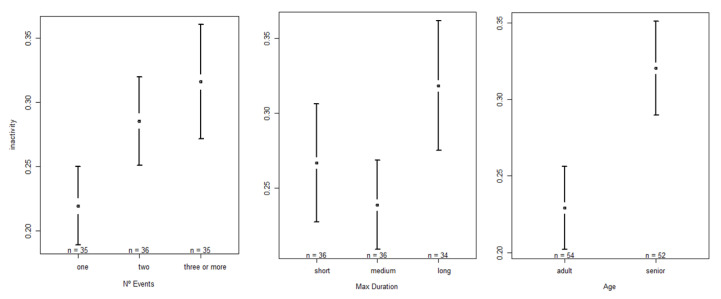
Figure 1
Figure 1
Confidence interval plots of inactivity behavior and the three significant fixed effects: number of sound events at night (N° events), duration of the longest event (max duration), and age category.
Figure 2
Figure 2
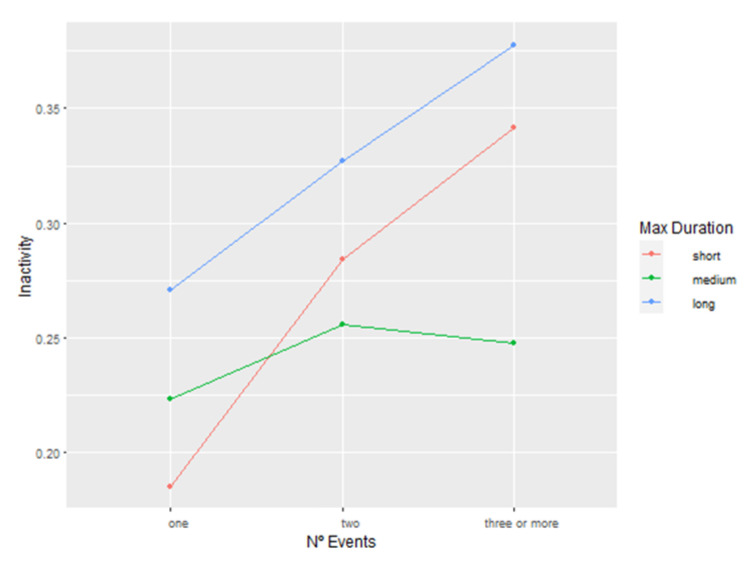
Plot representing the effect of the interaction between N° events and max duration on daytime inactivity of the chimpanzees. Each point on the plot is a predicted mean inactivity value and each connection between two points describes the effect, based on the data of the inactivity LMM model with N° events, max duration, sex, age category, and the interaction of N° events, max duration as fixed factors.
Figure 3
Figure 3
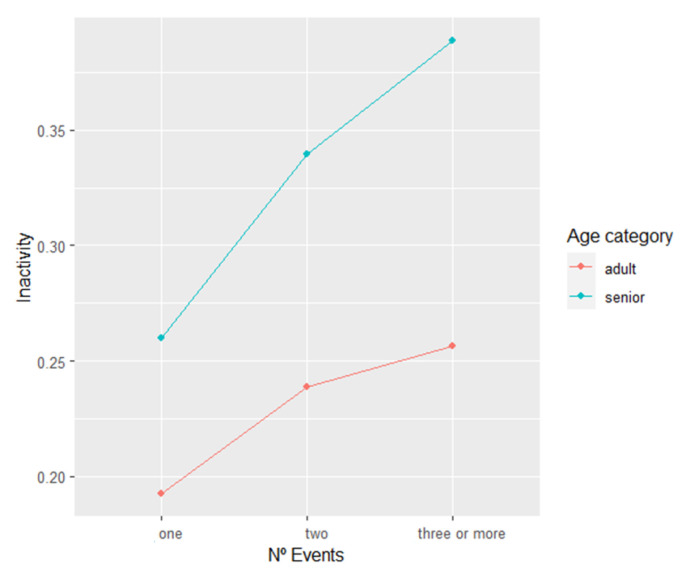
Plots representing the effect of the interaction between age category and N° events on daytime inactivity of the chimpanzees. Each point on the plot is a predicted mean inactivity value and each connection between two points describes the effect, based on the data of the Inactivity LMM model with N° events, max duration, sex, age category, and the interaction of age category and N° events as fixed factors.
Figure 4
Figure 4
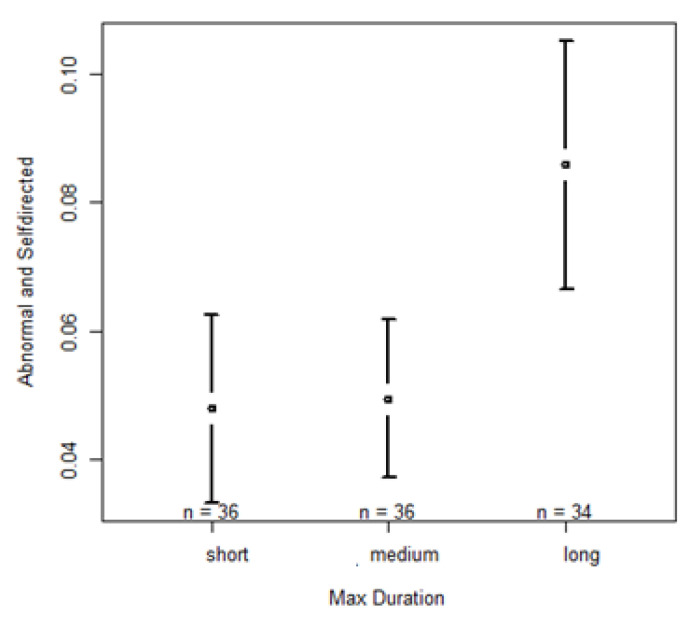
Confidence interval plots of abnormal and self-directed behaviors and the fixed effect duration of the longest event (max duration).
Figure 5
Figure 5
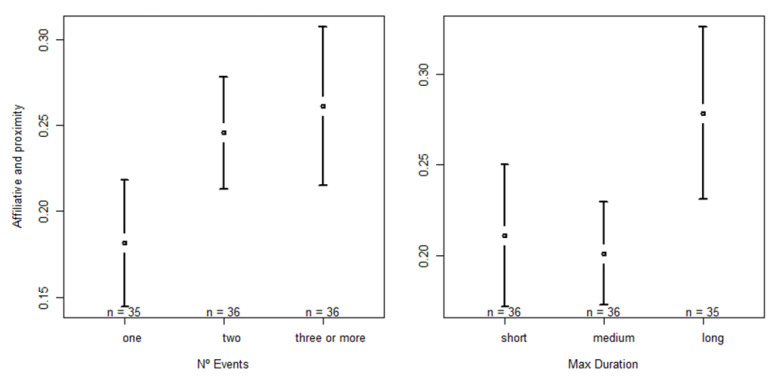
Confidence interval plots of social proximity and affiliative behaviors and the fixed effects number of sound events at night (N° events) and duration of the longest event (max duration).
Figure 6
Figure 6
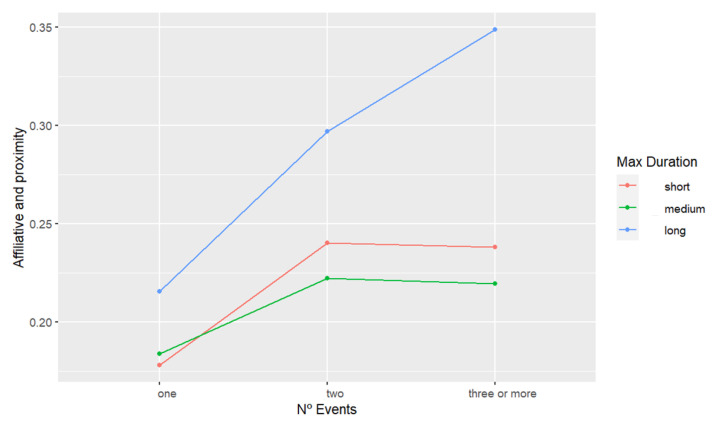
Plot representing the effect of the interaction between N° events and max duration on daytime affiliative and proximity behaviors of the chimpanzees. Each point on the plot is a predicted mean “Social proximity & Affiliative behavior” value and each connection between two points describes the effect, based on the data of the “Social proximity & Affiliative behavior” LMM model with N° events, max duration, sex, age category, and the interaction of N° events, max duration as fixed factors.

References

    1. Geiger S.D., Sabanayagam C., Shankar A. The Relationship between Insufficient Sleep and Self-Rated Health in a Nationally Representative Sample. J. Environ. Public Health. 2012;2012:e518263. doi: 10.1155/2012/518263. - DOI - PMC - PubMed
    1. Wells M.E., Vaughn B.V. Poor Sleep Challenging the Health of a Nation. Neurodiagn. J. 2012;52:233–249. - PubMed
    1. Buxton O.M., Marcelli E. Short and Long Sleep Are Positively Associated with Obesity, Diabetes, Hypertension, and Cardiovascular Disease among Adults in the United States. Soc. Sci. Med. 2010;71:1027–1036. doi: 10.1016/j.socscimed.2010.05.041. - DOI - PubMed
    1. Gangwisch J.E., Heymsfield S.B., Boden-Albala B., Buijs R.M., Kreier F., Pickering T.G., Rundle A.G., Zammit G.K., Malaspina D. Sleep Duration as a Risk Factor for Diabetes Incidence in a Large US Sample. Sleep. 2007;30:1667–1673. doi: 10.1093/sleep/30.12.1667. - DOI - PMC - PubMed
    1. Anderson J.R. Sleep, Sleeping Sites, and Sleep-Related Activities: Awakening to Their Significance. Am. J. Primatol. 1998;46:63–75. doi: 10.1002/(SICI)1098-2345(1998)46:1<63::AID-AJP5>3.0.CO;2-T. - DOI - PubMed