Review
. 2023 Jan 19;13(2):206.
doi: 10.3390/biom13020206.

The Essentials on microRNA-Encoded Peptides from Plants to Animals

Affiliations
Review

The Essentials on microRNA-Encoded Peptides from Plants to Animals

Mélanie Ormancey et al. Biomolecules. .

Abstract

Primary transcripts of microRNAs (pri-miRNAs) were initially defined as long non-coding RNAs that host miRNAs further processed by the microRNA processor complex. A few years ago, however, it was discovered in plants that pri-miRNAs actually contain functional open reading frames (sORFs) that translate into small peptides called miPEPs, for microRNA-encoded peptides. Initially detected in Arabidopsis thaliana and Medicago truncatula, recent studies have revealed the presence of miPEPs in other pri-miRNAs as well as in other species ranging from various plant species to animals. This suggests that miPEP numbers remain largely underestimated and that they could be a common signature of pri-miRNAs. Here we present the most recent advances in miPEPs research and discuss how their discovery has broadened our vision of the regulation of gene expression by miRNAs, and how miPEPs could be interesting tools in sustainable agriculture or the treatment of certain human diseases.

Keywords: animal miPEP; microRNA; peptide; plant miPEP; sORF.


Conflict of interest statement

The authors declare no conflict of interest.

Figures
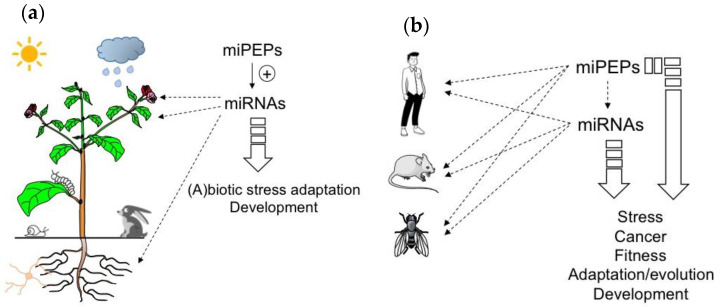
Figure 1
Figure 1
MicroRNA-encoded peptides (miPEPs) regulate many biological functions both in plants and animals. (a) The ability of plant miPEPs to positively regulate the expression of their respective pri-miRNAs is described for several miPEPs and plant species. (b) Conversely, in animals, the regulation of pri-miRNAs by miPEPs is less clear. MiPEPs frequently act independently.
Figure 2
Figure 2
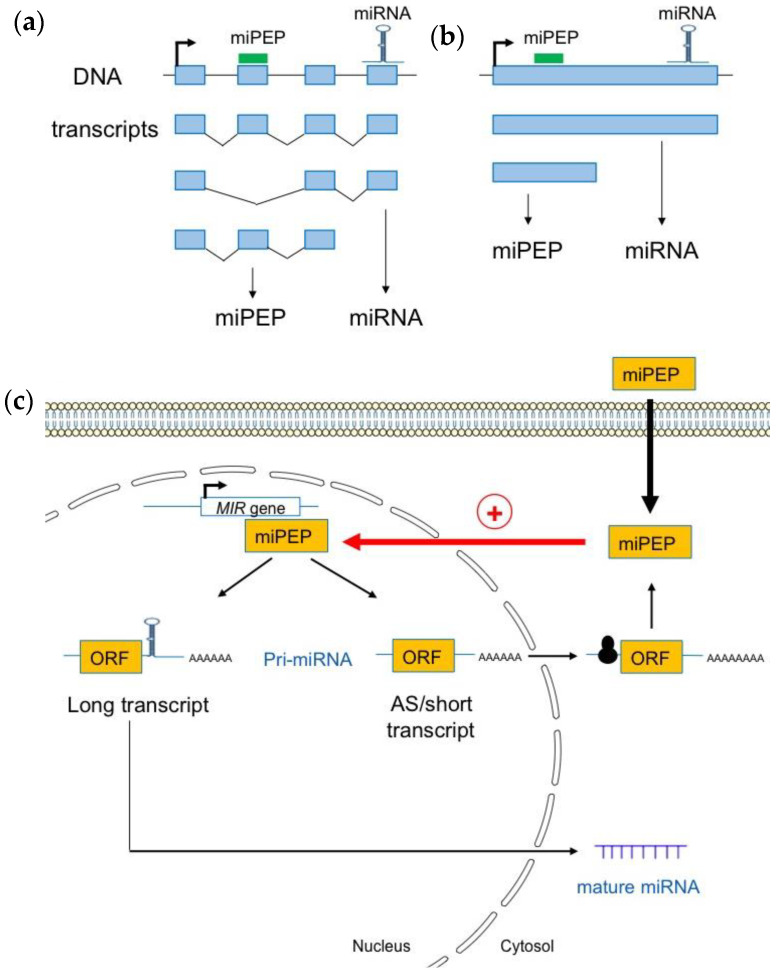
Plant pri-miRNAs are processed into a heterogeneous population of transcripts. (a) Pri-miRNAs are produced from alternative splicing (b) or alternative transcriptional termination sites. (c) Most short and alternatively spliced (AS) pri-miRNA transcripts are localized in the cytoplasm where they interact with the 60S ribosomal protein L18 (RPL18), suggesting that they are loaded into ribosomes for translation. Pri-miRNA transcripts containing the miRNA stem loop are enriched within nuclei where they can be used as templates to generate mature miRNAs (adapted from [39]).
Figure 3
Figure 3
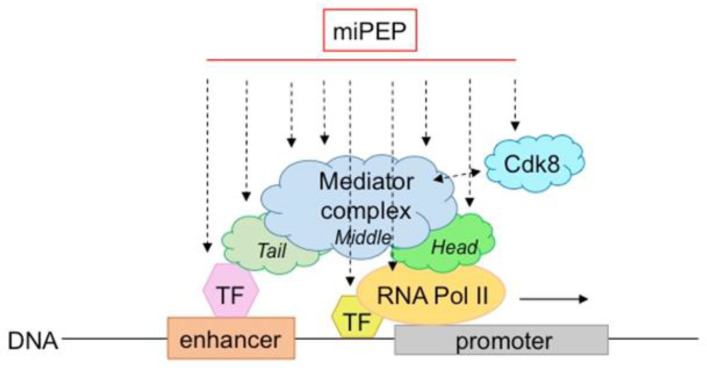
Model of possible miPEP interactions/crosstalk within the transcriptional machinery. MiPEPs might interact with different subunits/regions of the mediator or RNApolII complexes.

References

    1. Liu W.W., Meng J., Cui J., Luan Y.S. Characterization and function of microRNAs in plants. Front. Plant Sci. 2017;8:2200. doi: 10.3389/fpls.2017.02200. - DOI - PMC - PubMed
    1. Reis R.S., Eamens A.L., Waterhouse P.M. Missing pieces in the puzzle of plant microRNAs. Trends Plant Sci. 2015;20:721–728. doi: 10.1016/j.tplants.2015.08.003. - DOI - PubMed
    1. Wang J., Mei J., Ren G. Plant microRNAs: Biogenesis, homeostasis, and degradation. Front. Plant Sci. 2019;10:360. doi: 10.3389/fpls.2019.00360. - DOI - PMC - PubMed
    1. Moturu T.R., Sinha S., Salava H., Thula S., Nodzyński T., Vařeková R.S., Friml J., Simon S. Molecular evolution and diversification of proteins involved in miRNA maturation pathway. Plants. 2020;9:299. doi: 10.3390/plants9030299. - DOI - PMC - PubMed
    1. Samad A.F.A., Sajad M., Nazaruddin N., Fauzi I.A., Murad A.M.A., Zainal Z., Ismail I. MicroRNA and transcription factor: Key players in plant regulatory network. Front. Plant Sci. 2017;8:565. doi: 10.3389/fpls.2017.00565. - DOI - PMC - PubMed

Publication types

LinkOut - more resources