Review
. 2023 Feb 2;13(2):280.
doi: 10.3390/biom13020280.

Recent Developments in Biopolymer-Based Hydrogels for Tissue Engineering Applications

Affiliations
Review

Recent Developments in Biopolymer-Based Hydrogels for Tissue Engineering Applications

Rikako Hama et al. Biomolecules. .

Abstract

Hydrogels are being investigated for their application in inducing the regeneration of various tissues, and suitable conditions for each tissue are becoming more apparent. Conditions such as the mechanical properties, degradation period, degradation mechanism, and cell affinity can be tailored by changing the molecular structure, especially in the case of polymers. Furthermore, many high-functional hydrogels with drug delivery systems (DDSs), in which drugs or bioactive substances are contained in controlled hydrogels, have been reported. This review focuses on the molecular design and function of biopolymer-based hydrogels and introduces recent developments in functional hydrogels for clinical applications.

Keywords: biodegradation; chitosan; collagen; drug delivery system (DDS); elastin; hydrogel; proteoglycan; silk fibroin; tissue engineering.


Conflict of interest statement

The authors declare no conflict of interest.

Figures
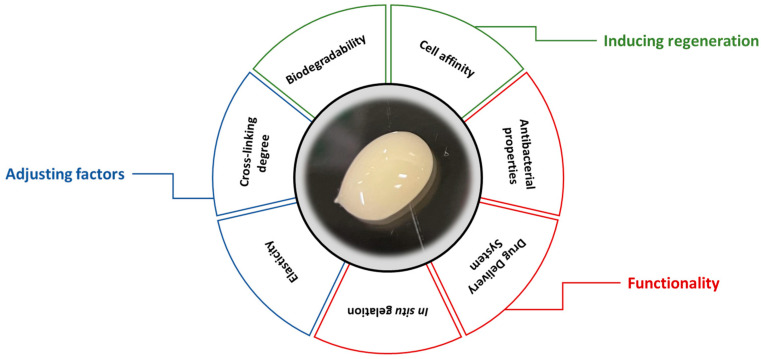
Figure 1
Figure 1
Requirements for ideal hydrogels.
Figure 2
Figure 2
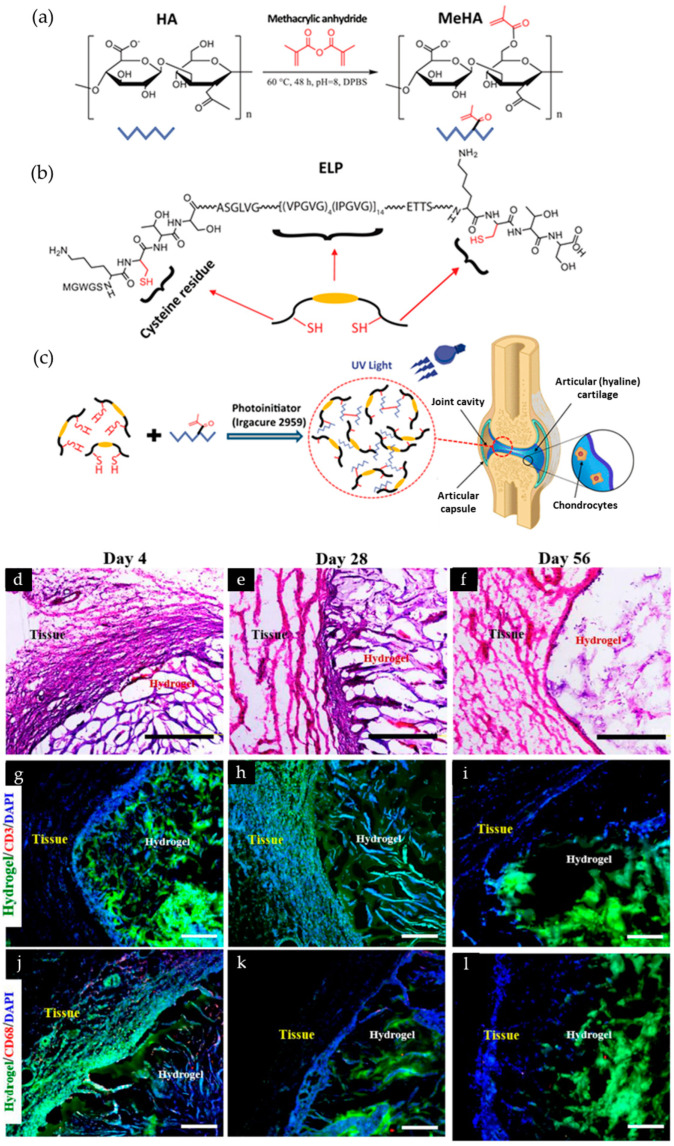
Schematic of methacrylated hyaluronic acid(MeHA)/elastin-like polypeptides(ELP) chemical structure. (a) HA methacrylation to form MeHA; (b) chemical structure of ELP; (c) schematic diagrams of photo-cross-linking of MeHA/ELP hydrogels and potential application as the adhesive composite. (di) In vivo biocompatibility and biodegradation of MeHA/ELP hybrid hydrogels in a rat subcutaneous implantation model. (df) Hematoxylin and eosin staining of MeHA/ELP sections (scale bars = 500 μm); (gi) fluorescent images at 4, 28, and 56 days of immunohistofluorescent analysis (scale bars = 200 μm). Green, red and blue colors in (gl) represent the MeHA/ELP autofluorescent hydrogels, the immune cells, and cell nuclei (DAPI), respectively. Hydrogels were formed by using 2% MeHA and 10% ELP at 120 s UV exposure time. Adapted with permission from [47]. Copyright 2018 American Chemical Society.
Figure 3
Figure 3
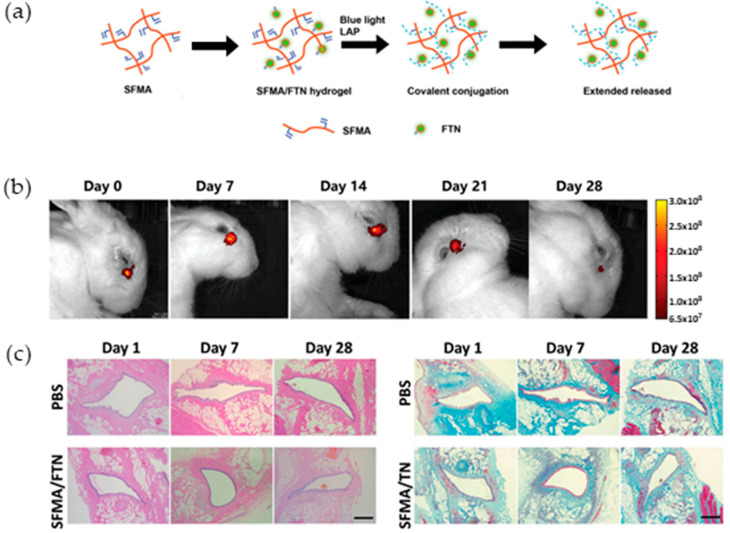
Synthesis and application of methacrylate-modified silk fibroin(SFMA)/fluorescent tracer nanoparticles (FTN) hydrogel plugs. (a) Schematic of the release of FTN from the SFMA hydrogel; (b) Long-term monitoring of SFMA/FTN hydrogel localized in the lacrimal sac of dry eye rabbits; (c) H&E and Masson staining observations for the biocompatibility assay after 1, 7, and 28 days of PBS and SFMA/FTN hydrogel in situ injection at the lacrimal duct, respectively (scale bars: 200 µm). Images reproduced with permission [64] ©WILEY-VCH Verlag GmbH & Co. KGaA, Weinheim.

References

    1. Kitsuka T., Hama R., Ulziibayar A., Matsuzaki Y., Kelly J., Shinoka T. Clinical Application for Tissue Engineering Focused on Materials. Biomedicines. 2022;10:1439. doi: 10.3390/biomedicines10061439. - DOI - PMC - PubMed
    1. Slaughter B.V., Khurshid S.S., Fisher O.Z., Khademhosseini A., Peppas N.A. Hydrogels in Regenerative Medicine. Adv. Mater. 2009;21:3307–3329. doi: 10.1002/adma.200802106. - DOI - PMC - PubMed
    1. Catoira M.C., Fusaro L., Di Francesco D., Ramella M., Boccafoschi F. Overview of Natural Hydrogels for Regenerative Medicine Applications. J. Mater. Sci. Mater. Med. 2019;30:1–10. doi: 10.1007/s10856-019-6318-7. - DOI - PMC - PubMed
    1. Hoffman A.S. Hydrogels for Biomedical Applications. Adv. Drug Deliv. Rev. 2012;64:18–23. doi: 10.1016/j.addr.2012.09.010. - DOI - PubMed
    1. Li Y., Rodrigues J., Tomás H. Injectable and Biodegradable Hydrogels: Gelation, Biodegradation and Biomedical Applications. Chem. Soc. Rev. 2012;41:2193–2221. doi: 10.1039/C1CS15203C. - DOI - PubMed

Publication types

LinkOut - more resources