Review
. 2023 Jan 18;11(2):247.
doi: 10.3390/biomedicines11020247.

The Homogeneous Azorean Machado-Joseph Disease Cohort: Characterization and Contributions to Advances in Research

Affiliations
Review

The Homogeneous Azorean Machado-Joseph Disease Cohort: Characterization and Contributions to Advances in Research

Manuela Lima et al. Biomedicines. .

Abstract

Machado-Joseph disease (MJD)/spinocerebellar ataxia type 3 (SCA3) is the most common autosomal dominant ataxia worldwide. MJD is characterized by late-onset progressive cerebellar ataxia associated with variable clinical findings, including pyramidal signs and a dystonic-rigid extrapyramidal syndrome. In the Portuguese archipelago of the Azores, the worldwide population cluster for this disorder (prevalence of 39 in 100,000 inhabitants), a cohort of MJD mutation carriers belonging to extensively studied pedigrees has been followed since the late 1990s. Studies of the homogeneous Azorean MJD cohort have been contributing crucial information to the natural history of this disease as well as allowing the identification of novel molecular biomarkers. Moreover, as interventional studies for this globally rare and yet untreatable disease are emerging, this cohort should be even more important for the recruitment of trial participants. In this paper, we profile the Azorean cohort of MJD carriers, constituted at baseline by 20 pre-ataxic carriers and 52 patients, which currently integrates the European spinocerebellar ataxia type 3/Machado-Joseph disease Initiative (ESMI), a large European longitudinal MJD cohort. Moreover, we summarize the main studies based on this cohort and highlight the contributions made to advances in MJD research. Knowledge of the profile of the Azorean MJD cohort is not only important in the context of emergent interventional trials but is also pertinent for the implementation of adequate interventional measures, constituting relevant information for Lay Associations and providing data to guide healthcare decision makers.

Keywords: European Spinocerebellar Ataxia type 3/Machado-Joseph disease Initiative (ESMI); MJD; SCA3; clinical trials; homogeneous cohorts; polyglutamine disorders; spinocerebellar ataxia type 3.


Conflict of interest statement

The authors declare that they have no competing interest.

Figures
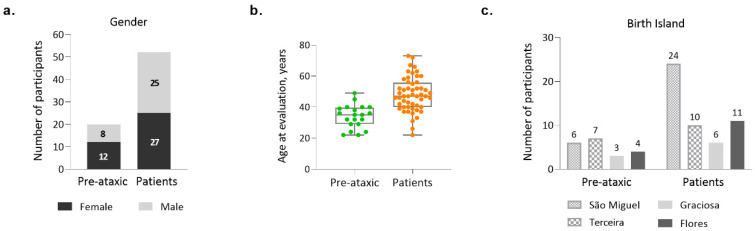
Figure 1
Figure 1
Demographic characterization of the Azorean MJD cohort (n = 72). (a) Number of pre-ataxic carriers and patients, by gender; (b) Age at evaluation/recruitment for pre-ataxic carriers and patients; (c) Number of pre-ataxic carriers and patients, by island of birth.
Figure 2
Figure 2
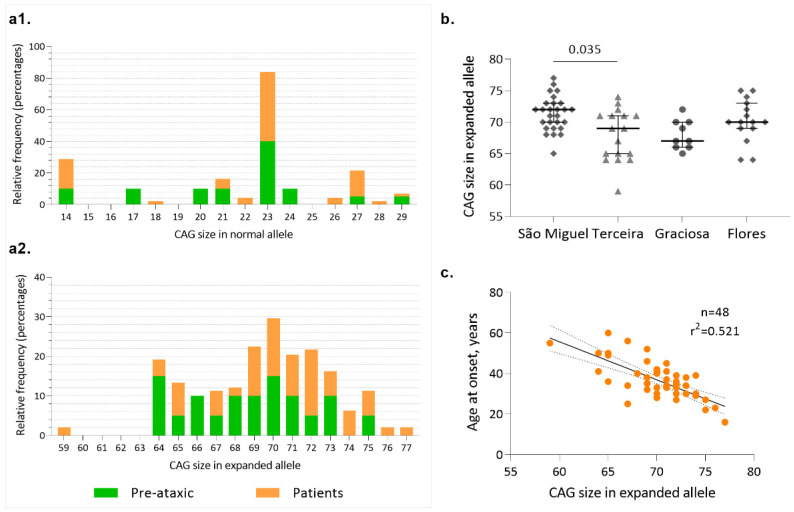
Allelic profile of the CAG repeats at ATXN3. (a1) Allelic distribution of the normal ATXN3 alleles (n = 69); (a2) Allelic distribution of expanded ATXN3 alleles (n = 69); (b) Distribution of the number of CAG repeats at the MJD locus by island of birth of carriers; (c) Linear relationship between the CAG number in the expanded allele and age at onset in MJD patients.
Figure 3
Figure 3
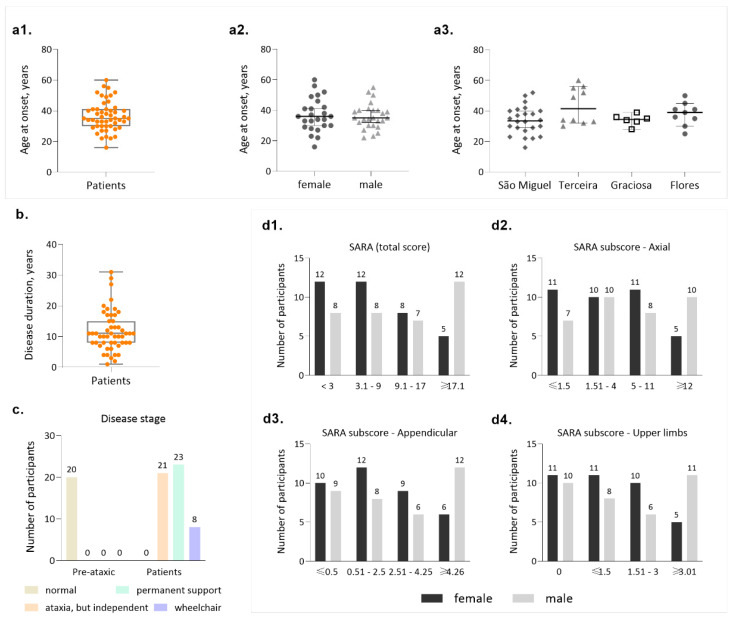
Main clinical features of the MJD Azorean cohort. (a1) Distribution of age at onset in MJD patients; (a2) Distribution of age at onset by gender; (a3) Distribution of age at onset by island of birth of the patients; (b) Disease duration in patients; (c) Frequencies of disease stages, as proposed by Klockgether and collaborators (1998); (d1) Distribution of patients by categories of the total SARA score (maximum score = 40); (d2) Distribution of patients by categories of the axial subscore of SARA (maximum subscore = 18); (d3) Distribution of patients by categories of the appendicular subscore of SARA (maximum subscore = 12); (d4) Distribution of patients by categories of the upper limbs subscore of SARA (maximum subscore = 12).
Figure 4
Figure 4
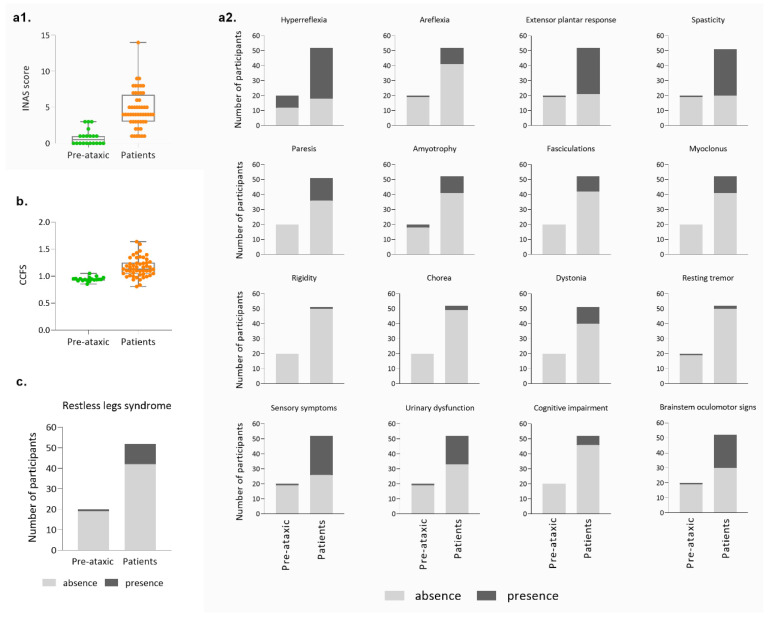
Main clinical features of the Azorean cohort (cont.). (a1) Distribution of the total INAS score of pre-ataxic carriers and patients; (a2) Presence and absence of the several signs/symptoms evaluated by the individual items of the INAS score; (b) CCFS score in pre-ataxic carriers and patients; (c) Frequency of restless leg syndrome in MJD mutation carriers.
Figure 5
Figure 5
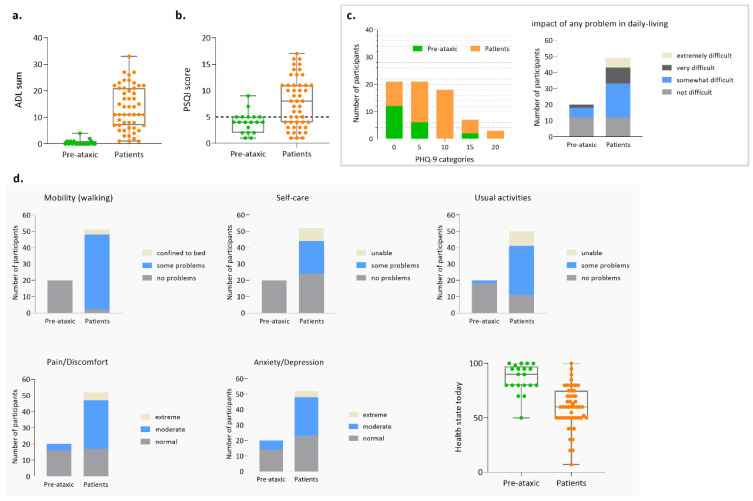
Patient-reported measures for the Azorean MJD cohort. (a) Score for the activities of daily living (ADL) questionnaire; (b) Score for the Pittsburgh Sleep Quality Index (PSQI); (c) Score for the Patient Health Questionnaire (PHQ-9); (d) Score for the EQ-5D-3L.
Figure 6
Figure 6
Correlation matrix showing variables analyzed in the present study, namely age, the number of CAG repeats in expanded alleles (CAGexp), age at onset (AO), disease duration (DD), SARA, INAS, CCFS, ASL, EQ-5D-3L (including the health status), PSQI, and PHQ-9. Spearman correlation coefficients (cell values) were shown, and each cell was colored according to its range and direction (positive or negative). * p-value lower than 0.05.

References

    1. Klockgether T., Mariotti C., Paulson H.L. Spinocerebellar ataxia. Nat. Rev. Dis. Prim. 2019;5:24. doi: 10.1038/s41572-019-0074-3. - DOI - PubMed
    1. Coutinho P., Ruano L., Loureiro J.L., Cruz V.T., Barros J., Tuna A., Barbot C., Guimarães J., Alonso I., Silveira I., et al. Hereditary ataxia and spastic paraplegia in Portugal: A population-based prevalence study. JAMA Neurol. 2013;70:746–755. doi: 10.1001/jamaneurol.2013.1707. - DOI - PubMed
    1. de Araujo M., Raposo M., Kazachkova N., Vasconcelos J., Kay T., Lima M. Trends in the Epidemiology of Spinocerebellar Ataxia Type 3 / Machado-Joseph Disease in the Azores Islands, Portugal. JSM Brain Sci. 2016;1:1001.
    1. Paulson H., Shakkottai V. Spinocerebellar Ataxia Type 3. In: Adam M.P., Everman D.B., Mirzaa G.M., Pagon R.A., Wallace S.E., Bean L.J.H., Gripp K.W., Amemiya A., editors. GeneReviews®. University of Washington; Seattle, WA, USA: 1998. pp. 1993–2022. - PubMed
    1. Bettencourt C., Lima M. Machado-Joseph Disease: From first descriptions to new perspectives. Orphanet J. Rare Dis. 2011;6:35. doi: 10.1186/1750-1172-6-35. - DOI - PMC - PubMed

LinkOut - more resources