


Cerebrospinal Fluid Biomarkers in Differential Diagnosis of Multiple Sclerosis and Systemic Inflammatory Diseases with Central Nervous System Involvement
- PMID: 36830963
- PMCID: PMC9953577
- DOI: 10.3390/biomedicines11020425
Cerebrospinal Fluid Biomarkers in Differential Diagnosis of Multiple Sclerosis and Systemic Inflammatory Diseases with Central Nervous System Involvement
Abstract
Background: Diagnosis of multiple sclerosis (MS) is established on criteria according to clinical and radiological manifestation. Cerebrospinal fluid (CSF) analysis is an important part of differential diagnosis of MS and other inflammatory processes in the central nervous system (CNS).
Methods: In total, 242 CSF samples were collected from patients undergoing differential MS diagnosis because of the presence of T2-hyperintensive lesions on brain MRI. The non-MS patients were subdivided into systemic inflammatory diseases with CNS involvement (SID) or cerebrovascular diseases (CVD) or other non-inflammatory diseases (NID). All samples were analyzed for the presence of oligoclonal bands and ELISA was performed for detection of: INF gamma, IL-6, neurofilaments light chain (NF-L), GFAP, CHI3L1, CXCL13, and osteopontin.
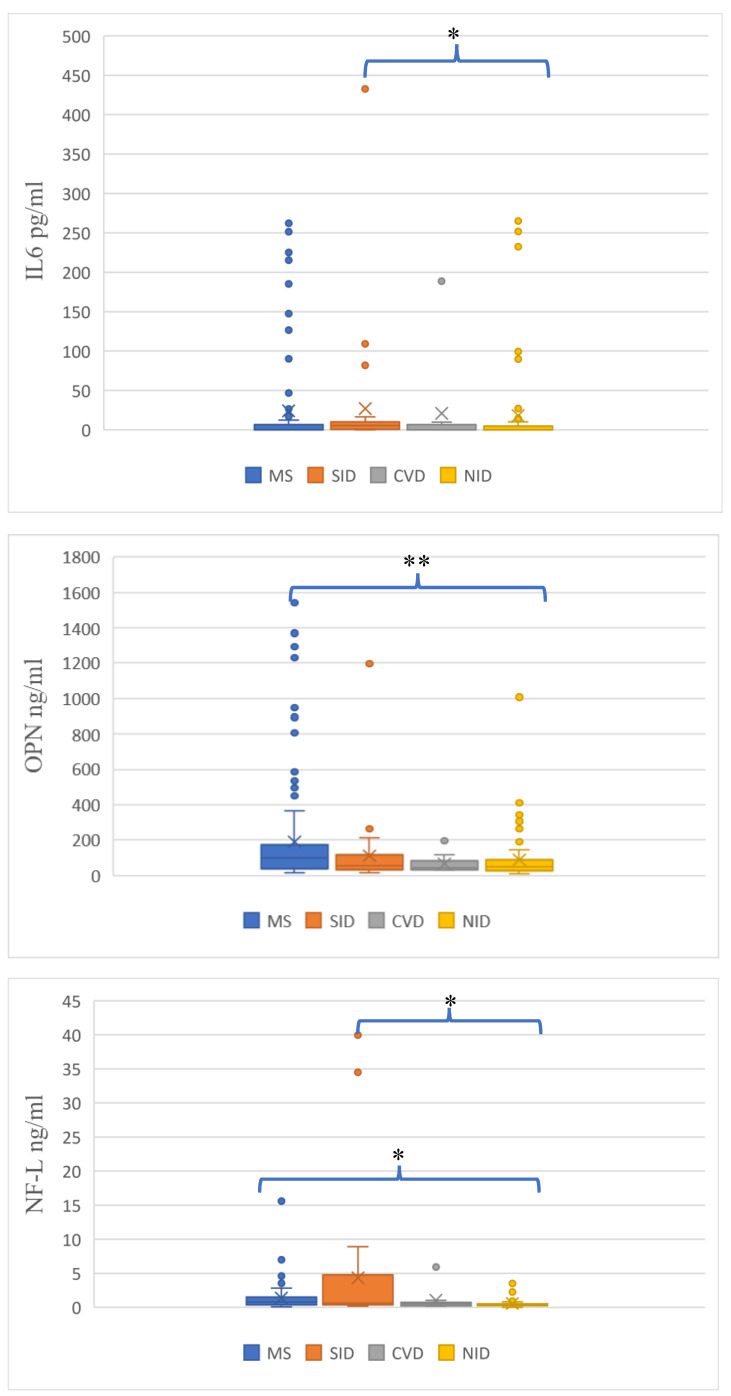
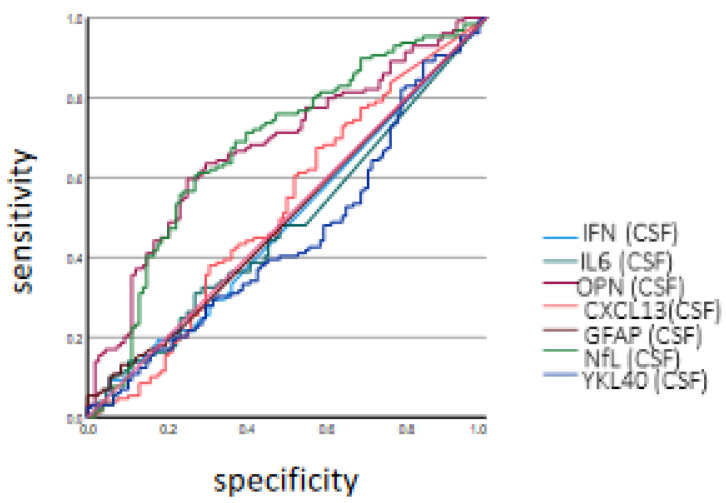
Results: The level of IL-6 (p = 0.024), osteopontin (p = 0.0002), and NF-L (p = 0.002) was significantly different among groups. IL-6 (p = 0.0350) and NF-L (p = 0.0015) level was significantly higher in SID compared to NID patients. A significantly higher level of osteopontin (p = 0.00026) and NF-L (p = 0.002) in MS compared to NID population was noted. ROC analysis found weak diagnostic power for osteopontin and NFL-L.
Conclusions: The classical and non-standard markers of inflammatory process and neurodegeneration do not allow for sufficient differentiation between MS and non-MS inflammatory CNS disorders. Weak diagnostic power observed for the osteopontin and NF-L needs to be further investigated.
Keywords: cerebrospinal fluid; differential diagnosis; interleukin 6; multiple sclerosis; neurofilaments light chain; oligoclonal bands; osteopontin.
Conflict of interest statement
The authors declare no conflict of interest.
Figures
References
-
- Wattjes M.P., Ciccarelli O., Reich D.S., Banwell B., de Stefano N., Enzinger C., Fazekas F., Filippi M., Frederiksen J., Gasperini C., et al. Magnetic Resonance Imaging in Multiple Sclerosis Study Group; Consortium of Multiple Sclerosis Centres; North American Imaging in Multiple Sclerosis Cooperative MRI guidelines working group. 2021 MAGNIMS-CMSC-NAIMS consensus recommendations on the use of MRI in patients with multiple sclerosis. Lancet Neurol. 2021;20:653–670. - PubMed
-
- Solomon A.J., Bourdette D.N., Cross A.H., Applebee A., Skidd P.M., Howard D.B., Spain R.I., Cameron M.H., Kim E., Mass M.K., et al. The contemporary spectrum of multiple sclerosis misdiagnosis: A multicenter study. Neurology. 2016;87:1393–1399. doi: 10.1212/WNL.0000000000003152. - DOI - PMC - PubMed
Grants and funding
LinkOut - more resources
Full Text Sources
Research Materials
Miscellaneous
