


Geographic Variation and Risk Factor Association of Early Versus Late Onset Colorectal Cancer
- PMID: 36831350
- PMCID: PMC9954005
- DOI: 10.3390/cancers15041006
Geographic Variation and Risk Factor Association of Early Versus Late Onset Colorectal Cancer
Abstract
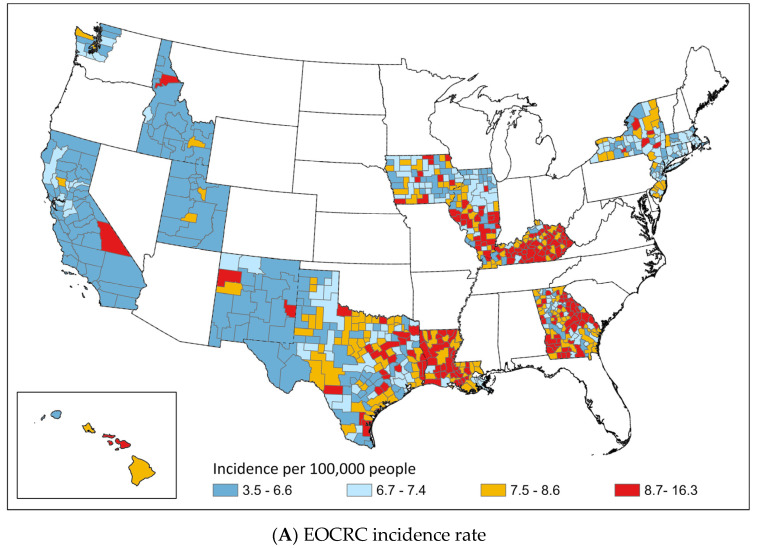
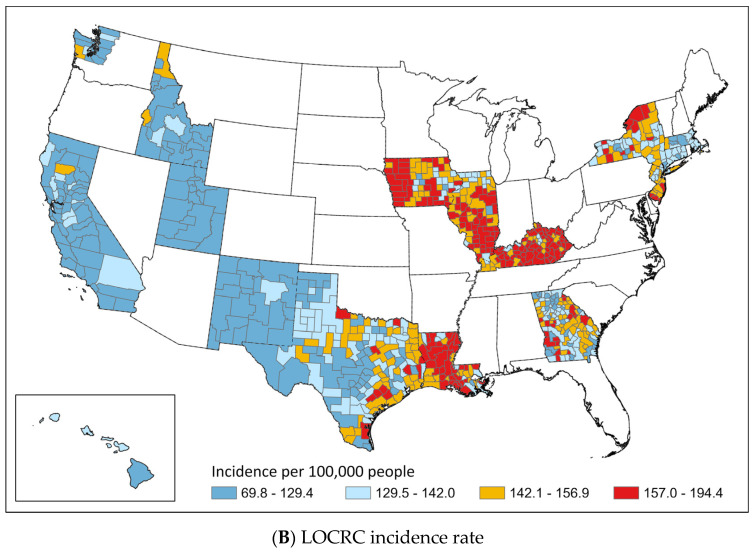
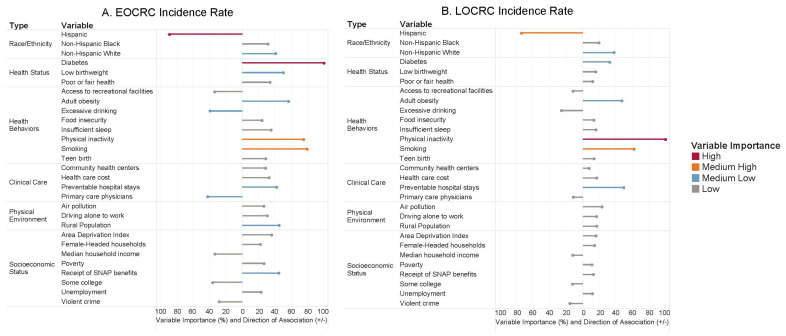
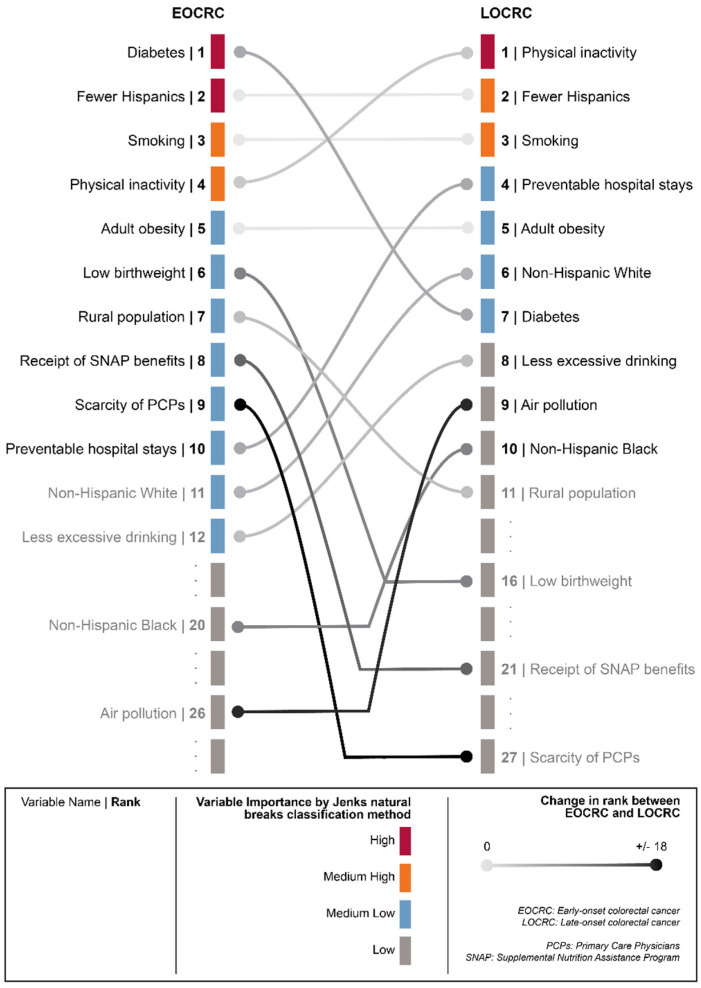
The proportion of patients diagnosed with colorectal cancer (CRC) at age < 50 (early-onset CRC, or EOCRC) has steadily increased over the past three decades relative to the proportion of patients diagnosed at age ≥ 50 (late-onset CRC, or LOCRC), despite the reduction in CRC incidence overall. An important gap in the literature is whether EOCRC shares the same community-level risk factors as LOCRC. Thus, we sought to (1) identify disparities in the incidence rates of EOCRC and LOCRC using geospatial analysis and (2) compare the importance of community-level risk factors (racial/ethnic, health status, behavioral, clinical care, physical environmental, and socioeconomic status risk factors) in the prediction of EOCRC and LOCRC incidence rates using a random forest machine learning approach. The incidence data came from the Surveillance, Epidemiology, and End Results program (years 2000-2019). The geospatial analysis revealed large geographic variations in EOCRC and LOCRC incidence rates. For example, some regions had relatively low LOCRC and high EOCRC rates (e.g., Georgia and eastern Texas) while others had relatively high LOCRC and low EOCRC rates (e.g., Iowa and New Jersey). The random forest analysis revealed that the importance of community-level risk factors most predictive of EOCRC versus LOCRC incidence rates differed meaningfully. For example, diabetes prevalence was the most important risk factor in predicting EOCRC incidence rate, but it was a less important risk factor of LOCRC incidence rate; physical inactivity was the most important risk factor in predicting LOCRC incidence rate, but it was the fourth most important predictor for EOCRC incidence rate. Thus, our community-level analysis demonstrates the geographic variation in EOCRC burden and the distinctive set of risk factors most predictive of EOCRC.
Keywords: colorectal cancer; early-onset; geographic information system; machine learning; random forest; regionalization; risk factor.
Conflict of interest statement
Weichuan Dong and Siran M. Koroukian reported receiving grants from American Cancer Society (RWIA-20-111-02 RWIA) and by contracts from Cleveland Clinic Foundation, including a subcontract from Celgene Corporation. Siran M. Koroukian was also supported by grants from the Centers for Disease Control and Prevention, U48 DP005030-05S1 and U48 DP006404-03S7; National Institutes of Health (R15 NR017792, UH3-DE025487, and R01 AG074946-01) and American Cancer Society (132678-RSGI-19-213-01-CPHPS). Uriel Kim is supported by grants from the National Institute of General Medical Sciences (5T32GM007250), National Center for Advancing Translational Sciences (5TL1TR002549), and the PhRMA Foundation (PDHO18). Johnie Rose reported receiving grants from NIH/National Cancer Institute during the conduct of the study; holding stock in Vinya Intelligence Inc outside the submitted work; and having a patent issued for US 270,799 B2 “In-home remote monitoring systems and methods for predicting health status decline”. No other disclosures were reported.
Figures
References
Grants and funding
LinkOut - more resources
Full Text Sources
Miscellaneous
