. 2023 Feb 20;13(4):811.
doi: 10.3390/diagnostics13040811.

AI: Can It Make a Difference to the Predictive Value of Ultrasound Breast Biopsy?

Affiliations

AI: Can It Make a Difference to the Predictive Value of Ultrasound Breast Biopsy?

Jean L Browne et al. Diagnostics (Basel). .

Abstract

(1) Background: This study aims to compare the ground truth (pathology results) against the BI-RADS classification of images acquired while performing breast ultrasound diagnostic examinations that led to a biopsy and against the result of processing the same images through the AI algorithm KOIOS DS TM (KOIOS). (2) Methods: All results of biopsies performed with ultrasound guidance during 2019 were recovered from the pathology department. Readers selected the image which better represented the BI-RADS classification, confirmed correlation to the biopsied image, and submitted it to the KOIOS AI software. The results of the BI-RADS classification of the diagnostic study performed at our institution were set against the KOIOS classification and both were compared to the pathology reports. (3) Results: 403 cases were included in this study. Pathology rendered 197 malignant and 206 benign reports. Four biopsies on BI-RADS 0 and two images are included. Of fifty BI-RADS 3 cases biopsied, only seven rendered cancers. All but one had a positive or suspicious cytology; all were classified as suspicious by KOIOS. Using KOIOS, 17 B3 biopsies could have been avoided. Of 347 BI-RADS 4, 5, and 6 cases, 190 were malignant (54.7%). Because only KOIOS suspicious and probably malignant categories should be biopsied, 312 biopsies would have resulted in 187 malignant lesions (60%), but 10 cancers would have been missed. (4) Conclusions: KOIOS had a higher ratio of positive biopsies in this selected case study vis-à-vis the BI-RADS 4, 5 and 6 categories. A large number of biopsies in the BI-RADS 3 category could have been avoided.

Keywords: artificial intelligence; breast biopsy; breast cancer; breast ultrasound; computer-aided diagnosis.


Conflict of interest statement

The authors declare no conflict of interest.

Figures
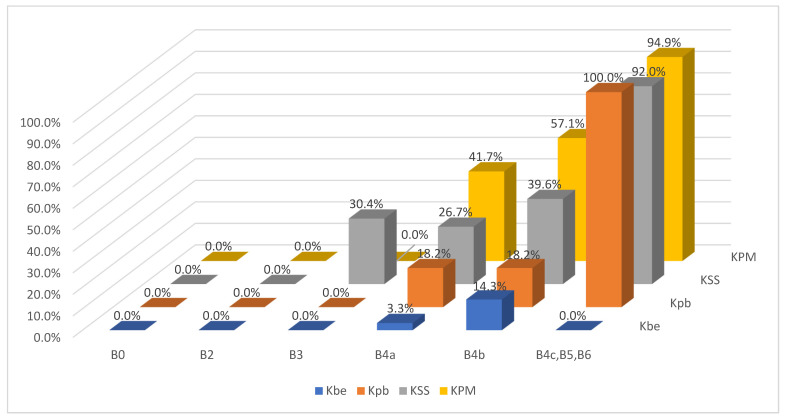
Figure 1
Figure 1
Probability of malignant biopsies for each combination of BI-RADS and KOIOS score.
Figure 2
Figure 2
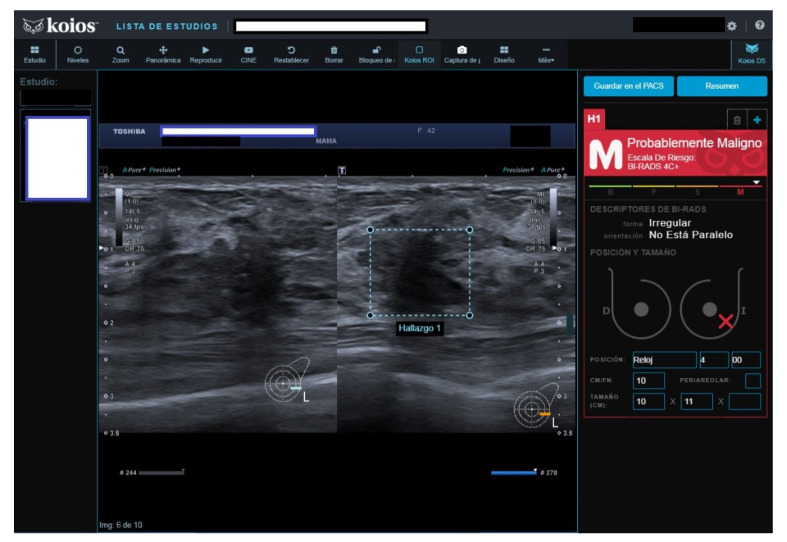
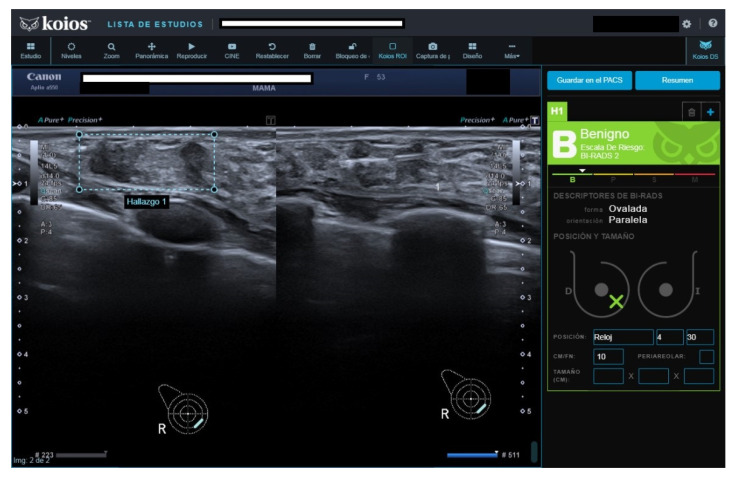
Suspicious image rated B2 by reader because of prior benign core biopsy (usual hyperplasia) and absence of change; rated KPM by KOIOS. Our multidisciplinary committee indicated a new and wider biopsy that was performed with US guidance and vacuum assistance. Pathology reported adenosis.
Figure 3
Figure 3
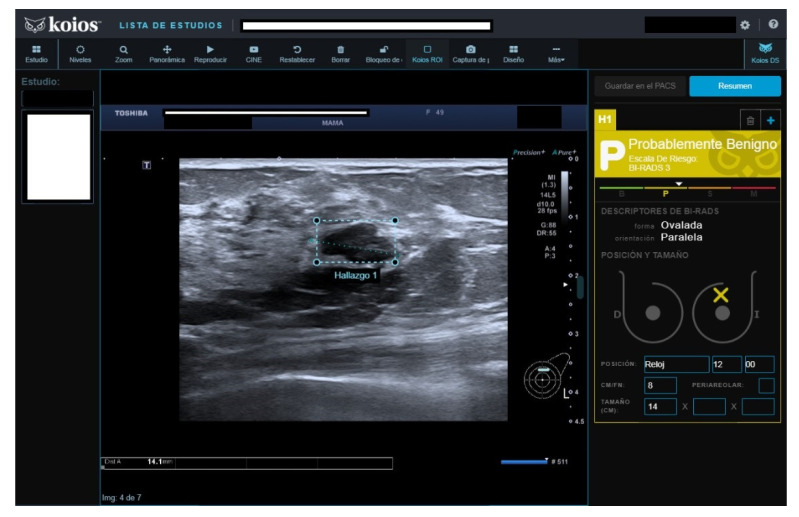
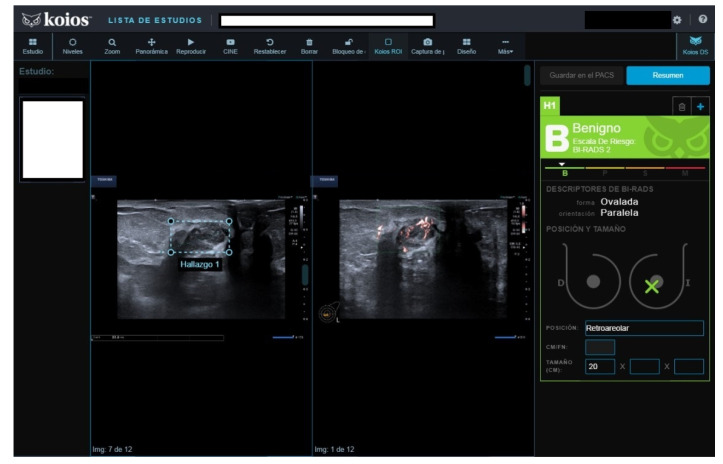
Nodule rated B3 by reader, Kpb by KOIOS. Cytology reported fibroadenoma with simple hyperplasia; biopsy rendered a fibroadenoma diagnosis.
Figure 4
Figure 4
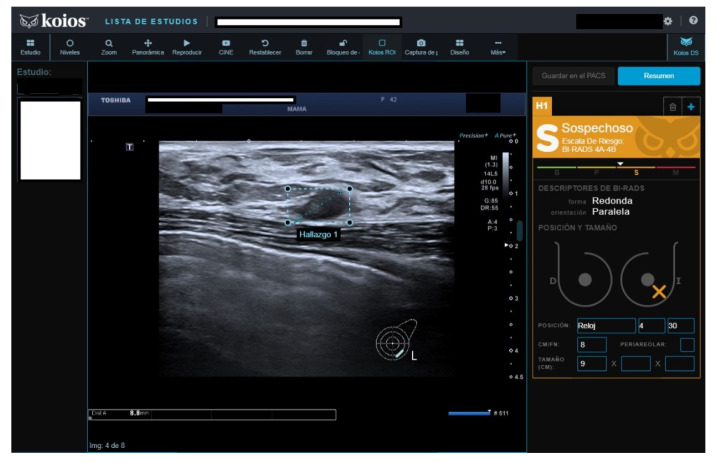
Nodule rated B3 by reader (no Doppler), KSS by KOIOS. Cytology reported grade 1 carcinoma. Biopsy confirmed invasive carcinoma.
Figure 5
Figure 5
New nodule in right breast with previous carcinoma 25 years before. Rated B4a, Kbe by KOIOS. Surgery rendered a malignant fibrous histiocytoma.
Figure 6
Figure 6
Palpable nodule rated B4b on BUS, Kbe by KOIOS. Confirmed invasive carcinoma.
Figure 7
Figure 7
Rated B4c (B4b in mammography), KOIOS rendered a Kbe category. Pathology: chronic and acute inflammation. No signs of malignancy. Patient refused further surgery. BUS 2 years later found no significative residual lesion.

References

    1. Berg W.A., Bandos A.I., Mendelson E.B., Lehrer D., Jong R.A., Pisano E.D. Ultrasound as the Primary Screening Test for Breast Cancer: Analysis From ACRIN 6666. J. Natl. Cancer Inst. 2015;108:djv367. doi: 10.1093/jnci/djv367. - DOI - PMC - PubMed
    1. Bae M.S., Han W., Koo H.R., Cho N., Chang J.M., Yi A., Park I.A., Noh D.Y., Choi W.S., Moon W.K. Characteristics of breast cancers detected by ultrasound screening in women with negative mammograms. Cancer Sci. 2011;102:1862–1867. doi: 10.1111/j.1349-7006.2011.02034.x. - DOI - PubMed
    1. Schwalbe N., Wahl B. Artificial intelligence and the future of global health. Lancet. 2020;395:1579–1586. doi: 10.1016/S0140-6736(20)30226-9. - DOI - PMC - PubMed
    1. Drukker L., Noble J.A., Papageorghiou A.T. Introduction to artificial intelligence in ultrasound imaging in obstetrics and gynecology. Ultrasound Obstet. Gynecol. 2020;56:498–505. doi: 10.1002/uog.22122. - DOI - PMC - PubMed
    1. Castelvecchi D. Can we open the black box of AI? Nature. 2016;538:20–23. doi: 10.1038/538020a. - DOI - PubMed

LinkOut - more resources