


Characterization and Expression of Holothurian Wnt Signaling Genes during Adult Intestinal Organogenesis
- PMID: 36833237
- PMCID: PMC9957329
- DOI: 10.3390/genes14020309
Characterization and Expression of Holothurian Wnt Signaling Genes during Adult Intestinal Organogenesis
Abstract
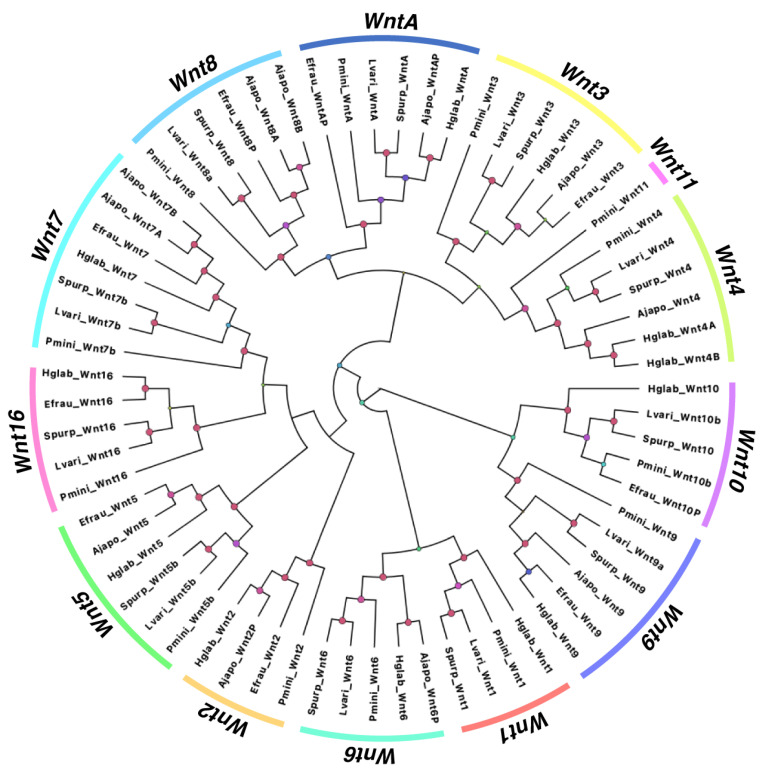
Wnt signaling has been shown to play multiple roles in regenerative processes, one of the most widely studied of which is the regeneration of the intestinal luminal epithelia. Most studies in this area have focused on self-renewal of the luminal stem cells; however, Wnt signaling may also have more dynamic functions, such as facilitating intestinal organogenesis. To explore this possibility, we employed the sea cucumber Holothuria glaberrima that can regenerate a full intestine over the course of 21 days after evisceration. We collected RNA-seq data from various intestinal tissues and regeneration stages and used these data to define the Wnt genes present in H. glaberrima and the differential gene expression (DGE) patterns during the regenerative process. Twelve Wnt genes were found, and their presence was confirmed in the draft genome of H. glaberrima. The expressions of additional Wnt-associated genes, such as Frizzled and Disheveled, as well as genes from the Wnt/β-catenin and Wnt/Planar Cell Polarity (PCP) pathways, were also analyzed. DGE showed unique distributions of Wnt in early- and late-stage intestinal regenerates, consistent with the Wnt/β-catenin pathway being upregulated during early-stages and the Wnt/PCP pathway being upregulated during late-stages. Our results demonstrate the diversity of Wnt signaling during intestinal regeneration, highlighting possible roles in adult organogenesis.
Keywords: Wnt genes; echinoderm; organogenesis; regeneration; sea cucumber.
Conflict of interest statement
The authors declare no conflict of interest.
Figures




References
-
- Yaglova N.V., Tsomartova D.A., Obernikhin S.S., Nazimova S.V. The Role of the Canonical Wnt-Signaling Pathway in Morphogenesis and Regeneration of the Adrenal Cortex in Rats Exposed to the Endocrine Disruptor Dichlorodiphenyltrichloroethane during Prenatal and Postnatal Development. Biol. Bull. Russ. Acad. Sci. 2019;46:74–81. doi: 10.1134/S1062359018060122. - DOI
Publication types
MeSH terms
Substances
Grants and funding
LinkOut - more resources
Full Text Sources
Miscellaneous
