Review
. 2023 Jan 27;14(2):325.
doi: 10.3390/genes14020325.

Extracellular Vesicles as Potential Biomarkers in Amyotrophic Lateral Sclerosis

Affiliations
Review

Extracellular Vesicles as Potential Biomarkers in Amyotrophic Lateral Sclerosis

Maruša Barbo et al. Genes (Basel). .

Abstract

Amyotrophic lateral sclerosis (ALS) is described as a fatal and rapidly progressive neurodegenerative disorder caused by the degeneration of upper motor neurons in the primary motor cortex and lower motor neurons of the brainstem and spinal cord. Due to ALS's slowly progressive characteristic, which is often accompanied by other neurological comorbidities, its diagnosis remains challenging. Perturbations in vesicle-mediated transport and autophagy as well as cell-autonomous disease initiation in glutamatergic neurons have been revealed in ALS. The use of extracellular vesicles (EVs) may be key in accessing pathologically relevant tissues for ALS, as EVs can cross the blood-brain barrier and be isolated from the blood. The number and content of EVs may provide indications of the disease pathogenesis, its stage, and prognosis. In this review, we collected a recent study aiming at the identification of EVs as a biomarker of ALS with respect to the size, quantity, and content of EVs in the biological fluids of patients compared to controls.

Keywords: ALS; amyotrophic lateral sclerosis; biomarkers; extracellular vesicles.


Conflict of interest statement

The authors declare no conflict of interest.

Figures
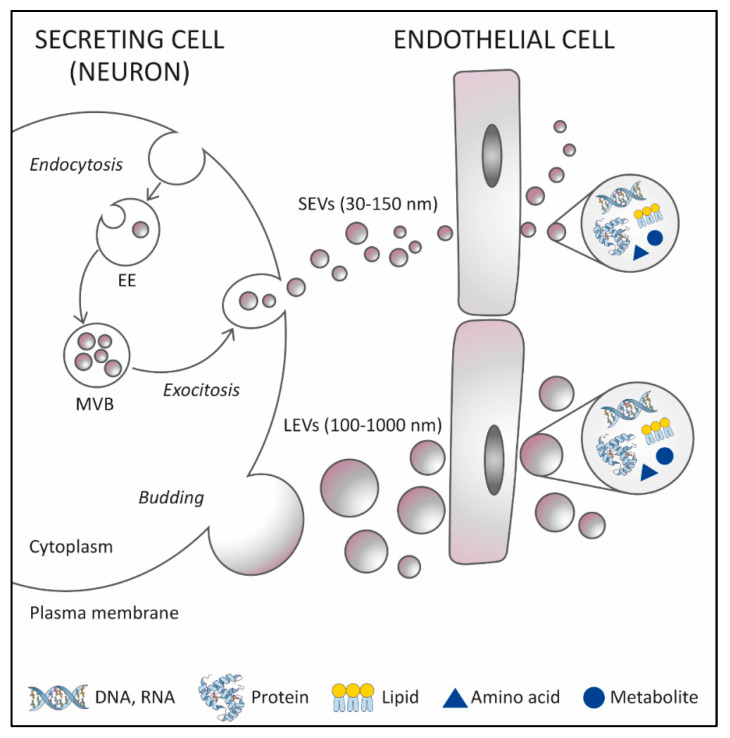
Figure 1
Figure 1
Formation of extracellular vesicles (EVs) and transport across the blood–brain barrier (BBB). Large EVs (LEVs) and small EVs (SEVs) are two subtypes of EVs, that can be distinguished by their size and biogenesis. LEVs are shed by budding of the plasma membrane, whereas SEVs are formed intracellularly and released by exocytosis of multivesicular bodies (MVBs). EVs can cross the BBB and thus enable various components, specific to secreting cells, including nucleic acids, proteins, amino acids, lipids, and metabolites in the EVs to be transported from the central nervous system (CNS) to peripheral biofluids. EE, early endosome.

References

    1. Dhasmana S., Dhasmana A., Narula A.S., Jaggi M., Yallapu M.M., Chauhan S.C. The panoramic view of amyotrophic lateral sclerosis: A fatal intricate neurological disorder. Life Sci. 2021;288:120156. doi: 10.1016/j.lfs.2021.120156. - DOI - PubMed
    1. Fang F., Ingre C., Roos P.M., Kamel F., Piehl F. Risk factors for amyotrophic lateral sclerosis. Clin. Epidemiol. 2015;7:181–193. doi: 10.2147/CLEP.S37505. - DOI - PMC - PubMed
    1. Morris J. Amyotrophic Lateral Sclerosis (ALS) and Related Motor Neuron Diseases: An Overview. Neurodiagnostic J. 2015;55:180–194. doi: 10.1080/21646821.2015.1075181. - DOI - PubMed
    1. Banack S.A., Dunlop R.A., Stommel E.W., Mehta P., Cox P.A. miRNA extracted from extracellular vesicles is a robust biomarker of amyotrophic lateral sclerosis. J. Neurol. Sci. 2022;442:120396. doi: 10.1016/j.jns.2022.120396. - DOI - PubMed
    1. Srinivasan E., Rajasekaran R. A Systematic and Comprehensive Review on Disease-Causing Genes in Amyotrophic Lateral Sclerosis. J. Mol. Neurosci. 2020;70:1742–1770. doi: 10.1007/s12031-020-01569-w. - DOI - PubMed

Publication types
