


Tumor Androgen Receptor Protein Level Is Positively Associated with a Better Overall Survival in Melanoma Patients
- PMID: 36833272
- PMCID: PMC9957358
- DOI: 10.3390/genes14020345
Tumor Androgen Receptor Protein Level Is Positively Associated with a Better Overall Survival in Melanoma Patients
Abstract
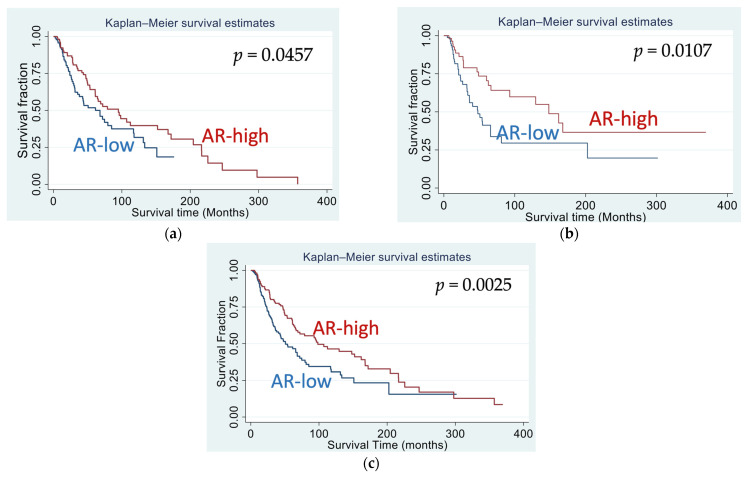
Androgen receptor (AR) is expressed in numerous tissues and serves important biologic functions in skin, prostate, immune, cardiovascular, and neural systems, alongside sexual development. Several studies have associated AR expression and patient survival in various cancers, yet there are limited studies examining the relationship between AR expression and cutaneous melanoma. This study used genomics and proteomics data from The Cancer Proteome Atlas (TCPA) and The Cancer Genome Atlas (TCGA), with 470 cutaneous melanoma patient data points. Cox regression analyses evaluated the association between AR protein level with overall survival and revealed that a higher level of AR protein was positively associated with a better overall survival (OS) (p = 0.003). When stratified by sex, the AR association with OS was only significant for both sexes. The multivariate Cox models with justifications of sex, age of diagnosis, stage of disease, and Breslow depth of the tumor confirmed the AR-OS association in all patients. However, the significance of AR was lost when ulceration was included in the model. When stratified by sex, the multivariate Cox models indicated significant role of AR in OS of female patients but not in males. AR-associated genes were identified and enrichment analysis revealed shared and distinct gene network in male and female patients. Furthermore, AR was found significantly associated with OS in RAS mutant subtypes of melanoma but not in BRAF, NF1, or triple-wild type subtypes of melanoma. Our study may provide insight into the well-known female survival advantage in melanoma patients.
Keywords: androgen receptor; cancer; melanoma; melanoma survival; protein expression.
Conflict of interest statement
The authors declare no conflict of interest.
Figures
References
-
- Ma M., Ghosh S., Tavernari D., Katarkar A., Clocchiatti A., Mazzeo L., Samarkina A., Epiney J., Yu Y.R., Ho P.C., et al. Sustained androgen receptor signaling is a determinant of melanoma cell growth potential and tumorigenesis. J. Exp. Med. 2021;218:e20201137. doi: 10.1084/jem.20201137. - DOI - PMC - PubMed
-
- Reintgen D.S., Paull D.E., Seigler H.F., Cox E.B., McCarty K.S., Jr. Sex related survival differences in instances of melanoma. Surg. Gynecol. Obstet. 1984;159:367–372. - PubMed
MeSH terms
Substances
LinkOut - more resources
Full Text Sources
Medical
Research Materials
Miscellaneous
