


Global Distribution of Founder Variants Associated with Non-Syndromic Hearing Impairment
- PMID: 36833326
- PMCID: PMC9957346
- DOI: 10.3390/genes14020399
Global Distribution of Founder Variants Associated with Non-Syndromic Hearing Impairment
Abstract
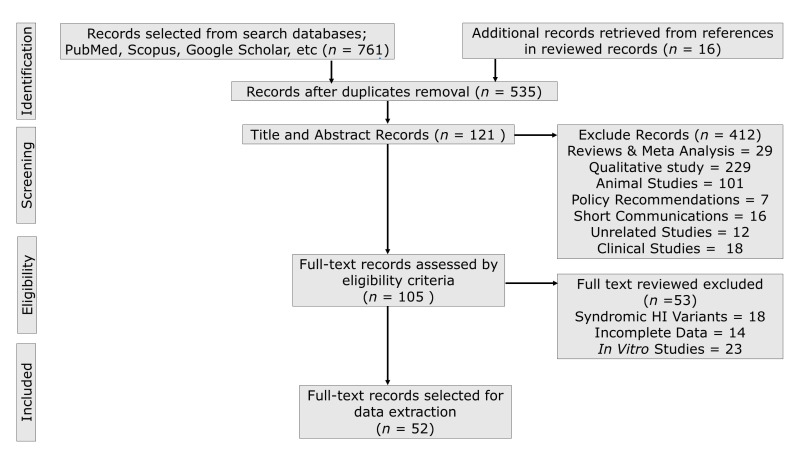
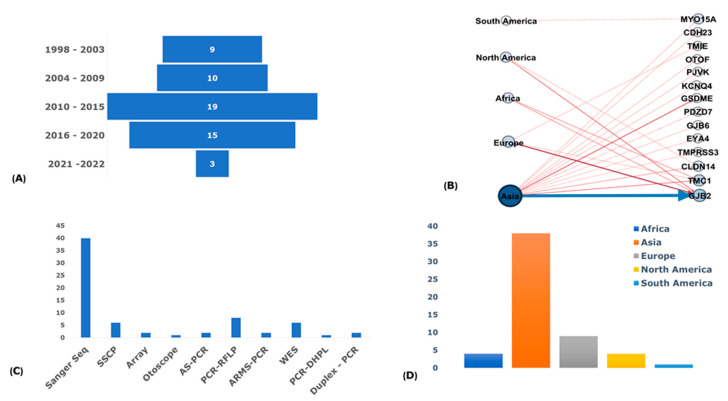
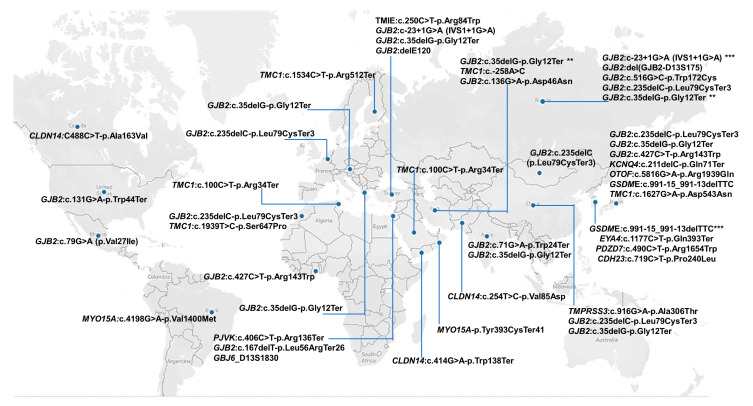
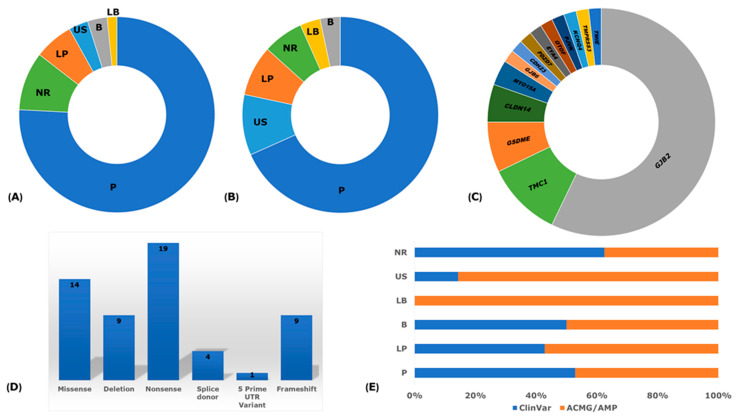
The genetic etiology of non-syndromic hearing impairment (NSHI) is highly heterogeneous with over 124 distinct genes identified. The wide spectrum of implicated genes has challenged the implementation of molecular diagnosis with equal clinical validity in all settings. Differential frequencies of allelic variants in the most common NSHI causal gene, gap junction beta 2 (GJB2), has been described as stemming from the segregation of a founder variant and/or spontaneous germline variant hot spots. We aimed to systematically review the global distribution and provenance of founder variants associated with NSHI. The study protocol was registered on PROSPERO, the International Prospective Register of Systematic Reviews, with the registration number "CRD42020198573". Data from 52 reports, involving 27,959 study participants from 24 countries, reporting 56 founder pathogenic or likely pathogenic (P/LP) variants in 14 genes (GJB2, GJB6, GSDME, TMC1, TMIE, TMPRSS3, KCNQ4, PJVK, OTOF, EYA4, MYO15A, PDZD7, CLDN14, and CDH23), were reviewed. Varied number short tandem repeats (STRs) and single nucleotide polymorphisms (SNPs) were used for haplotype analysis to identify the shared ancestral informative markers in a linkage disequilibrium and variants' origins, age estimates, and common ancestry computations in the reviewed reports. Asia recorded the highest number of NSHI founder variants (85.7%; 48/56), with variants in all 14 genes, followed by Europe (16.1%; 9/56). GJB2 had the highest number of ethnic-specific P/LP founder variants. This review reports on the global distribution of NSHI founder variants and relates their evolution to population migration history, bottleneck events, and demographic changes in populations linked with the early evolution of deleterious founder alleles. International migration and regional and cultural intermarriage, coupled to rapid population growth, may have contributed to re-shaping the genetic architecture and structural dynamics of populations segregating these pathogenic founder variants. We have highlighted and showed the paucity of data on hearing impairment (HI) variants in Africa, establishing unexplored opportunities in genetic traits.
Keywords: founder variant; gab junction beta 2 (GJB2); genetics; global populations; hearing impairment; non-syndromic.
Conflict of interest statement
The authors declare no conflict of interest.
Figures
References
-
- Bliznetz E.A., Lalayants M.R., Markova T.G., Balanovsky O.P., Balanovska E.V., Skhalyakho R.A., Pocheshkhova E.A., Nikitina N.V., Voronin S.V., Kudryashova E.K. Update of the GJB2/DFNB1 Mutation Spectrum in Russia: A Founder Ingush Mutation Del (GJB2-D13S175) Is the Most Frequent among Other Large Deletions. J. Hum. Genet. 2017;62:789–795. doi: 10.1038/jhg.2017.42. - DOI - PMC - PubMed
-
- Mikstiene V., Jakaitiene A., Byckova J., Gradauskiene E., Preiksaitiene E., Burnyte B., Tumiene B., Matuleviciene A., Ambrozaityte L., Uktveryte I. The High Frequency of GJB2 Gene Mutation c. 313_326del14 Suggests Its Possible Origin in Ancestors of Lithuanian Population. BMC Genet. 2016;17:1–12. doi: 10.1186/s12863-016-0354-9. - DOI - PMC - PubMed
-
- Borck G., Rainshtein L., Hellman-Aharony S., Volk A.E., Friedrich K., Taub E., Magal N., Kanaan M., Kubisch C., Shohat M. High Frequency of Autosomal-Recessive DFNB59 Hearing Loss in an Isolated Arab Population in Israel. Clin. Genet. 2012;82:271–276. doi: 10.1111/j.1399-0004.2011.01741.x. - DOI - PubMed
Publication types
MeSH terms
Substances
Grants and funding
LinkOut - more resources
Full Text Sources
Research Materials
Miscellaneous
