. 2023 Feb 3;14(2):401.
doi: 10.3390/genes14020401.

Increased On-Target Rate and Risk of Concatemerization after CRISPR-Enhanced Targeting in ES Cells

Affiliations

Increased On-Target Rate and Risk of Concatemerization after CRISPR-Enhanced Targeting in ES Cells

Valérie Erbs et al. Genes (Basel). .

Abstract

The French mouse clinic (Institut Clinique de la Souris; ICS) has produced more than 2000 targeting vectors for 'à la carte' mutagenesis in C57BL/6N mice. Although most of the vectors were used successfully for homologous recombination in murine embryonic stem cells (ESCs), a few have failed to target a specific locus after several attempts. We show here that co-electroporation of a CRISPR plasmid with the same targeting construct as the one that failed previously allows the systematic achievement of positive clones. A careful validation of these clones is, however, necessary as a significant number of clones (but not all) show a concatemerization of the targeting plasmid at the locus. A detailed Southern blot analysis permitted characterization of the nature of these events as standard long-range 5' and 3' PCRs were not able to distinguish between correct and incorrect alleles. We show that a simple and inexpensive PCR performed prior to ESC amplification allows detection and elimination of those clones with concatemers. Finally, although we only tested murine ESCs, our results highlight the risk of mis-validation of any genetically modified cell line (such as established lines, induced pluripotent stem cells or those used for ex vivo gene therapy) that combines the use of CRISPR/Cas9 and a circular double-stranded donor. We strongly advise the CRISPR community to perform a Southern blot with internal probes when using CRISPR to enhance homologous recombination in any cell type, including fertilized oocytes.

Keywords: CRISPR/Cas9; double-strand break; embryonic stem cells; gene targeting; genome editing; homologous recombination; reproducibility.


Conflict of interest statement

The authors declare no conflict of interest.

Figures

Figure 1
Figure 1
Example of a CRISPR design. (A) Scheme showing the position of the CRISPR-induced DSB relative to selection cassette. (B) Magnification of the sequences: a guide RNA was selected at the position of the insertion of the selection cassette so that the targeting construct would not be linearized. The PAM is underlined, and the 20 nt sequence recognized by the sgRNA is in light grey and surrounded by a rectangle. (C) PCR was performed on both the WT genomic DNA (F1-R1) and on the targeting construct in the region surrounding both LoxP sites (5′ F1-K7R and 3′ K7F-R1); the guide RNA was tested in the presence of the Cas9 protein on these PCR fragments (+); the PCR product alone is shown on the line indicated by a (−). Whereas a clear cut is observed on the WT PCR fragment, no DSB is observed on the PCR products from the targeting construct. (D) The whole targeting construct was run on a 1% agarose gel; (−) shows the pattern of the undigested plasmid. No linearization is observed in the presence of CRISPR (+), whereas a clear linearization (at the size of the targeting construct) is observed when the plasmid is digested with EcoRV (+EcoRV).
Figure 2
Figure 2
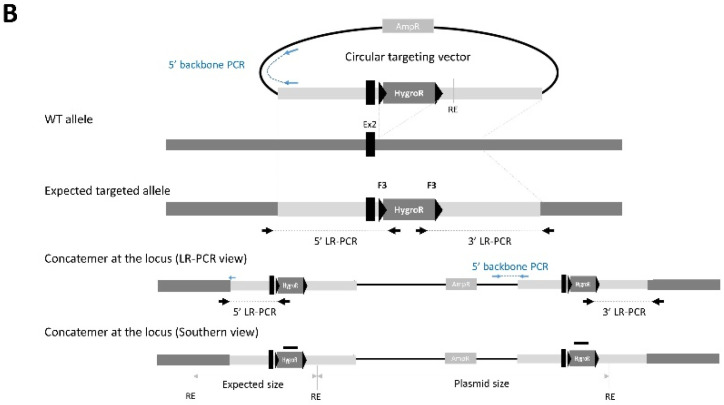
A construct that did not give any LR-PCR positive clones was co-electroporated linear (20 µg) and circular (20 µg) plasmids the same day in ESCs. The same CRISPR plasmid was used (20 µg) for both electroporation. Resistant clones were picked and subcloned, and ESC lysates were screened by 3′ LR-PCR (1ary screen). Twenty five percent clones (46/186 clones screened) were found to be positive when the linearized construct was used; 55% clones (78/141) were positive when the construct was circular. Thirteen clones obtained with the linearized construct were amplified, and all were confirmed by 5′ and 3′ LR-PCR (clone 62 gave faint PCR products); similarly, nine clones obtained with the circular construct were amplified and eight were confirmed by both 5′ and 3′ LR-PCR. Amplified ESCs were analyzed by Southern blotting with an internal probe (Hygro probe). A single band at the correct size was expected, the expected sizes for each restriction digests are indicated (see Suppl. Figure S1 for detailed schemes). Five clones (3, 14, 53, 68 and 83) show a unique band for each digest when the linear plasmid was electroporated and two clones (26 and 62) when the circular plasmid was electroporated. Strikingly, the Southern blot pattern of the other (unvalidated) clones was very predictable when the targeting construct was used as circular and the size of the additional band corresponded to the complete plasmid fragment size (including the plasmid backbone). When the linearized construct was used, numerous additional insertions were observed. A Southern blot probe with a 3′ external probe (only performed on clones obtained with a circular construct) showed an expected pattern with a WT band and a targeted band as the expected size. Note that clone 52 could be homozygous (no WT band detected). All clones with an incorrect Southern blot pattern were also positive for a PCR (5′ backbone PCR) specific for the targeting construct backbone. A ‘backbone PCR’ performed between the plasmid backbone and the extremity of the 5′ HR arm permits easy recognition of the incorrect clones (see Figure 3 for the position of the PCR primers).
Figure 3
Figure 3
Scheme showing with the various alleles that are possible when a construct is electroporated in linear (A) or circular (B) form in the presence of a CRISPR/Cas9 construct. The position of the primers is shown. A scheme for a concatemer allele is shown here; both the LR-PCR view and Southern blot view (one restriction digest and one internal; Hygro probe, bold black line) are illustrated.
Figure 3
Figure 3
Scheme showing with the various alleles that are possible when a construct is electroporated in linear (A) or circular (B) form in the presence of a CRISPR/Cas9 construct. The position of the primers is shown. A scheme for a concatemer allele is shown here; both the LR-PCR view and Southern blot view (one restriction digest and one internal; Hygro probe, bold black line) are illustrated.
Figure 4
Figure 4
Evidence that concatemers occur at the locus. (A) Schematic drawing of the expected targeted, WT and clone #119 alleles (surrounded by a black rectangle). If concatemers at the locus occur, the action of the Flp recombinase, when optimal, should remove all the additional copies and leave only one F3 site. In order to visualize the allele (as the Hygro probe could no longer be used), we designed a new probe that recognized a 500 bps genomic sequence; this probe also recognized the targeting construct (in the 3′ homology arm). (B) Southern blot with an internal probe that recognizes both the genomic DNA and the targeting construct. The position of the WT probe is illustrated with a black bold feature in A. The WT line shows the expected WT fragment size. Line 119 shows the pattern of the paternal clone. This clone has an indel allele (blue arrow; 5.5 kb with an EcoNI digest) whose size differs from the WT allele (yellow arrow). A fragment that could not be distinguished from the WT size and which corresponds to the Flp-excised allele was observed in all of the subclones. The concatemer allele (corresponding to the size of the digested targeting vector; red arrow) was detected at 11 kb with the EcoNI digest. An EcoNI restriction fragment was observed at 8.6 kb in clone #119. Subclones 9, 18, 27, 43, 87 and 91 showed a Flp excision pattern with only one band at the expected size. No other band than the indel band could now be detected. A band at 8.6 kb could still be clearly detected in subclones 13 and 84, confirming that the excision of the additional copy was not complete. (C) The same clone and sub-clones were analyzed with the probe located in the hygromycin-resistance cassette. The typical concatemer Southern blot pattern was observed on parental clone #119 (expected size shown with a green arrow; plasmid concatemer shown with a red arrow); all subclones had their hygroR cassette excised except sub-clone 13. Flp-mediated excision between all F3 sites was not complete. (D) The 5′ backbone PCR was still positive for both sub-clones 13 and 84, confirming the persistence of an incomplete Flp recombination event; this was observed with the internal probe for both clones and the hygro probe for clone 13.

References

    1. Gurumurthy C.B., O’Brien A.R., Quadros R.M., Adams J., Alcaide P., Ayabe S., Ballard J., Batra S.K., Beauchamp M.-C., Becker K.A., et al. Reproducibility of CRISPR-Cas9 methods for generation of conditional mouse alleles: A multi-center evaluation. Genome Biol. 2019;20:171. doi: 10.1186/s13059-019-1776-2. - DOI - PMC - PubMed
    1. Gennequin B., Otte D.-M., Zimmer A. CRISPR/Cas-induced double-strand breaks boost the frequency of gene replacements for humanizing the mouse Cnr2 gene. Biochem. Biophys. Res. Commun. 2013;441:815–819. doi: 10.1016/j.bbrc.2013.10.138. - DOI - PubMed
    1. Cong L., Ran F.A., Cox D., Lin S., Barretto R., Habib N., Hsu P.D., Wu X., Jiang W., Marraffini L.A., et al. Multiplex Genome Engineering Using CRISPR/Cas Systems. Science. 2013;339:819–823. doi: 10.1126/science.1231143. - DOI - PMC - PubMed
    1. Mali P., Yang L., Esvelt K.M., Aach J., Guell M., DiCarlo J.E., Norville J.E., Church G.M. RNA-Guided Human Genome Engineering via Cas9. Science. 2013;339:823–826. doi: 10.1126/science.1232033. - DOI - PMC - PubMed
    1. Hou Z., Zhang Y., Propson N.E., Howden S.E., Chu L.-F., Sontheimer E.J., Thomson J.A. Efficient genome engineering in human pluripotent stem cells using Cas9 from Neisseria meningitidis. Proc. Natl. Acad. Sci. USA. 2013;110:15644–15649. doi: 10.1073/pnas.1313587110. - DOI - PMC - PubMed

Publication types

LinkOut - more resources