


Healthy Food Prices Increased More Than the Prices of Unhealthy Options during the COVID-19 Pandemic and Concurrent Challenges to the Food System
- PMID: 36833837
- PMCID: PMC9967271
- DOI: 10.3390/ijerph20043146
Healthy Food Prices Increased More Than the Prices of Unhealthy Options during the COVID-19 Pandemic and Concurrent Challenges to the Food System
Abstract
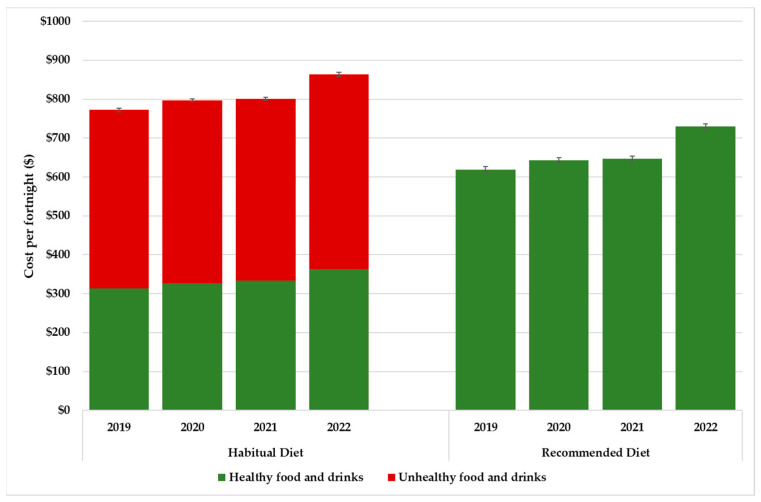
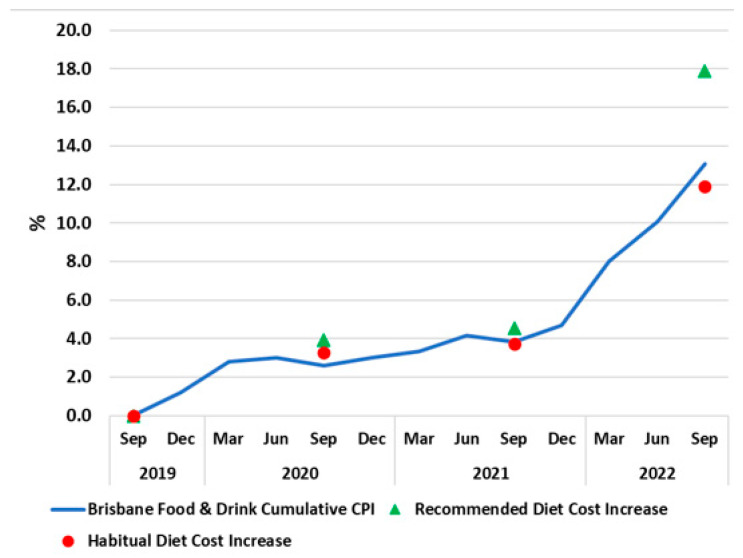
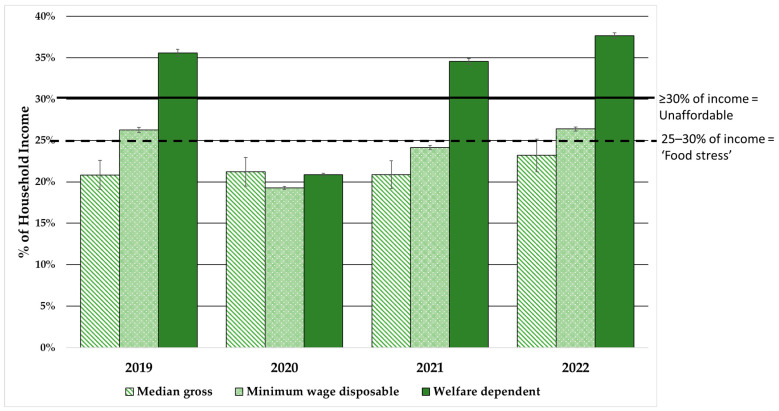
Food prices have escalated due to impacts of the COVID-19 pandemic on global food systems, and other regional shocks and stressors including climate change and war. Few studies have applied a health lens to identify the most affected foods. This study aimed to assess costs and affordability of habitual (unhealthy) diets and recommended (healthy, equitable and more sustainable) diets and their components in Greater Brisbane, Queensland, Australia from 2019 to 2022 using the Healthy Diets Australian Standardised Affordability and Pricing protocol. Affordability was determined for reference households at three levels of income: median, minimum wage, and welfare-dependent. The recommended diet cost increased 17.9%; mostly in the last year when the prices of healthy foods, such as fruit, vegetables and legumes, healthy fats/oils, grains, and meats/alternatives, increased by 12.8%. In contrast, the cost of the unhealthy foods and drinks in the habitual diet 'only' increased 9.0% from 2019 to 2022, and 7.0% from 2021 to 2022. An exception was the cost of unhealthy take-away foods which increased by 14.7% over 2019-2022. With government COVID-19-related payments, for the first time recommended diets were affordable for all and food security and diets improved in 2020. However, the special payments were withdrawn in 2021, and recommended diets became 11.5% less affordable. Permanently increasing welfare support and providing an adequate minimum wage, while keeping basic, healthy foods GST-free and increasing GST to 20% on unhealthy foods, would improve food security and diet-related health inequities. Development of a Consumer Price Index specifically for healthy food would help highlight health risks during economic downturns.
Keywords: Australia; COVID-19; diet affordability; diet cost; food security.
Conflict of interest statement
The authors declare no conflict of interest. The funders had no role in the design of the study; in the collection, analyses, or interpretation of data; in the writing of the manuscript; or in the decision to publish the results.
Figures
References
-
- National Health and Medical Research Council . Australian Dietary Guidelines—Providing the Scientific Evidence for Healthier Australian Diets. National Health and Medical Research Council; Canberra, Australia: 2013.
-
- Australian Bureau of Statistics . Australian Health Survey, National Health Survey, 2011–2012. Australian Bureau of Statistics; Canberra, Australia: 2013.
-
- Australian Bureau of Statistics Overweight and Obesity 2017–18. [(accessed on 24 October 2022)];2022 Available online: https://www.abs.gov.au/statistics/health/health-conditions-and-risks/ove....
-
- Australian Institute of Health and Welfare . Australian Burden of Disease Study: Impact and Causes of Illness and Death in Australia 2018. AIHW; Canberra, Australia: 2021.
Publication types
MeSH terms
LinkOut - more resources
Full Text Sources
Medical
Research Materials
