


Menstrual Cycle and Sport Injuries: A Systematic Review
- PMID: 36833966
- PMCID: PMC9958828
- DOI: 10.3390/ijerph20043264
Menstrual Cycle and Sport Injuries: A Systematic Review
Abstract
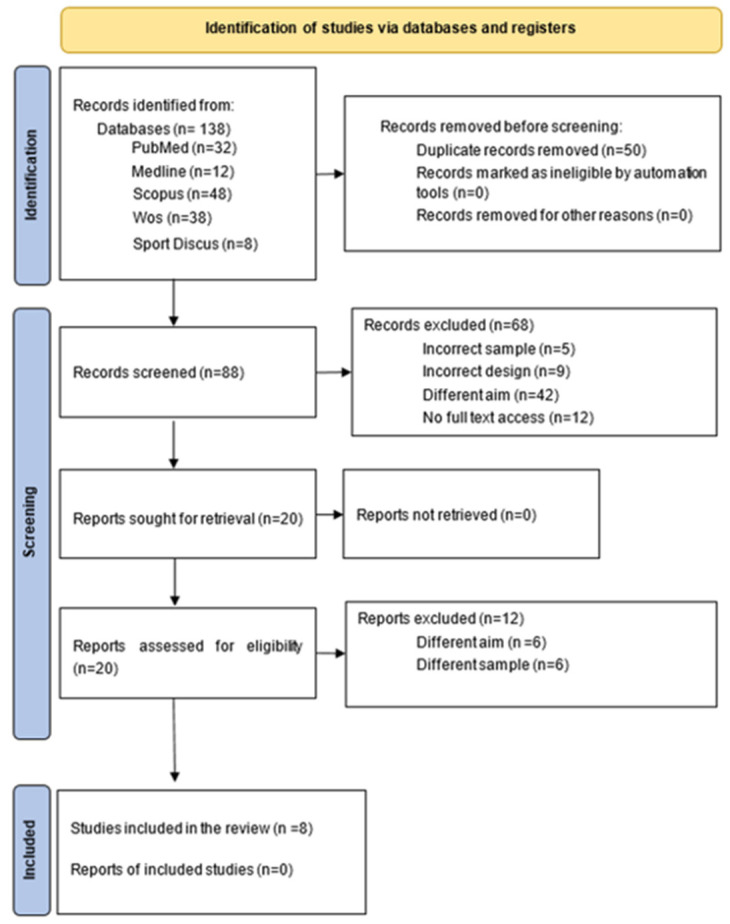
The presence of female athletes has only increased in recent years, as has the incidence of injuries in female sports activities. These injuries are conditioned by multiple factors, including hormonal agents. It is estimated that the menstrual cycle may be related to the predisposition to suffer an injury. However, a causal relationship has not yet been established. The aim of this study was to analyse the relationship between the menstrual cycle and injuries in female sports practice. A systematic search of the scientific literature available in PubMed, Medline, Scopus, Web of Science, and Sport Discus was carried out in January 2022. With 138 articles, only eight studies were found that met the selection criteria for this study. Peak estradiol is associated with increased laxity, strength, and poor use of neuromuscular control. Thus, the ovulatory phase is associated with an increased risk of injury. In conclusion, it seems that hormonal fluctuations throughout the menstrual cycle alter values such as laxity, strength, body temperature, and neuromuscular control, among others. This fact causes women to constantly adapt to hormonal variations, which exposes them to a higher risk of injury.
Keywords: athletes; menstrual cycle; sports; sports injuries.
Conflict of interest statement
The authors declare no conflict of interest.
References
-
- Konovalova E. El ciclo menstrual y el entranmiento deportivo; una mirada al problema. Rev. UDCA Actual. Divulg. Cient. 2013;16:293–302. doi: 10.31910/rudca.v16.n2.2013.900. - DOI
-
- Bonen A., Keizer H.A. Athletic Menstrual Cycle Irregularity: Endocrine Response to Exercise and Training. Phys. Sportsmed. 1984;12:78–94. doi: 10.1080/00913847.1984.11701925. - DOI
-
- Moore K.L., Persaud T.V.N. Embriología Clínica. 9th ed. Elsevier España, S.L.; Barcelona, Spain: 2013. pp. 20–26.
-
- Godoy R.C., Pérez L.F., Curbelo S.T., Bosch N. Fisiología reproductiva femenina: Hormonas sexuales y sus ciclos. BioCancer Res. J. 2004;2:10.
Publication types
MeSH terms
Substances
LinkOut - more resources
Full Text Sources
Medical
Miscellaneous
