


Co-Occurring Conduct Problems and Anxiety: Implications for the Functioning and Treatment of Youth with Oppositional Defiant Disorder
- PMID: 36834097
- PMCID: PMC9962766
- DOI: 10.3390/ijerph20043405
Co-Occurring Conduct Problems and Anxiety: Implications for the Functioning and Treatment of Youth with Oppositional Defiant Disorder
Abstract
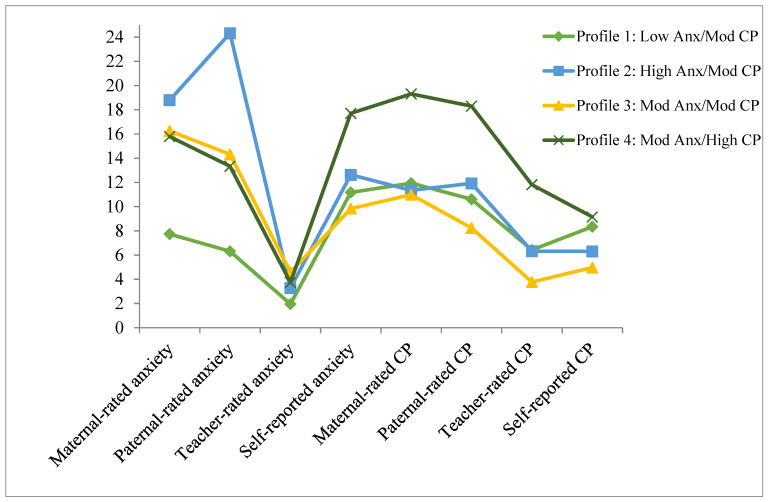
Conduct problems and anxiety symptoms commonly co-occur among youths with oppositional defiant disorder (ODD); however, how these symptoms influence functioning and treatment outcomes remains unclear. This study examined subtypes based on these co-occurring symptoms in a clinical sample of 134 youths (Mage = 9.67, 36.6% female, 83.6% white) with ODD and the predictive power of these subgroups for youth functioning and psychosocial treatment outcomes. The latent profile analysis (LPA) was used to identify subgroups based on parent- and self-reported conduct problems and anxiety symptoms. Differences among the subgroups in clinician-, parent-, and/or self-reported accounts of symptom severity, school performance, underlying processing known to be impaired across ODD, conduct and anxiety disorders, self-concept, and psychosocial treatment outcomes were examined. Four distinct profiles were identified: (1) Low Anxiety/Moderate Conduct Problems (n = 42); (2) High Anxiety/Moderate Conduct Problems (n = 33); (3) Moderate Anxiety/Moderate Conduct Problems (n = 40); and (4) Moderate Anxiety/High Conduct Problems (n = 19). The Moderate Anxiety/High Conduct Problems group exhibited more severe behavioral problems, greater difficulties with negative emotionality, emotional self-control, and executive functioning; they also demonstrated worse long-term treatment outcomes than the other subgroups. These findings suggest more homogeneous subgroups within and across diagnostic categories may result in a deeper understanding of ODD and could inform nosological systems and intervention efforts.
Keywords: anxiety; conduct problems; latent profile analysis; oppositional defiant disorder; subtypes.
Conflict of interest statement
The authors have no conflict of interest to disclose.
Figures
References
-
- American Psychiatric Association . Diagnostic and Statistical Manual of Mental Disorders. 5th ed. American Psychiatric Association; Washington, DC, USA: 2013.
Publication types
MeSH terms
Grants and funding
LinkOut - more resources
Full Text Sources
Medical
Miscellaneous
