


Exercise Promotion in Saudi Arabia: Understanding Personal, Environmental, and Social Determinants of Physical Activity Participation and Well-Being
- PMID: 36834247
- PMCID: PMC9965198
- DOI: 10.3390/ijerph20043554
Exercise Promotion in Saudi Arabia: Understanding Personal, Environmental, and Social Determinants of Physical Activity Participation and Well-Being
Abstract
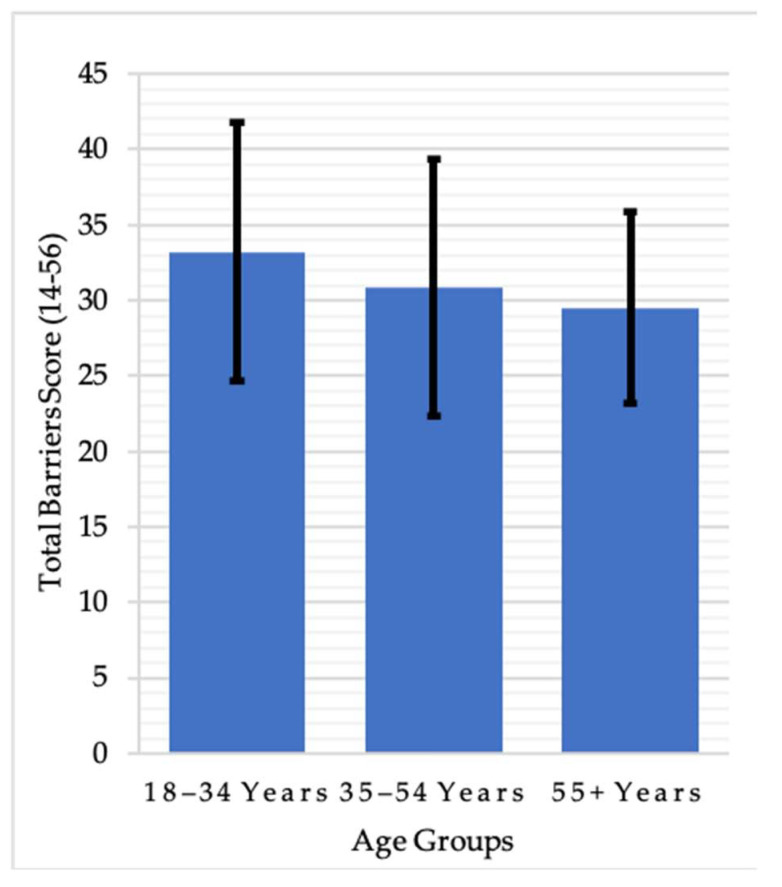
Physical activity promotion has received increasing attention globally due to the considerable benefits of regular activity for population health and well-being. In Saudi Arabia, government strategy explicitly aims to increase physical activity participation among residents. This study assessed the barriers to physical activity among the general Saudi population including any age and gender differences and examined the contribution of contextual factors and nature relatedness to health and well-being. A representative sample of 1046 Saudi adults (aged 18 years and above) completed an online survey that included four validated scales: the International Physical Activity Questionnaire-short form, the Exercise Benefits/Barriers Scale, the World Health Organization Five Well-Being Index and the Nature Relatedness Scale. Analyses indicated that young Saudi adults perceived more barriers than middle-aged and older adults, but few gender differences were observed. Furthermore, exercising outdoors, with other people and via sport predicted higher levels of mental well-being, as did nature relatedness. Therefore, developing a comprehensive strategy package that includes the development of outdoor environments for all age groups across regions and fostering a connection with nature may be particularly effective to improve the health and well-being of Saudi adults.
Keywords: Saudi Arabia; barriers; exercise; health; nature relatedness; physical activity; well-being.
Conflict of interest statement
The authors declare no conflict of interest.
Figures
References
-
- Arem H., Moore S.C., Patel A., Hartge P., Berrington de Gonzalez A., Visvanathan K., Campbell P.T., Freedman M., Weiderpass E., Adami H.O., et al. Leisure time physical activity and mortality: A detailed pooled analysis of the dose-response relationship. JAMA Intern. Med. 2015;175:959–967. doi: 10.1001/jamainternmed.2015.0533. - DOI - PMC - PubMed
-
- Giandonato J.A., Tringali V.M., Thoms R.C. Improving mental health through physical activity: A narrative literature review. Phys. Act. Health. 2021;5:146–153. doi: 10.5334/paah.108. - DOI
-
- Guthold R., Stevens G.A., Riley L.M., Bull F.C., Bull F.C. Worldwide trends in insufficient physical activity from 2001 to 2016: A pooled analysis of 358 population-based surveys with 1·9 million participants. Lancet Glob. Health. 2018;6:e1077–e1086. doi: 10.1016/S2214-109X(18)30357-7. - DOI - PubMed
-
- WHO Global Action Plan on Physical Activity 2018–2030: More Active People for a Healthier World. World Health Organization; Geneva, Switzerland: 2018.
MeSH terms
LinkOut - more resources
Full Text Sources
Medical
