Review
. 2023 Feb 6;24(4):3171.
doi: 10.3390/ijms24043171.

Methyl Donor Micronutrients: A Potential Dietary Epigenetic Target in Systemic Lupus Erythematosus Patients

Affiliations
Review

Methyl Donor Micronutrients: A Potential Dietary Epigenetic Target in Systemic Lupus Erythematosus Patients

Karen Pesqueda-Cendejas et al. Int J Mol Sci. .

Abstract

Systemic lupus erythematosus (SLE) is a chronic autoimmune disease characterized by an aberrant immune response and persistent inflammation. Its pathogenesis remains unknown; however, a complex interaction between environmental, genetic, and epigenetic factors has been suggested to cause disease onset. Several studies have demonstrated that epigenetic alterations, such as DNA hypomethylation, miRNA overexpression, and altered histone acetylation, may contribute to SLE onset and the disease's clinical manifestations. Epigenetic changes, especially methylation patterns, are modifiable and susceptible to environmental factors such as diet. It is well known that methyl donor nutrients, such as folate, methionine, choline, and some B vitamins, play a relevant role in DNA methylation by participating as methyl donors or coenzymes in one-carbon metabolism. Based on this knowledge, this critical literature review aimed to integrate the evidence in animal models and humans regarding the role of nutrients in epigenetic homeostasis and their impact on immune system regulation to suggest a potential epigenetic diet that could serve as adjuvant therapy in SLE.

Keywords: DNA methylation; epigenetic diet; histone modifications; methyl donor nutrients; miRNAs; systemic lupus erythematosus.


Conflict of interest statement

The authors declare no conflict of interest. Figure 1 and Figure 2 were created with BioRender software, ©biorender.com. “Figure 3 was created using SankeyMATIC online tool”.

Figures
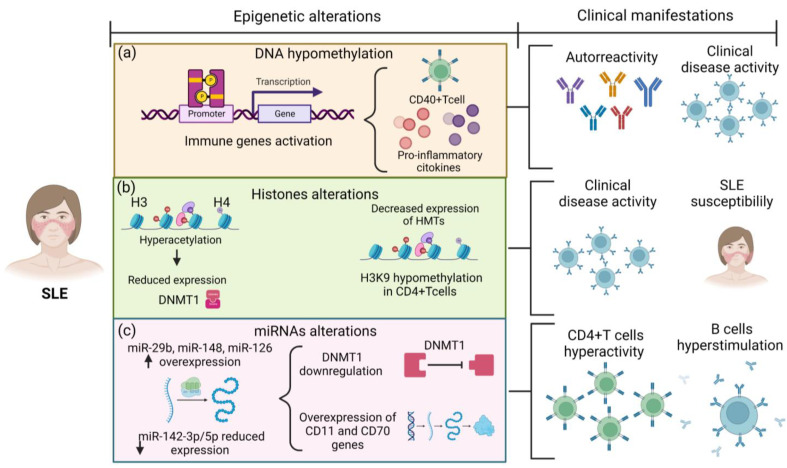
Figure 1
Figure 1
Epigenetic alterations in the pathophysiology of SLE. (a) SLE patients present epigenetic alterations as DNA hypomethylation of immune-related genes promoting immune cell overexpression and pro-inflammatory cytokine overproduction, which is associated with autoreactivity and clinical disease activity on SLE. 1. Red circles: Interleukins-13; Purple circles: Interleukins-10. (b) H3 and H4 histone hyperacetylation reduces DNMT1 expression; additionally, H3K9 hypomethylation in CD4+ T cells is associated with clinical disease activity and SLE susceptibility. (c) The overexpression of miR-29, miR-148, and miR-126 induces DNMT1 downregulation; in contrast, reduced expression of miR-142-3p/5p promote overexpression of CD11 and CD70 genes. These miRNA disturbances result in CD4+ T cell hyperactivity and B cell hyperstimulation. SLE: systemic lupus erythematosus patients; DNMT1: DNA methyltransferase.
Figure 2
Figure 2
The role of the diet in epigenetic changes. Nutrients have a role in epigenetic modifications. (a) B vitamins and choline donate methyl groups to promote DNA methylation and could reduce the expression of immune-related genes and subsequently reduce cytokine overproduction. (b) Fatty acids stimulate DNMT1 expression, which could compensate for the downregulation of DNMT1 in SLE patients. (c) The methionine intake reduces hydroxymethylation a step before demethylation. Altogether, these mechanisms promote epigenetic homeostasis. Therefore, a healthy epigenetic diet that provides an adequate amount of these nutrients acts as an adjuvant therapy for SLE. SLE: systemic lupus erythematosus. DNMT1: DNA methyltransferase 1.
Figure 3
Figure 3
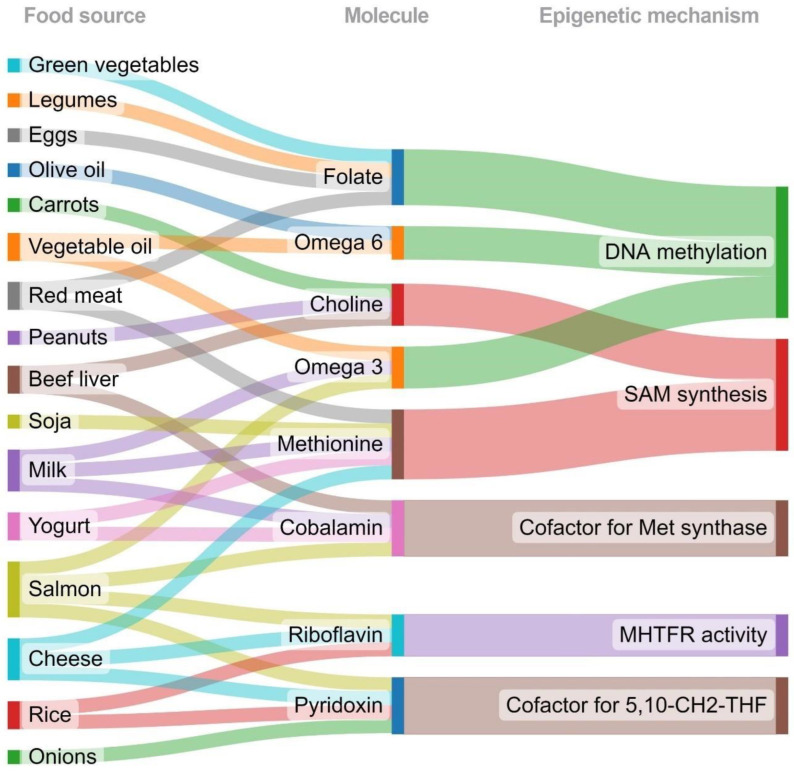
Food sources of molecules involved in epigenetic mechanisms. This diagram graphically illustrates the relationships between the different studies and their characteristics. The nodes’ food sources, molecules, and epigenetic mechanisms show the study characteristics that were compared between the studies. The rainbow lines between the bars reflect the congruencies and differences between the different studies. The wider the gray connection lines, the more congruency that exists. MTHFR: methylenetetrahydrofolate reductase; SAM: S-adenosyl methionine; 5,10-CH2-THF: 5,10 methylenetetrahydrofolate.

References

    1. Montoya T., Castejón M.L., Muñoz-García R., Alarcón-de-la-Lastra C. Epigenetic linkage of systemic lupus erythematosus and nutrition. Nutr. Res. Rev. 2021;16:1–21. - PubMed
    1. Kaul A., Gordon C., Crow M.K., Touma Z., Urowitz M.B., Van Vollenhoven R., Ruiz-Irastorza G., Hughes G. Systemic lupus erythematosus. Nat. Rev. Dis. Prim. 2016;2:16039. doi: 10.1038/nrdp.2016.39. - DOI - PubMed
    1. Oku K., Atsumi T. Systemic lupus erythematosus: Nothing stale her infinite variety. Mod. Rheumatol. 2018;28:758–765. doi: 10.1080/14397595.2018.1494239. - DOI - PubMed
    1. Pons-Estel G.J., Alarcón G.S., Scofield L., Reinlib L., Cooper G.S. Understanding the Epidemiology and Progression of Systemic Lupus Erythematosus. Semin. Arthritis Rheum. 2010;39:257–268. doi: 10.1016/j.semarthrit.2008.10.007. - DOI - PMC - PubMed
    1. Renaudineau Y., Youinou P. Epigenetics and Autoimmunity, with Special Emphasis on Methylation. Keio J. Med. 2011;60:10–16. doi: 10.2302/kjm.60.10. - DOI - PubMed