


Genome-Wide Characterization and Analysis of bHLH Transcription Factors Related to Anthocyanin Biosynthesis in Cinnamomum camphora ('Gantong 1')
- PMID: 36834907
- PMCID: PMC9959432
- DOI: 10.3390/ijms24043498
Genome-Wide Characterization and Analysis of bHLH Transcription Factors Related to Anthocyanin Biosynthesis in Cinnamomum camphora ('Gantong 1')
Abstract
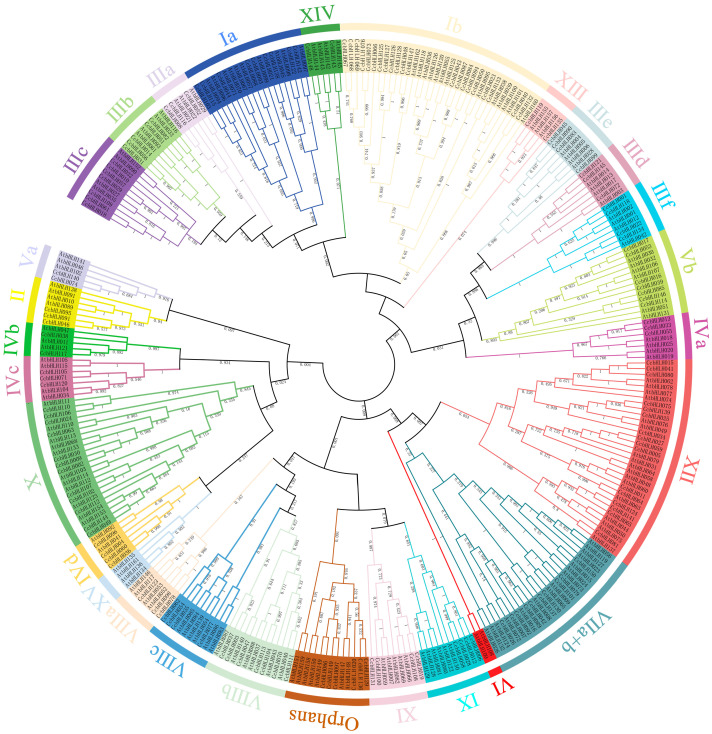
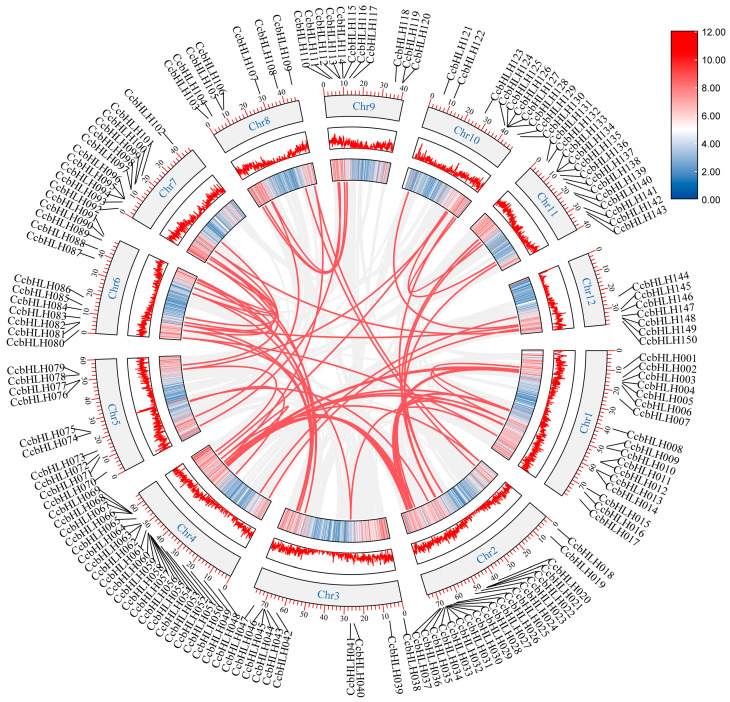
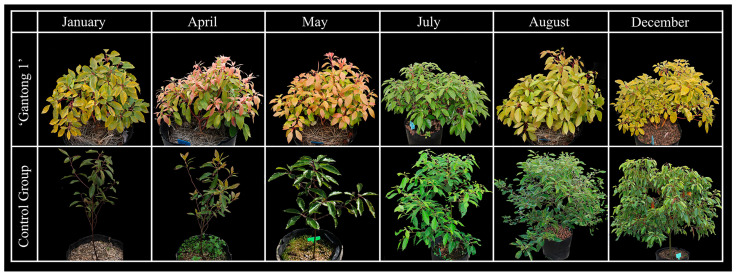
Cinnamomum camphora is one of the most commonly used tree species in landscaping. Improving its ornamental traits, particularly bark and leaf colors, is one of the key breeding goals. The basic helix-loop-helix (bHLH) transcription factors (TFs) are crucial in controlling anthocyanin biosynthesis in many plants. However, their role in C. camphora remains largely unknown. In this study, we identified 150 bHLH TFs (CcbHLHs) using natural mutant C. camphora 'Gantong 1', which has unusual bark and leaf colors. Phylogenetic analysis revealed that 150 CcbHLHs were divided into 26 subfamilies which shared similar gene structures and conserved motifs. According to the protein homology analysis, we identified four candidate CcbHLHs that were highly conserved compared to the TT8 protein in A. thaliana. These TFs are potentially involved in anthocyanin biosynthesis in C. camphora. RNA-seq analysis revealed specific expression patterns of CcbHLHs in different tissue types. Furthermore, we verified expression patterns of seven CcbHLHs (CcbHLH001, CcbHLH015, CcbHLH017, CcbHLH022, CcbHLH101, CcbHLH118, and CcbHLH134) in various tissue types at different growth stages using qRT-PCR. This study opens a new avenue for subsequent research on anthocyanin biosynthesis regulated by CcbHLH TFs in C. camphora.
Keywords: Cinnamomum camphora; RNA sequencing; anthocyanin; basic helix–loop–helix (bHLH) transcription factors; collinearity analysis.
Conflict of interest statement
The authors declare no conflict of interest.
Figures


References
-
- Zhong Y., Yang A., Li Z., Zhang H., Liu L., Wu Z., Li Y., Liu T., Xu M., Yu F. Genetic Diversity and Population Genetic Structure of Cinnamomum camphora in South China Revealed by EST-SSR Markers. Forests. 2019;10:1019. doi: 10.3390/f10111019. - DOI
-
- Miller R., Owens S.J., Rørslett B. Plants and colour: Flowers and pollination. Opt. Laser Technol. 2011;43:282–294. doi: 10.1016/j.optlastec.2008.12.018. - DOI
-
- Zhong Y., Chen C., Gong X., Luan X., Wu Z., Li H., Liu Q., Xu M., Yu F. Transcriptome and metabolome analyses reveal a key role of the anthocyanin biosynthetic pathway cascade in the pigmentation of a Cinnamomum camphora red bark mutant (‘Gantong 1’) Ind. Crops Prod. 2022;175:114236. doi: 10.1016/j.indcrop.2021.114236. - DOI
-
- Pang Q., Yu W., Ehsan S., Chen X., Hong P., Tariq P., Ren Y., Zhang Y., Dong T., Jia H., et al. Omic analysis of anthocyanin synthesis in wine grape leaves under low-temperature. Sci. Hortic. 2022;307:111483. doi: 10.1016/j.scienta.2022.111483. - DOI
-
- Lin Y., Fan L., He J., Wang Z., Yin Y., Cheng Y., Li Z. Anthocyanins contribute to fruit defense against postharvest green mold. Postharvest Biol. Technol. 2021;181:111661. doi: 10.1016/j.postharvbio.2021.111661. - DOI
MeSH terms
Substances
Grants and funding
- No. 32060354 and 31860079/the National Natural Science Foundation of China
- 2021YSBG10002/the Key Industrial Technology Research Project of Jiangxi Academy of Sciences
- 20203ABC28W016/the Important S & T Specific Projects of Jiangxi Provincial Department of Science and Technology
- 2021YSBG22015/the Key R&D Project of Jiangxi Academy of Sciences
LinkOut - more resources
Full Text Sources
