


Effects of Estradiol/Micronized Progesterone vs. Conjugated Equine Estrogens/Medroxyprogesterone Acetate on Breast Cancer Gene Expression in Healthy Postmenopausal Women
- PMID: 36835533
- PMCID: PMC9959219
- DOI: 10.3390/ijms24044123
Effects of Estradiol/Micronized Progesterone vs. Conjugated Equine Estrogens/Medroxyprogesterone Acetate on Breast Cancer Gene Expression in Healthy Postmenopausal Women
Abstract
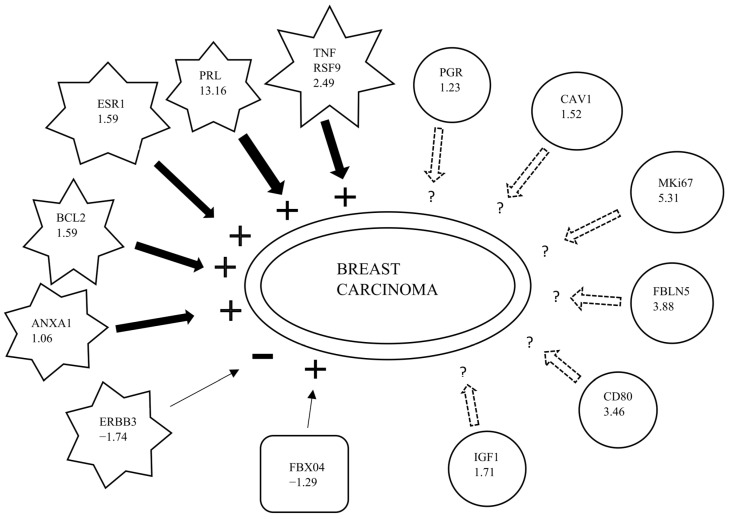
Recent studies suggest estradiol (E2)/natural progesterone (P) confers less breast cancer risk compared with conjugated equine estrogens (CEE)/synthetic progestogens. We investigate if differences in the regulation of breast cancer-related gene expression could provide some explanation. This study is a subset of a monocentric, 2-way, open observer-blinded, phase 4 randomized controlled trial on healthy postmenopausal women with climacteric symptoms (ClinicalTrials.gov; EUCTR-2005/001016-51). Study medication was two 28-day cycles of sequential hormone treatment with oral 0.625 mg CEE and 5 mg of oral medroxyprogesterone acetate (MPA) or 1.5 mg E2 as percutaneous gel/day with the addition of 200 mg oral micronized P. MPA and P were added days 15-28/cycle. Material from two core-needle breast biopsies in 15 women in each group was subject to quantitative PCR (Q-PCR). The primary endpoint was a change in breast carcinoma development gene expression. In the first eight consecutive women, RNA was extracted at baseline and after two months of treatment and subjected to microarray for 28856 genes and Ingenuity Pathways Analysis (IPA) to identify risk factor genes. Microarray analysis showed 3272 genes regulated with a fold-change of >±1.4. IPA showed 225 genes belonging to mammary-tumor development function: 198 for CEE/MPA vs. 34 for E2/P. Sixteen genes involved in mammary tumor inclination were subject to Q-PCR, inclining the CEE/MPA group towards an increased risk for breast carcinoma compared to the E2/P group at a very high significance level (p = 3.1 × 10⁻⁸, z-score 1.94). The combination of E2/P affected breast cancer-related genes much less than CEE/MPA.
Keywords: breast cancer gene expression; conjugated equine estrogens/medroxyprogesterone acetate; core needle biopsies; estradiol/micronized progesterone; healthy postmenopausal women; menopausal hormone treatment and breast cancer risk.
Conflict of interest statement
P.G.L.L. Lalitkumar has received consulting fees from IVF access, India. No disclosures were reported by the other authors.
Figures
References
-
- Rossouw J.E., Anderson G.L., Prentice R.L., LaCroix A.Z., Kooperberg C., Stefanick M.L., Jackson R.D., Beresford S.A.A., Howard B.V., Johnsin K.C., et al. Writing Group for the Women’s Health Initiative Investigators. Risks and benefits of estrogen plus progestin in healthy postmenopausal women: Principal results from the Women’s Health Initiative randomized controlled trial. JAMA. 2002;288:321–333. - PubMed
-
- Weiss L.K., Burkman R.T., Cushing-Haugen K.L., Voigt L.F., Simon M.S., Daling J.R. Hormone Replacement Therapy Regimens and Breast Cancer Risk. Obstet. Gynecol. 2002;100:1148–1158. - PubMed
-
- Chlebowski R.T., Hendrix S.L., Langer R.D., Stefanik M.L., Gass M., Lane D., Rodabough R.J., Gilligan M.A., Cyr M.G., Thomson C.A., et al. Influence of Estrogen Plus Progestin on Breast Cancer and Mammography in Healthy Postmenopausal Women. The Women’s Initiative Randomized Trial. JAMA. 2003;289:3243–3353. doi: 10.1001/jama.289.24.3243. - DOI - PubMed
-
- Manson J.E., Chlebowski R.T., Stefanick M.L., Aragaki A.K., Rossouw J.E., Prentice R.L., Anderson G., Howard B.V., Thomson C.A., LaCroix A.Z., et al. Menopausal hormone therapy and health outcomes during the intervention and extended post-stopping phases of the Women’s Health Initiative randomized trials. JAMA. 2013;310:1353–1368. doi: 10.1001/jama.2013.278040. - DOI - PMC - PubMed
Publication types
MeSH terms
Substances
LinkOut - more resources
Full Text Sources
Medical
