


Thermal Oviposition Performance of the Ladybird Stethorus gilvifrons Preying on Two-Spotted Spider Mites
- PMID: 36835768
- PMCID: PMC9959168
- DOI: 10.3390/insects14020199
Thermal Oviposition Performance of the Ladybird Stethorus gilvifrons Preying on Two-Spotted Spider Mites
Abstract
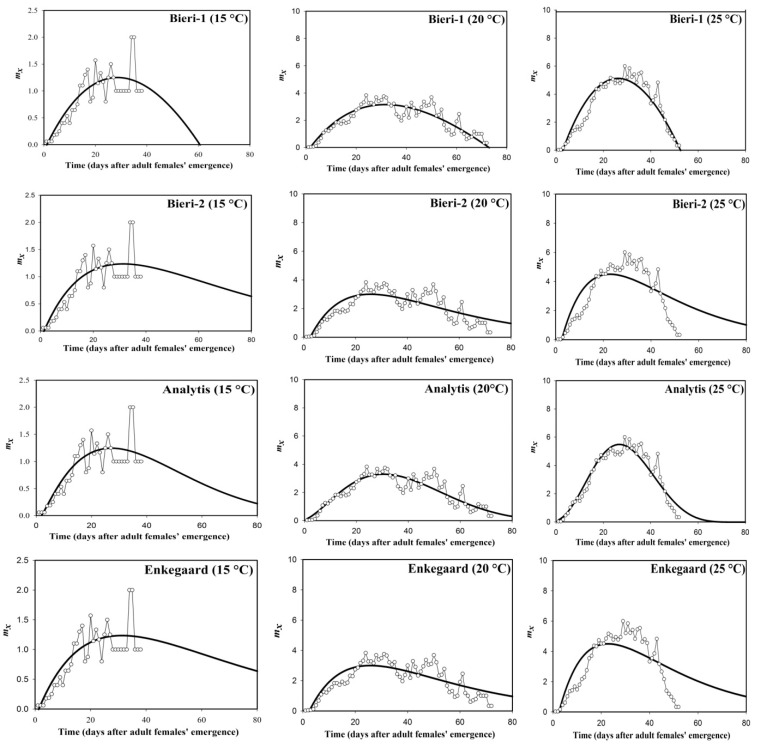
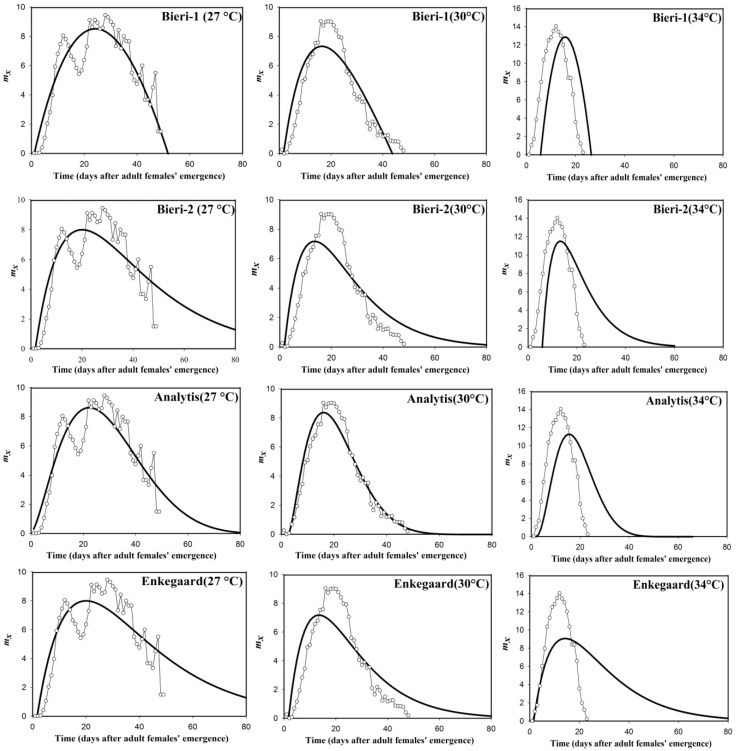
The ladybird, Stethorus gilvifrons (Mulsant) (Coleoptera: Coccinellidae), is an important predator of two-spotted spider mites, Tetranychus urticae Koch (Acari: Tetranychidae), in southeastern Europe and western and southwestern Asia, such as Iran, India, and Turkey. To enhance forecasting the occurrence and performance of this predator in natural control and improve its usage in biological control, we evaluated and compared four non-linear oviposition models, i.e., Enkegaard, Analytis, Bieri-1, and Bieri-2. The models were validated by using data of age-specific fecundity of female S. gilvifrons at six constant temperatures (15, 20, 25, 27, 30, and 34 °C). All four models provided good fit quality to age-dependent oviposition at 15 to 30 °C (R2 0.67 to 0.94; R2adj 0.63 to 0.94) but had a poor fit at 34 °C (R2 0.33 to 0.40; R2adj 0.17 to 0.34). Within temperatures, the best performing models were Bieri-1 (R2), Bieri-2 (R2adj), and Analytis (RSS) at 15 °C, Bieri-1 at 27 °C, and Analytis at 20, 25, and 30 °C. Analytis was the best suited model across the wide temperature range tested (from 15 to 30 °C). The models presented here allow for prediction of the population dynamics of S. gilvifrons in field and greenhouse crops in temperate and subtropical climates.
Keywords: Stethorus gilvifrons; Tetranychus urticae; fecundity; non-linear modeling; temperature.
Conflict of interest statement
The authors declare no conflict of interest.
Figures
References
-
- Jeppson L.R., Keifer H.H., Baker E.W. Mites Injurious to Economic Plants. University of California Press; Berkeley, CA, USA: 1975.
-
- Mossadegh M.S., Kocheili F. A Semi Descriptive Checklist of Identified Species of Arthropods (Agricultural, Medical) and Other Pests from Khuzestan, Iran. Shahid Chamran University Press; Ahvaz, Iran: 2003.
-
- Helle W., Sabelis M.W. Spider Mites: Their Biology, Natural Enemies, and Control, Volume 1A. Elsevier; Amsterdam, The Netherlands: 1985.
-
- Knapp M., van Houten Y., van Baal E., Groot T. Use of predatory mites in commercial biocontrol: Current status and future prospects. Acarologia. 2018;58:72–82. doi: 10.24349/acarologia/20184275. - DOI
Grants and funding
LinkOut - more resources
Full Text Sources
Medical
