


Research on Establishing Corneal Edema after Phacoemulsification Prediction Model Based on Variable Selection with Copula Entropy
- PMID: 36835826
- PMCID: PMC9963919
- DOI: 10.3390/jcm12041290
Research on Establishing Corneal Edema after Phacoemulsification Prediction Model Based on Variable Selection with Copula Entropy
Abstract
Background: Corneal edema (CE) affects the outcome of phacoemulsification. Effective ways to predict the CE after phacoemulsification are needed.
Methods: On the basis of data from patients conforming to the protocol of the AGSPC trial, 17 variables were selected to predict CE after phacoemulsification by constructing a CE nomogram through multivariate logistic regression, which was improved via variable selection with copula entropy. The prediction models were evaluated using predictive accuracy, the area under the receiver operating characteristic curve (AUC), and decision curve analysis (DCA).
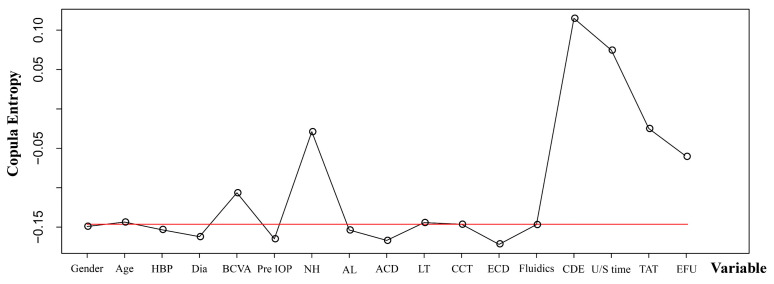
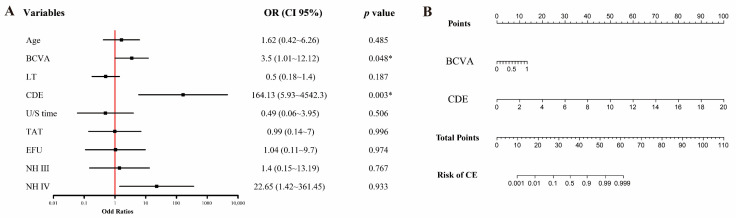
Results: Data from 178 patients were used to construct prediction models. After copula entropy variable selection, which shifted the variables used for prediction in the CE nomogram from diabetes, best corrected visual acuity (BCVA), lens thickness and cumulative dissipated energy (CDE) to CDE and BCVA in the Copula nomogram, there was no significant change in predictive accuracy (0.9039 vs. 0.9098). There was also no significant difference in AUCs between the CE nomogram and the Copula nomogram (0.9637, 95% CI 0.9329-0.9946 vs. 0.9512, 95% CI 0.9075-0.9949; p = 0.2221). DCA suggested that the Copula nomogram has clinical application.
Conclusions: This study obtained a nomogram with good performance to predict CE after phacoemulsification, and showed the improvement of copula entropy for nomogram models.
Keywords: copula entropy; corneal edema; nomogram; phacoemulsification; prediction model.
Conflict of interest statement
The authors declare no conflict of interest.
Figures


References
-
- Lundstrom M., Barry P., Henry Y., Rosen P., Stenevi U. Evidence-based guidelines for cataract surgery: Guidelines based on data in the European registry of quality outcomes for cataract and refractive surgery database. J. Cataract. Refract. Surg. 2012;38:1086–1093. doi: 10.1016/j.jcrs.2012.03.006. - DOI - PubMed
-
- de Silva S.R., Riaz Y., Evans J.R. Phacoemulsification with posterior chamber intraocular lens versus extracapsular cataract extraction (ECCE) with posterior chamber intraocular lens for age-related cataract. Cochrane Database Syst. Rev. 2014:CD008812. doi: 10.1002/14651858.CD008812.pub2. - DOI - PMC - PubMed
-
- Sorrentino F.S., Matteini S., Imburgia A., Bonifazzi C., Sebastiani A., Parmeggiani F. Torsional phacoemulsification: A pilot study to revise the “harm scale” evaluating the endothelial damage and the visual acuity after cataract surgery. PLoS ONE. 2017;12:e0186975. doi: 10.1371/journal.pone.0186975. - DOI - PMC - PubMed
Grants and funding
LinkOut - more resources
Full Text Sources
