


A Landscape of the Genomic Structure of Cryptococcus neoformans in Colombian Isolates
- PMID: 36836249
- PMCID: PMC9959405
- DOI: 10.3390/jof9020135
A Landscape of the Genomic Structure of Cryptococcus neoformans in Colombian Isolates
Abstract
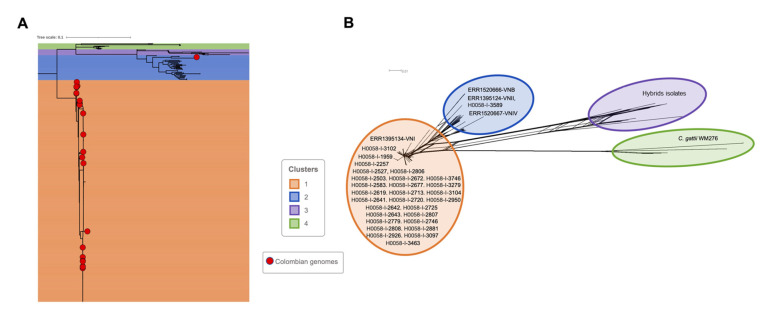
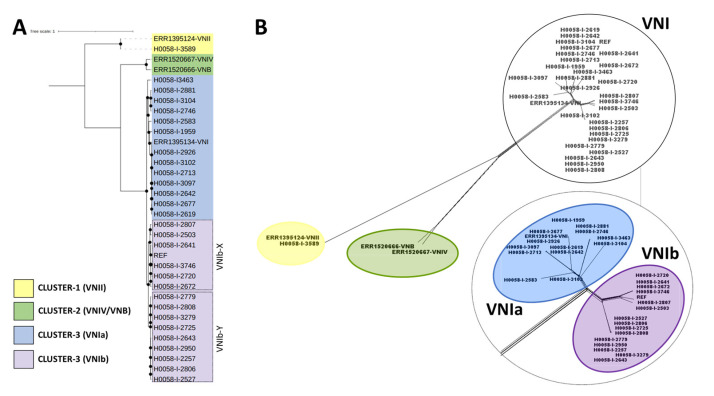
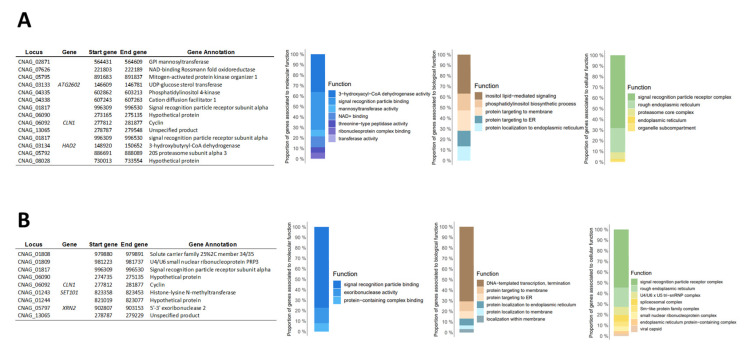
Cryptococcus neoformans species complexes are recognized as environmental fungi responsible for lethal meningoencephalitis in immunocompromised individuals. Despite the vast knowledge about the epidemiology and genetic diversity of this fungus in different regions of the world, more studies are necessary to comprehend the genomic profiles across South America, including Colombia, considered to be the second country with the highest number of Cryptococcosis. Here, we sequenced and analyzed the genomic architecture of 29 Colombian C. neoformans isolates and evaluated the phylogenetic relationship of these strains with publicly available C. neoformans genomes. The phylogenomic analysis showed that 97% of the isolates belonged to the VNI molecular type and the presence of sub-lineages and sub-clades. We evidenced a karyotype without changes, a low number of genes with copy number variations, and a moderate number of single-nucleotide polymorphisms (SNPs). Additionally, a difference in the number of SNPs between the sub-lineages/sub-clades was observed; some were involved in crucial fungi biological processes. Our study demonstrated the intraspecific divergence of C. neoformans in Colombia. These findings provide evidence that Colombian C. neoformans isolates do not probably require significant structural changes as adaptation mechanisms to the host. To the best of our knowledge, this is the first study to report the whole genome sequence of Colombian C. neoformans isolates.
Keywords: CNV; Cryptococcus neoformans; SNP; whole genome sequencing.
Conflict of interest statement
The authors declare no conflict of interest.
Figures
Similar articles
-
Genomic Diversification, Structural Plasticity, and Hybridization in Leishmania (Viannia) braziliensis.Front Cell Infect Microbiol. 2020 Oct 16;10:582192. doi: 10.3389/fcimb.2020.582192. eCollection 2020. Front Cell Infect Microbiol. 2020. PMID: 33178631 Free PMC article.
-
Identification of novel hybrids between Cryptococcus neoformans var. grubii VNI and Cryptococcus gattii VGII.Mycopathologia. 2012 Jun;173(5-6):337-46. doi: 10.1007/s11046-011-9491-x. Epub 2011 Nov 13. Mycopathologia. 2012. PMID: 22081254
-
Intraspecific Genomic Divergence and Minor Structural Variations in Leishmania (Viannia) panamensis.Genes (Basel). 2020 Feb 27;11(3):252. doi: 10.3390/genes11030252. Genes (Basel). 2020. PMID: 32120946 Free PMC article.
-
Cryptococcus neoformans and Cryptococcus gattii Species Complexes in Latin America: A Map of Molecular Types, Genotypic Diversity, and Antifungal Susceptibility as Reported by the Latin American Cryptococcal Study Group.J Fungi (Basel). 2021 Apr 9;7(4):282. doi: 10.3390/jof7040282. J Fungi (Basel). 2021. PMID: 33918572 Free PMC article. Review.
-
Importance of Clinical Isolates in Cryptococcus neoformans Research.J Fungi (Basel). 2023 Mar 16;9(3):364. doi: 10.3390/jof9030364. J Fungi (Basel). 2023. PMID: 36983532 Free PMC article. Review.
Cited by
-
Outbreaks of Fungal Infections in Hospitals: Epidemiology, Detection, and Management.J Fungi (Basel). 2023 Oct 29;9(11):1059. doi: 10.3390/jof9111059. J Fungi (Basel). 2023. PMID: 37998865 Free PMC article. Review.
References
-
- Rajasingham R., Smith R.M., Park B.J., Jarvis J.N., Govender N.P., Chiller T.M., Denning D.W., Loyse A., Boulware D.R. Global burden of disease of HIV-associated cryptococcal meningitis: An updated analysis. Lancet Infect. Dis. 2017;17:873–881. doi: 10.1016/S1473-3099(17)30243-8. - DOI - PMC - PubMed
-
- Firacative C., Meyer W., Castaneda E. Cryptococcus neoformans and Cryptococcus gattii Species Complexes in Latin America: A Map of Molecular Types, Genotypic Diversity, and Antifungal Susceptibility as Reported by the Latin American Cryptococcal Study Group. J. Fungi. 2021;7:282. doi: 10.3390/jof7040282. - DOI - PMC - PubMed
Grants and funding
LinkOut - more resources
Full Text Sources
