Review
. 2023 Jan 30;13(2):377.
doi: 10.3390/life13020377.

Current Views on Infective Endocarditis: Changing Epidemiology, Improving Diagnostic Tools and Centering the Patient for Up-to-Date Management

Affiliations
Review

Current Views on Infective Endocarditis: Changing Epidemiology, Improving Diagnostic Tools and Centering the Patient for Up-to-Date Management

Giovanni Cimmino et al. Life (Basel). .

Abstract

Infective endocarditis (IE) is a rare but potentially life-threatening disease, sometimes with longstanding sequels among surviving patients. The population at high risk of IE is represented by patients with underlying structural heart disease and/or intravascular prosthetic material. Taking into account the increasing number of intravascular and intracardiac procedures associated with device implantation, the number of patients at risk is growing too. If bacteremia develops, infected vegetation on the native/prosthetic valve or any intracardiac/intravascular device may occur as the final result of invading microorganisms/host immune system interaction. In the case of IE suspicion, all efforts must be focused on the diagnosis as IE can spread to almost any organ in the body. Unfortunately, the diagnosis of IE might be difficult and require a combination of clinical examination, microbiological assessment and echocardiographic evaluation. There is a need of novel microbiological and imaging techniques, especially in cases of blood culture-negative. In the last few years, the management of IE has changed. A multidisciplinary care team, including experts in infectious diseases, cardiology and cardiac surgery, namely, the Endocarditis Team, is highly recommended by the current guidelines.

Keywords: antibiotics; imaging technique; infection; multidisciplinary team.


Conflict of interest statement

The authors declare no conflict of interest.

Figures
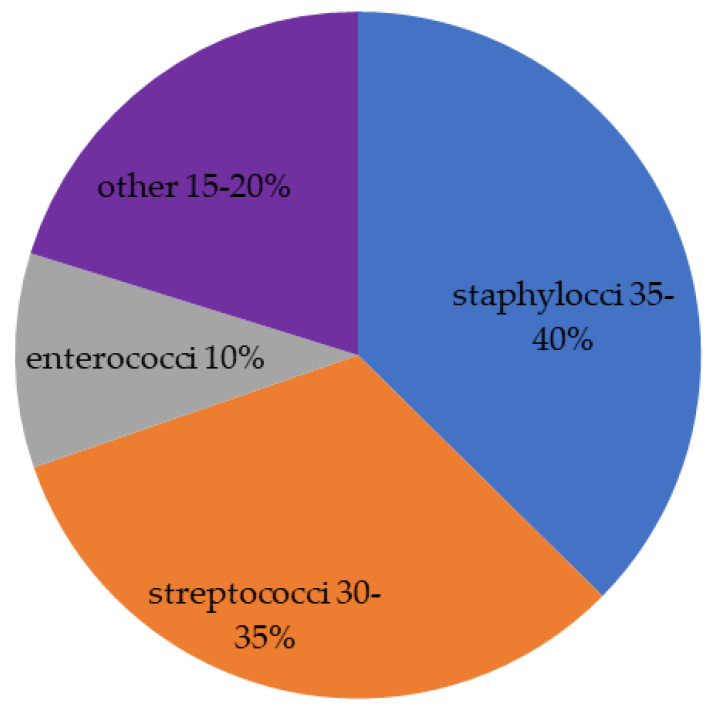
Figure 1
Figure 1
Distribution of pathogens mainly involved in IE. The last group includes HACEK group (2%), fungi, polymicrobial infection and, rarely, aerobic Gram-negative bacilli.
Figure 2
Figure 2
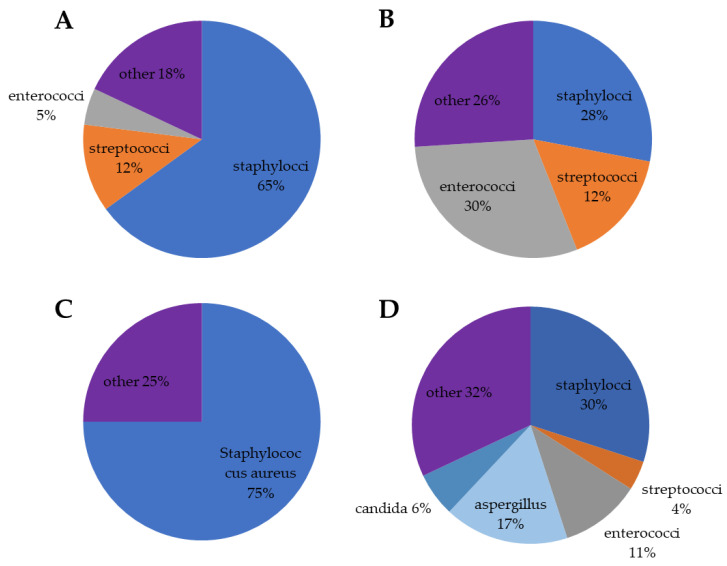
Distribution of pathogens in different clinical settings. (A) cardiac device related-infective endocarditis; the other group includes Candida spp., other fungi, Gram-negative bacilli and polymicrobial. (B) transcatheter aortic valve implantation (TAVI); the other group includes Gram-negative bacille, Moraxella, candida albicans, Histoplasma and corynebacterium. (C) right-sided infective endocarditis; the other group includes streptococci, coagulase-negative staphylococcal, pseudomonas aeruginosa and fungi. (D) immunosuppressive therapy in solid organ transplantation; the other group includes Gram-negative bacilli, Corynebacteria, Clostridium ramosum, Pseudallescheria boydii, Nocardia asteroids and Polymicrobial.
Figure 3
Figure 3
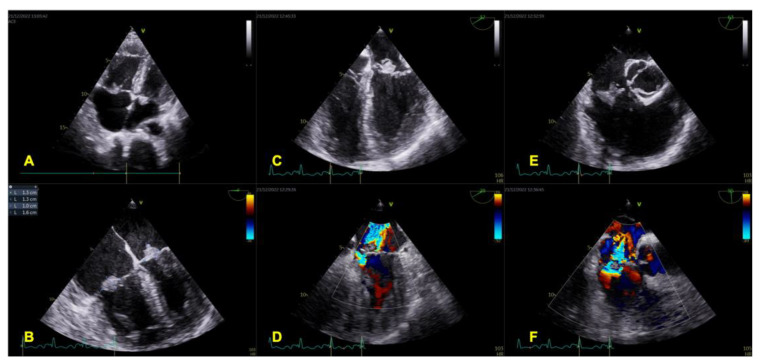
IE of both tricuspid and mitral valve. Vegetations are well-imaged by TTE, which is the first imaging tool in diagnosing IE (A). Their presence, size and location are confirmed by TOE (B,C,E). Both vegetations are associated with significant valve regurgitations (D,F). IE: infective endocarditis; TTE: transthoracic echocardiography; TOE: transesophageal echocardiography.
Figure 4
Figure 4
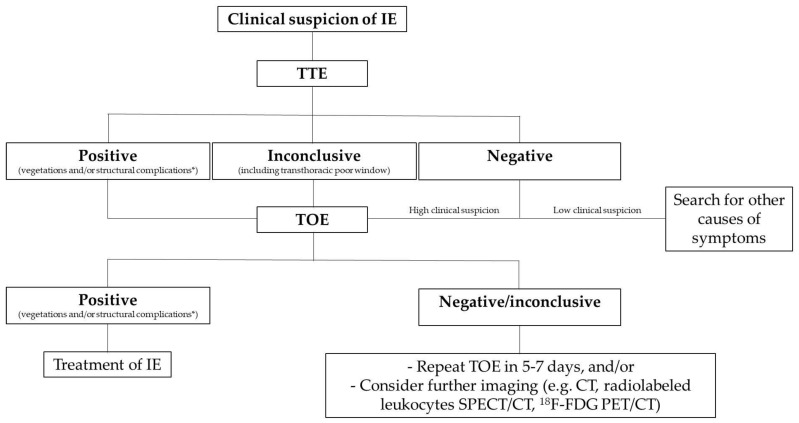
Diagnostic imaging tools in suspected IE. Structural complications include abscess, pseudoaneurysm, intracardiac fistula, valvular perforation or aneurysm and new dehiscence of prosthetic valve. CT: computed tomography; FDG: fluorodeoxyglucose; IE: infective endocarditis; PET: positron emission tomography; SPECT: single photon emission computed tomography; TOE: transesophageal echocardiography; TTE: transthoracic echocardiography.
Figure 5
Figure 5
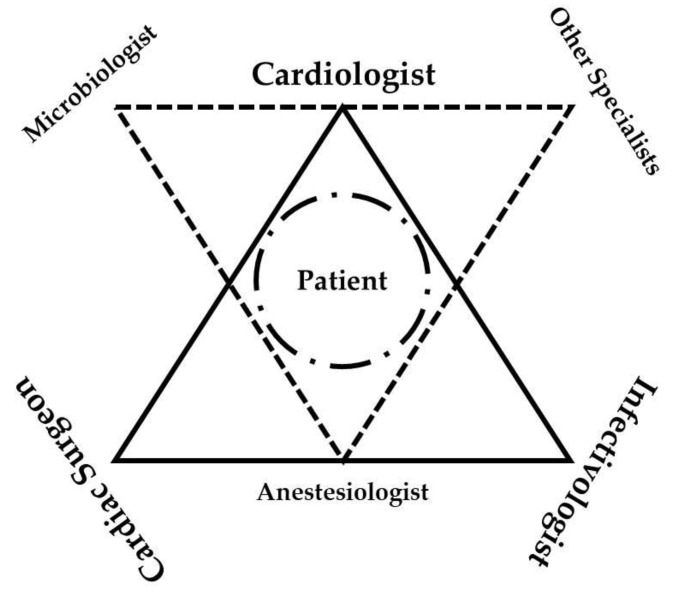
Schematic view of Endocarditis Team. The continuous line indicates the main specialists involved in the decision-making process where the patient is in the center. Discontinuous line indicates the other medical specialists that might be involved according to the single case.

Similar articles

Cited by

References

    1. Iung B., Duval X. Infective endocarditis: Innovations in the management of an old disease. Nature reviews. Cardiology. 2019;16:623–635. doi: 10.1038/s41569-019-0215-0. - DOI - PubMed
    1. Habib G. Infective Endocarditis After Transcatheter Aortic Valve Replacement: The Worst That Can Happen. J. Am. Heart Assoc. 2018;7:e010287. doi: 10.1161/JAHA.118.010287. - DOI - PMC - PubMed
    1. Cimmino G., Ciccarelli G., Golino M., D’Amico C., Golino P. A Fatal Case of Endocarditis on CoreValve ReValving System Caused by Enterococcus faecium Complicated by Iatrogenic Pancytopenia and Subacute Disseminated Intravascular Coagulation. J. Heart Valve Dis. 2015;24:130–132. - PubMed
    1. Habib G., Lancellotti P., Antunes M.J., Bongiorni M.G., Casalta J.P., Del Zotti F., Dulgheru R., El Khoury G., Erba P.A., Iung B., et al. 2015 ESC Guidelines for the management of infective endocarditis: The Task Force for the Management of Infective Endocarditis of the European Society of Cardiology (ESC). Endorsed by: European Association for Cardio-Thoracic Surgery (EACTS), the European Association of Nuclear Medicine (EANM) Eur. Heart J. 2015;36:3075–3128. doi: 10.1093/eurheartj/ehv319. - DOI - PubMed
    1. Diab M., Franz M., Hagel S., Guenther A., Struve A., Musleh R., Penzel A., Sponholz C., Lehmann T., Kuehn H., et al. Impact of an In-Hospital Endocarditis Team and a State-Wide Endocarditis Network on Perioperative Outcomes. J. Clin. Med. 2021;10:4734. doi: 10.3390/jcm10204734. - DOI - PMC - PubMed

LinkOut - more resources