. 2023 Feb 14;13(2):524.
doi: 10.3390/life13020524.

Suppression of the HOS1 Gene Affects the Level of ROS Depending on Light and Cold

Affiliations

Suppression of the HOS1 Gene Affects the Level of ROS Depending on Light and Cold

Tatiana Y Gorpenchenko et al. Life (Basel). .

Abstract

The E3 ubiquitin-protein ligase HOS1 is an important integrator of temperature information and developmental processes. HOS1 is a negative regulator of plant cold tolerance, and silencing HOS1 leads to increased cold tolerance. In the present work, we studied ROS levels in hos1Cas9Arabidopsis thaliana plants, in which the HOS1 gene was silenced by disruption of the open reading frame via CRISPR/Cas9 technology. Confocal imaging of intracellular reactive oxygen species (ROS) showed that the hos1 mutation moderately increased levels of ROS under both low and high light (HL) conditions, but wild-type (WT) and hos1Cas9 plants exhibited similar ROS levels in the dark. Visualization of single cells did not reveal differences in the intracellular distribution of ROS between WT and hos1Cas9 plants. The hos1Cas9 plants contained a high basal level of ascorbic acid, maintained a normal balance between reduced and oxidized glutathione (GSH and GSSG), and generated a strong antioxidant defense response against paraquat under HL conditions. Under cold exposure, the hos1 mutation decreased the ROS level and substantially increased the expression of the ascorbate peroxidase genes Apx1 and Apx2. When plants were pre-exposed to cold and further exposed to HL, the expression of the NADPH oxidase genes RbohD and RbohF was increased in the hos1Cas9 plants but not in WT plants. hos1-mediated changes in the level of ROS are cold-dependent and cold-independent, which implies different levels of regulation. Our data indicate that HOS1 is required to maintain ROS homeostasis not only under cold conditions, but also under conditions of both low and high light intensity. It is likely that HOS1 prevents the overinduction of defense mechanisms to balance growth.

Keywords: Apx1; Apx2; Arabidopsis; HOS1; RbohD; RbohF; cold stress; high light stress; intracellular ROS accumulations; reactive oxygen species.


Conflict of interest statement

The authors declare no conflict of interest.

Figures
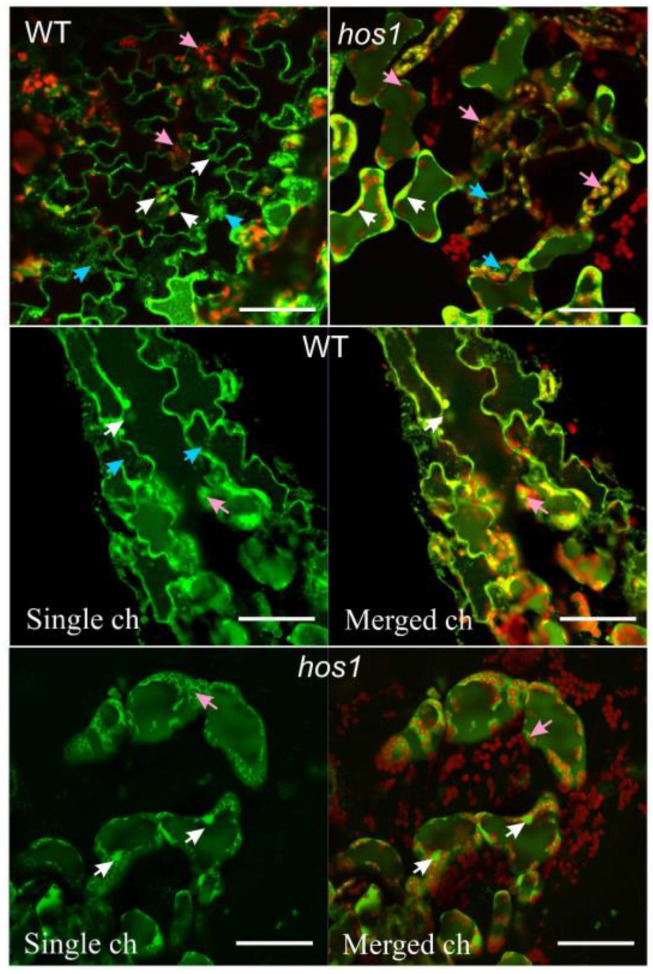
Figure 1
Figure 1
A representative view of ROS localization in epidermal cells of WT and hos1Cas9 plants. The upper panel shows cell images using two merged channels: the “ROS channel,” in which DCF fluorescence was measured at an excitation wavelength of 488 nm and detected at 505–530 nm, in combination with the “chloroplast channel.” The chloroplast channel represents chloroplast autofluorescence, which was recorded using an emission channel at 600 nm. Chloroplasts are visible as red organelles with green inclusions reflecting ROS localization. White arrows indicate ROS localization in the nucleus (green color), pink arrows indicate chloroplasts (red color), and blue arrows indicate vesicles with ROS (green color). Two bottom panels show images of WT and hos1Cas9 epidermal cells in a single ROS detection channel (left) and the same cells in merged ROS and chloroplast channels (on the right). The scale bars are 50 µm.
Figure 2
Figure 2
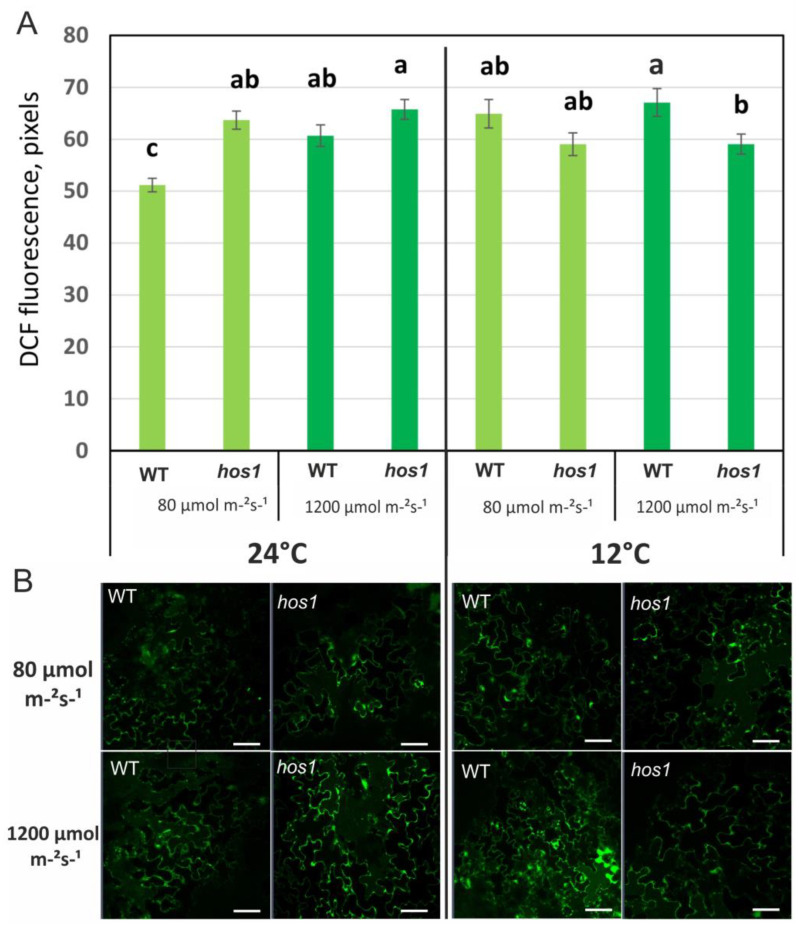
ROS content in epidermal cells from the abaxial leaf side of wild-type (WT) plants, hos1Cas9 lines of A. thaliana plants. The plants were loaded with H2DCF-DA, and the fluorescence of DCF was visualized by laser-scanning confocal microscopy under control conditions (24 °C/80 µmol m−2 s−1), high light (24 °C/1200 µmol m−2 s−1 for 2 h), cold conditions (12 °C for 24 h/80 µmol m−2 s−1), and high light conditions after cold pre-treatment (12 °C for 24 h, followed by 1200 µmol m−2 s−1 for 2 h). (A) ROS levels are presented as the mean ± SE from three independent experiments. Different letters above the bars indicate significantly different means (p < 0.05; Fisher’s LSD). (B) A representative view of epidermal cells of wild-type (WT) plants and hos1Cas9 A. thaliana plants loaded with H2DCF-DA. The brightness of the green fluorescence reflects intracellular ROS abundance. The scale bars are 50 µm.
Figure 3
Figure 3
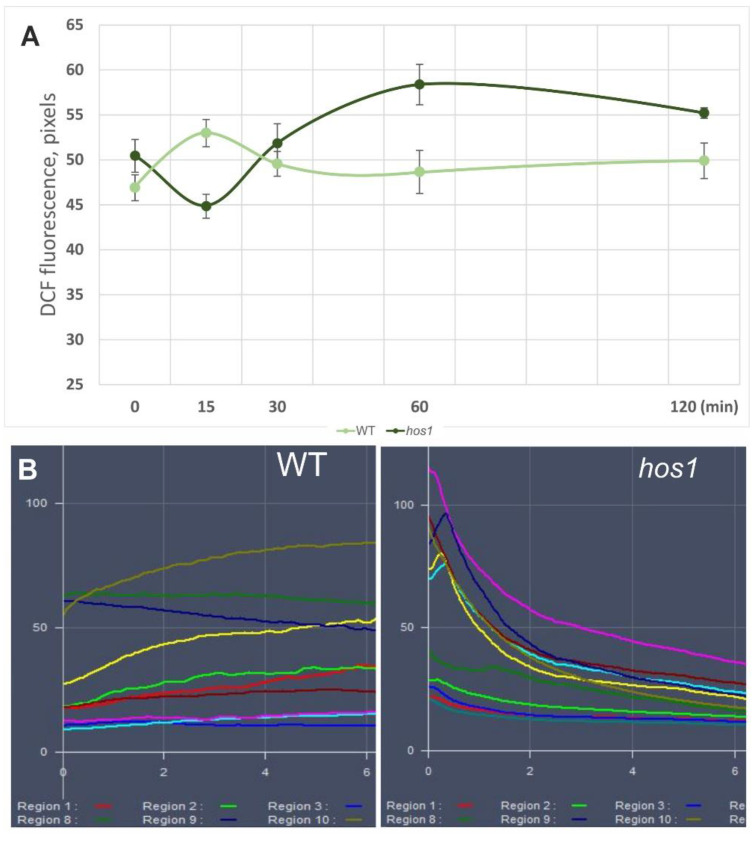
The hos1Cas9 mutation has a biphasic effect on the level of ROS under HL illumination. Before these experiments, plants were grown at control conditions (24 °C/80 µmol m−2 s−1). (A) ROS dynamics during the 2-h incubation of Arabidopsis plants at intense light 1200 µmol m−2 s−1. A statistically significant difference from the mean of two replicates was observed at 15-, 60-, and 120-min intervals (Student’s t-test, p < 0.05). (B) Different dynamics of ROS accumulation in WT and hos1Cas9 plants epidermal cells under high-intensity argon laser illumination. X-axis shows DCF fluorescence; Y-axis shows time in minutes. Each color line represents DCF fluorescence in the region of interest (ROI) of an individual cell. Approximately half of the hos1Cas9-mutant cells initially show high levels of ROS, but then the ROS content steadily decreases. Full 15-min scans and ROI of the analyzed cells are presented in Supplemental Figure S5.
Figure 4
Figure 4
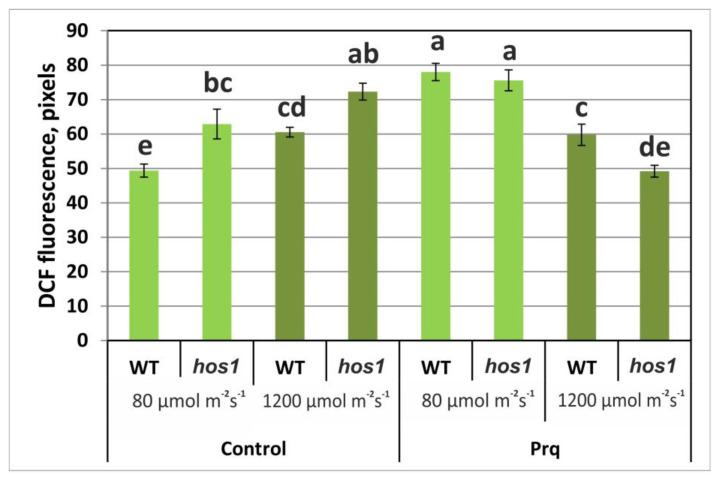
ROS levels in epidermal cells from the abaxial leaf side of WT and hos1Cas9 lines of A. thaliana plants treated with 10 μM paraquat under low and high light conditions. Data were obtained using confocal microscopy. The plants were loaded with H2DCF-DA, and the fluorescence of DCF was visualized by laser-scanning confocal microscopy under control conditions (24 °C/80 µmol m−2 s−1) and high light (24 °C/1200 µmol m−2 s−1 for 2 h). ROS levels are presented as the mean ± SE from three independent experiments. Different letters above the bars indicate significantly different means (p < 0.05; Fisher’s LSD).
Figure 5
Figure 5
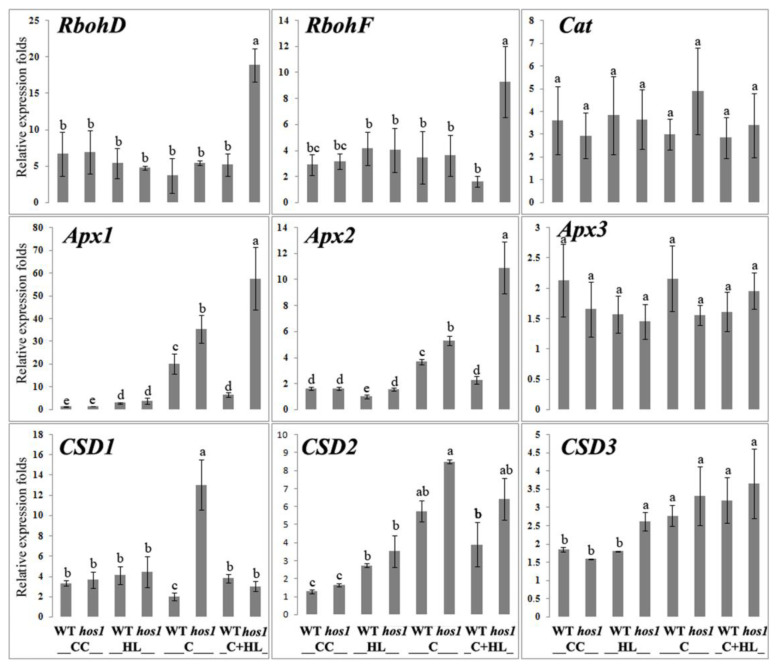
Expression of Rboh genes and genes encoding ROS-detoxifying enzymes in WT and hos1Cas9 plants. The genes encoding ROS-detoxifying enzymes are presented by superoxide dismutase (SOD, CSD1-3), ascorbate peroxidase (APX1-3), and catalase (Cat1). Data are presented as the mean ± SE from the analysis of two different experiments with three technical replicates. Different letters above the bars indicate significantly different means (p < 0.05; Fisher’s LSD). CC, control conditions (24 °C/80 µmol m−2 s−1); HL, high light (24 °C/1200 µmol m−2 s−1 for 2 h); C, cold conditions (12 °C for 24 h/80 µmol m−2 s−1); C + HL, cold and high light conditions (12 °C for 24 h, followed by 1200 µmol m−2 s−1 for 2 h).
Figure 6
Figure 6
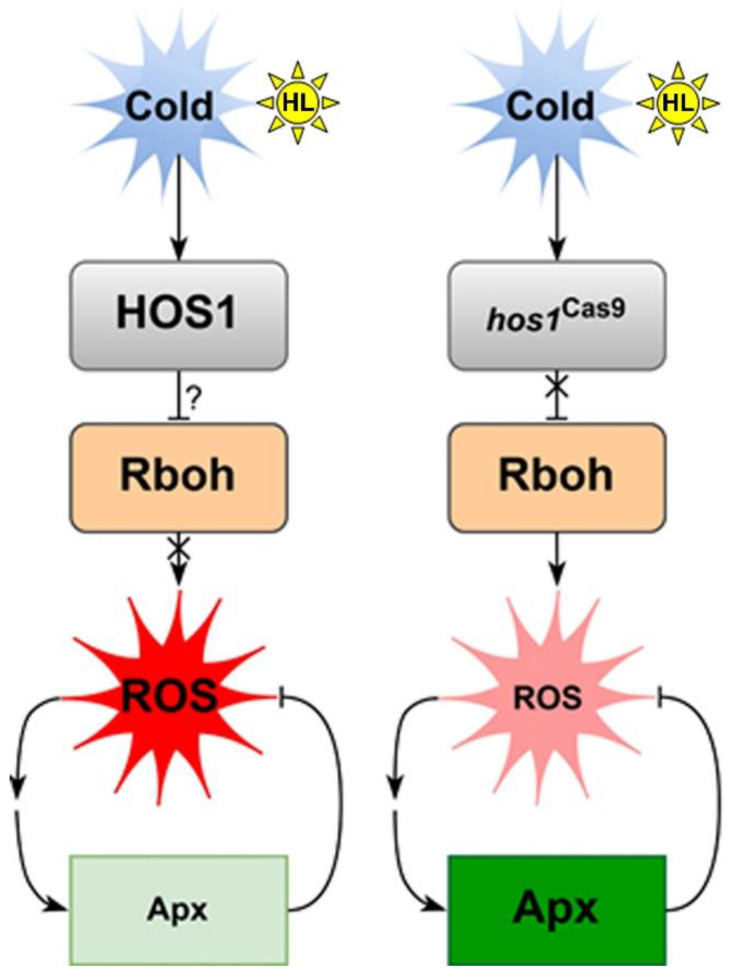
A working model showing putative signal transduction mediated by the HOS1 protein under cold exposure and strong lighting. It can be supposed (?) that when exposed to cold and strong light, HOS1 stabilizes the content of ROS by blocking its generation through NADPH oxidases (RbohD/F). As a result, there is no increased generation of ROS and no activation of ROS-regulated expression of ascorbate peroxidases Apx1 and Apx2. Inactivation of HOS1 removes (X) this regulatory block. The expression of RbohD/F activates the pathway of ROS-regulated expression of Apx1 and Apx2, which leads to a decrease in the content of ROS by active ROS decomposition.

References

    1. MacGregor D.R., Penfield S. Exploring the pleiotropy of hos1. J. Exp. Bot. 2015;66:1661–1671. doi: 10.1093/jxb/erv022. - DOI - PubMed
    1. Lee H., Xiong L., Gong Z., Ishitani M., Stevenson B., Zhu J.-K. The Arabidopsis HOS1 gene negatively regulates cold signal transduction and encodes a RING finger protein that displays cold-regulated nucleo-cytoplasmic partitioning. Genes Dev. 2001;15:912–924. doi: 10.1101/gad.866801. - DOI - PMC - PubMed
    1. Dong C.-H., Agarwal M., Zhang Y., Xie Q., Zhu J.-K. The negative regulator of plant cold responses, HOS1, is a RING E3 ligase that mediates the ubiquitination and degradation of ICE1. Proc. Natl. Acad. Sci. USA. 2006;103:8281–8286. doi: 10.1073/pnas.0602874103. - DOI - PMC - PubMed
    1. Ding Y., Li H., Zhang X., Xie Q., Gong Z., Yang S. OST1 kinase modulates freezing tolerance by enhancing ICE1 stability in Arabidopsis. Dev. Cell. 2015;32:278–289. doi: 10.1016/j.devcel.2014.12.023. - DOI - PubMed
    1. Ye K., Li H., Ding Y., Shi Y., Song C., Gong Z., Yanga S. BRASSINOSTEROID-INSENSITIVE2 negatively regulates the stability of transcription factor ICE1 in response to cold stress in Arabidopsis. Plant Cell. 2019;31:2682–2696. doi: 10.1105/tpc.19.00058. - DOI - PMC - PubMed

LinkOut - more resources