Review
. 2023 Feb 19;15(4):1036.
doi: 10.3390/nu15041036.

Nutritional Approaches to Modulate Cardiovascular Disease Risk in Systemic Lupus Erythematosus: A Literature Review

Affiliations
Review

Nutritional Approaches to Modulate Cardiovascular Disease Risk in Systemic Lupus Erythematosus: A Literature Review

Karen Pesqueda-Cendejas et al. Nutrients. .

Abstract

Systemic lupus erythematosus (SLE) is a chronic pathology characterized by a bimodal mortality pattern attributed to clinical disease activity and cardiovascular disease (CVD). A complex interaction between traditional CVD risk factors such as obesity, dyslipidemia, smoking, insulin resistance, metabolic syndrome, and hypertension, as well as the presence of non-traditional CVD risk factors such as hyperhomocysteinemia, pro-inflammatory cytokines, and C-reactive protein levels, has been suggested as a cause of the high prevalence of CVD in SLE patients. On the other hand, environmental factors, such as nutritional status, could influence the disease's prognosis; several nutrients have immunomodulators, antioxidants, and anti-cardiometabolic risk properties which could reduce SLE severity and organ damage by decreasing the development of traditional and non-traditional CVD risk factors. Therefore, this critical literature review discusses the therapeutic potential of nutritional approaches that could modulate the development of the main comorbidities related to CVD risk in SLE patients.

Keywords: C-reactive protein; cardiovascular disease risk; dyslipidemia; hyperhomocysteinemia; hypertension; systemic lupus erythematosus.


Conflict of interest statement

The authors declare no conflict of interest. Figures were created with BioRender software, ©biorender.com.

Figures

Figure 1
Figure 1
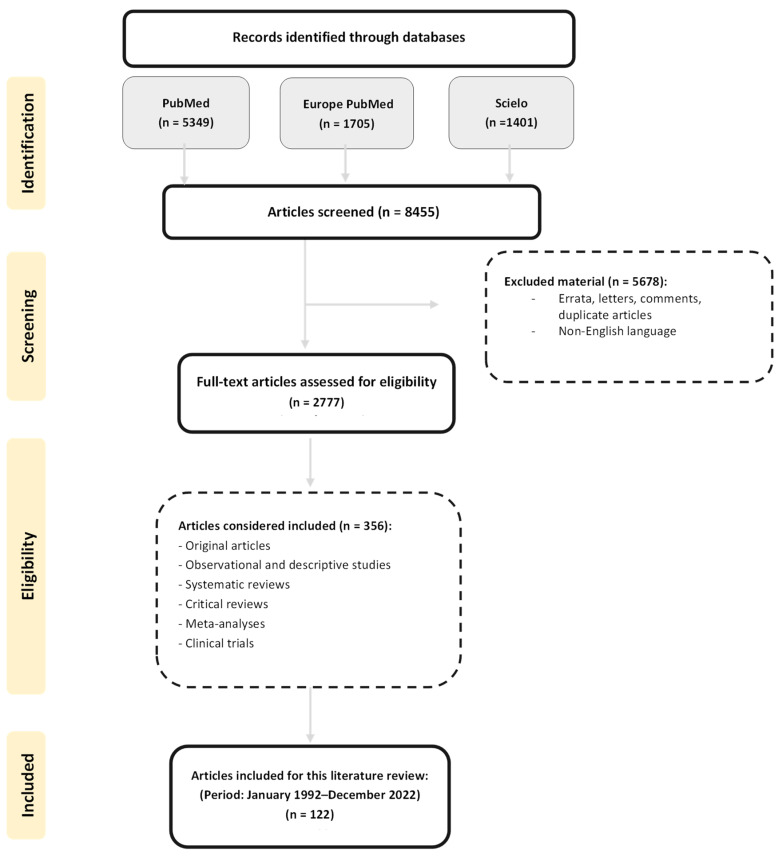
Methodological diagram of the literature search and selection process.
Figure 2
Figure 2
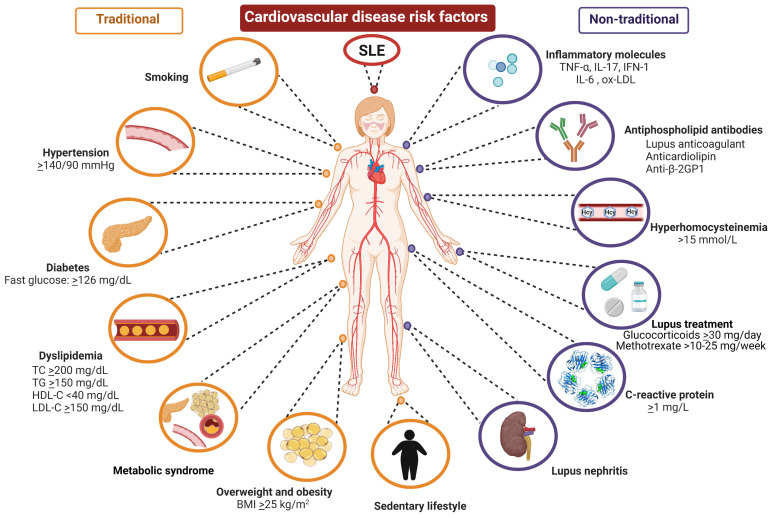
Traditional and non-traditional cardiovascular disease risk factors in SLE patients. SLE patients have a high prevalence of traditional risk factors for CVD, which are also common in the general population. However, SLE patients have CVD risk factors related to SLE pathophysiology and SLE pharmacotherapy, known as non-traditional CVD risk factors. The interaction between traditional and non-traditional CVD risk factors results in high morbidity and mortality in SLE patients due to cardiovascular alterations. SLE: systemic lupus erythematosus; TC: total cholesterol; TG: triglycerides; LDL-C: low-density lipoprotein cholesterol; HDL-C: high-density lipoprotein cholesterol; BMI: body mass index; TNF-α: tumor necrosis factor alpha; IL-17: interleukin 17; IFN-1: Type 1 interferons; IL-6: interleukin 6; CRP: C-reactive protein; ox-LDL: oxidized low-density lipoprotein; anti-β-2GP1: anti-beta-2 glycoprotein 1 antibodies.
Figure 3
Figure 3
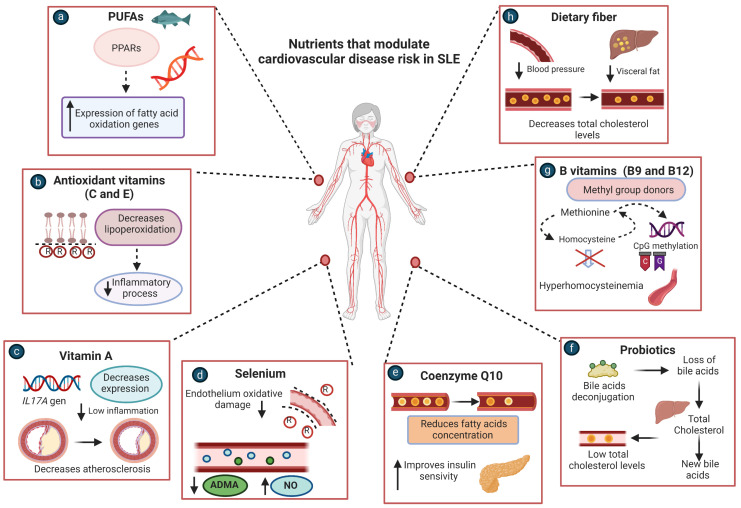
Nutrients that modulate the cardiovascular disease risk in SLE patients. (a) PUFAs: can reduce triglycerides through activation of PPARs to increase expression of genes involved in fatty acid oxidation. (b) Antioxidants vitamins C and E: can decrease lipoperoxidation and reduce superoxide and hydrogen peroxide generation linked to CVD. (c) Vitamin A: decreases expression of the IL17A gene, which could reduce the inflammatory process and slow atherosclerosis progression. (d) Selenium: reduces ADMA concentration, which is considered an independent cardiovascular risk factor due to its capacity to inhibit NO production. (e) Coenzyme Q10: can improve the lipid profile and reduce insulin resistance through modulation of insulin and adiponectin receptors. (f) Probiotics: can deconjugate bile acids which coprecipitate with total cholesterol, to compensate for the loss of bile acids; the liver then converts cholesterol into new bile acids, which can reduce serum total cholesterol levels. (g) B vitamins (B12 and B9): act as cofactors in Hcy metabolism and promote its conversion to methionine, thus decreasing Hcy serum levels. (h) Dietary fiber: its fermentation by gut bacteria provides short-chain fatty acids, such as propionic acid; its absorption decreases cholesterol synthesis in the liver and increases water and sodium absorption into the colonic mucosal cells. SLE: systemic lupus erythematosus; PUFAs: polyunsaturated fatty acids; PPARs: peroxisome proliferator-activated receptors; CVD: cardiovascular disease; ADMA: asymmetric dimethylarginine NO: nitric oxide; Hcy: homocysteine.

References

    1. Ye Y., Wu T., Zhang T., Han J., Habazi D., Saxena R., Mohan C. Elevated oxidized lipids, anti-lipid autoantibodies and oxidized lipid immune complexes in active SLE. Clin. Immunol. 2019;205:43–48. doi: 10.1016/j.clim.2019.05.004. - DOI - PubMed
    1. Sinicato N.A. Risk Factors in Cardiovascular Disease in Systemic Lupus Erythematosus. Curr. Cardiol. Rev. 2013;9:15–19. - PMC - PubMed
    1. Wigren M., Nilsson J., Kaplan M.J. Pathogenic immunity in systemic lupus erythematosus and atherosclerosis: Common mechanisms and possible targets for intervention. J. Intern. Med. 2015;278:494–506. doi: 10.1111/joim.12357. - DOI - PMC - PubMed
    1. Croca S., Rahman A. Atherosclerosis in systemic lupus erythematosus. Best Pract Res. Clin. Rheumatol. 2017;31:364–372. doi: 10.1016/j.berh.2017.09.012. - DOI - PubMed
    1. Meza-Meza M.R., Vizmanos-Lamotte B., Muñoz-Valle J.F., Parra-Rojas I., Garaulet M., Campos-López B., Montoya-Buelna M., Cerpa-Cruz S., Martínez-López E., Oregon-Romero E., et al. Relationship of Excess Weight with Clinical Activity and Dietary Intake Deficiencies in Systemic Lupus Erythematosus Patients. Nutrients. 2019;11:2683. doi: 10.3390/nu11112683. - DOI - PMC - PubMed

MeSH terms