


Clinical and Epidemiological Characteristics of Persistent Bacteremia: A Decadal Observational Study
- PMID: 36839484
- PMCID: PMC9960527
- DOI: 10.3390/pathogens12020212
Clinical and Epidemiological Characteristics of Persistent Bacteremia: A Decadal Observational Study
Abstract
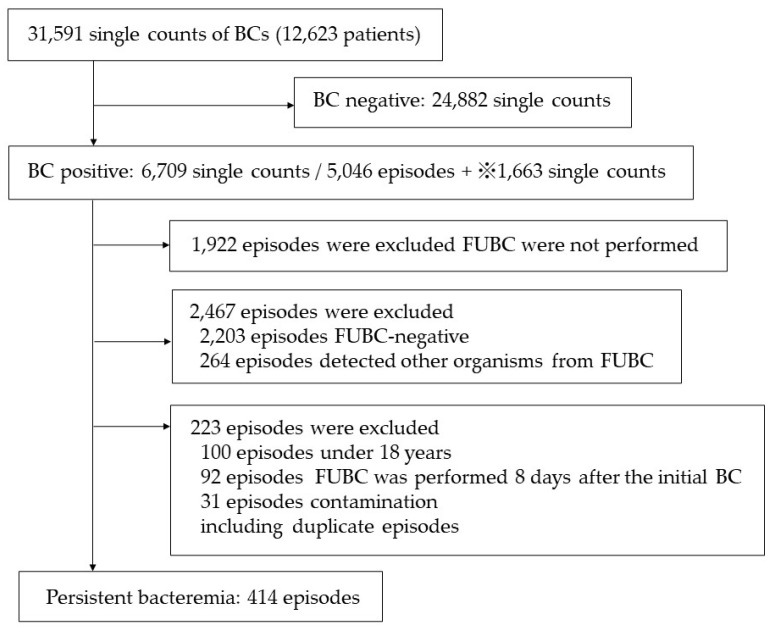
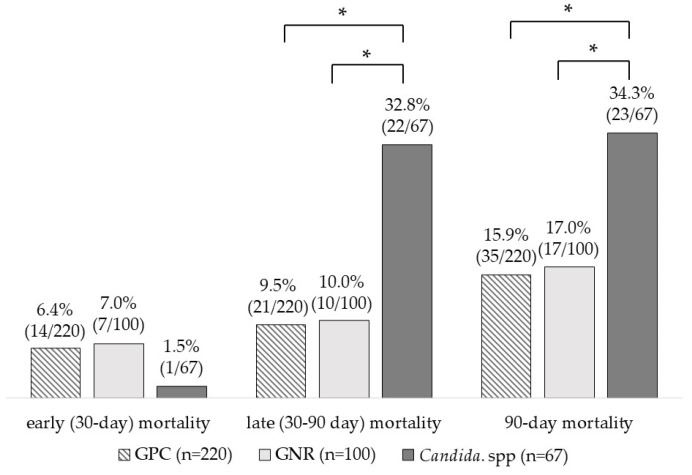
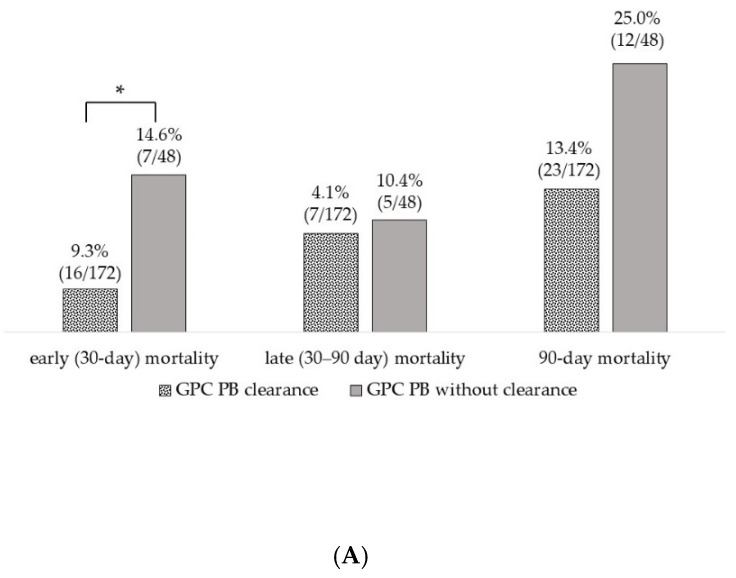
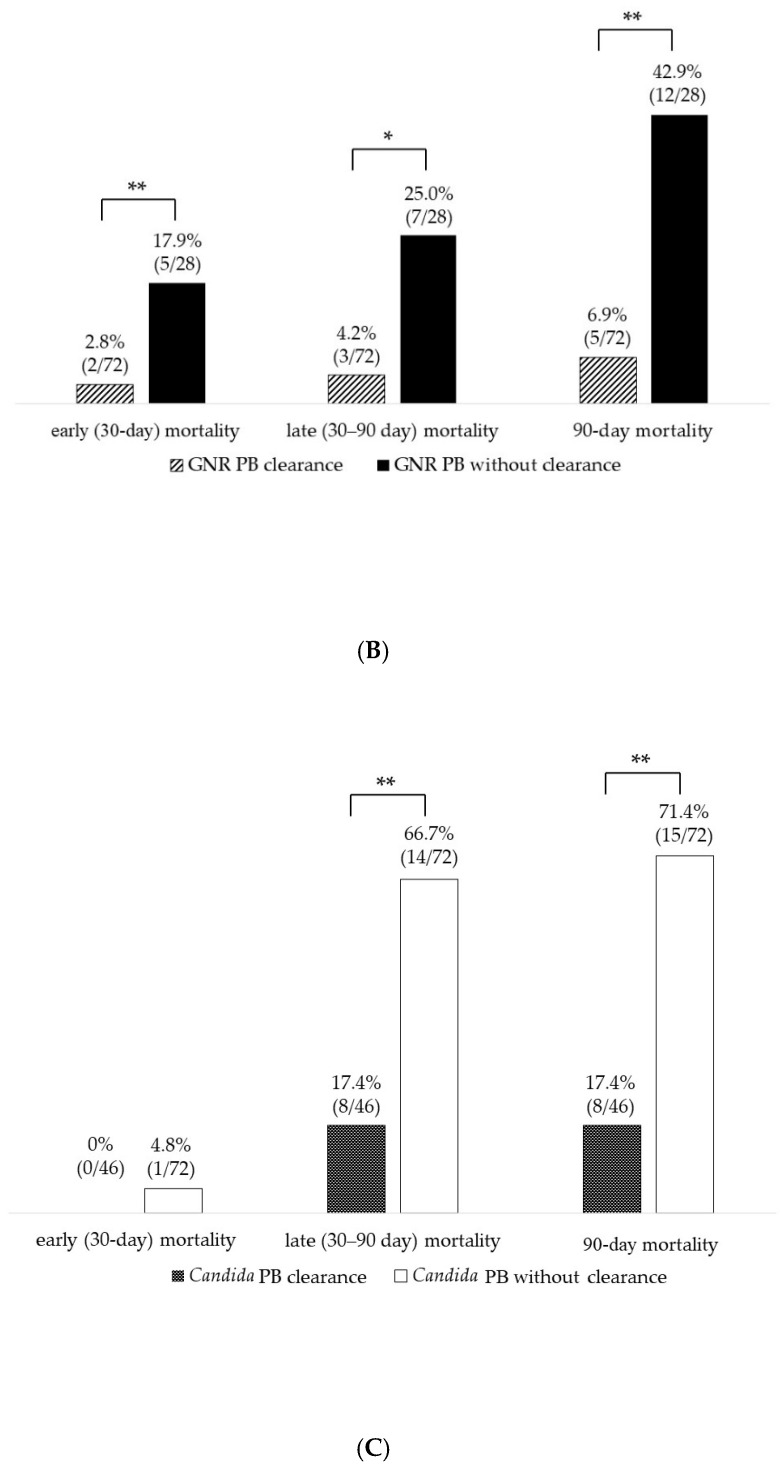
Background: Bloodstream infections (BSIs), including persistent bacteremia (PB), are a leading source of morbidity and mortality globally. PB has a higher mortality rate than non- PB, but the clinical aspects of PB in terms of the causative pathogens and the presence of clearance of PB are not well elucidated. Therefore, this study aimed to describe the clinical and epidemiological characteristics of PB in a real-world clinical setting. Methods: We performed a retrospective observational survey of patients who underwent blood culture between January 2012 and December 2021 at Tohoku University Hospital. Cases of PB were divided into three groups depending on the causative pathogen: gram-positive cocci (GPC), gram-negative rods (GNRs), and Candida spp. For each group, we examined the clinical and epidemiological characteristics of PB, including differences in clinical features depending on the clearance of PB. The main outcome variable was mortality, assessed as early (30-day), late (30-90 day), and 90-day mortality. Results: Overall, we identified 31,591 cases of single bacteremia; in 6709 (21.2%) cases, the first blood culture was positive, and in 3124 (46.6%) cases, a follow-up blood culture (FUBC) was performed. Of the cases with FUBCs, 414 (13.2%) were confirmed to be PB. The proportion of PB cases caused by Candida spp. was significantly higher (29.6%, 67/226 episodes) than that for GPC (11.1%, 220/1974 episodes, p < 0.001) and GNRs (12.1%, 100/824 episodes, p < 0.001). The Candida spp. group also had the highest late (30-90 day) and 90-day mortality rates. In all three pathogen groups, the subgroup without the clearance of PB tended to have a higher mortality rate than the subgroup with clearance. Conclusions: Patients with PB due to Candida spp. have a higher late (30-90 day) and 90-day mortality rate than patients with PB due to GPC or GNRs. In patients with PB, FUBCs and confirming the clearance of PB are useful to improve the survival rate.
Keywords: bloodstream infections; follow-up blood cultures; persistent bacteremia.
Conflict of interest statement
The authors declare no conflict of interest.
Figures
References
-
- Cheung Y., Ko S., Wong O.F., Lam H.S.B., Ma H.M., Lit C.H.A. Clinical experience in management of bloodstream infection in emergency medical ward: A preliminary report. Hong Kong J. Emerg. Med. 2021;28:215–226. doi: 10.1177/1024907919890495. - DOI
-
- Liu C., Bayer A., Cosgrove S.E., Daum R.S., Fridkin S.K., Gorwitz R.J., Kaplan S.L., Karchmer A.W., Levine D.P., Murray B.E., et al. Clinical Practice Guidelines by the Infectious Diseases Society of America for the Treatment of Methicillin-Resistant Staphylococcus aureus Infections in Adults and Children: Executive Summary. Clin. Infect. Dis. 2011;52:285–292. doi: 10.1093/cid/cir034. - DOI - PubMed
-
- Pappas P.G., Kauffman C.A., Andes D.R., Clancy C.J., Marr K.A., Ostrosky-Zeichner L., Reboli A.C., Schuster M.G., Vazquez J.A., Walsh T.J., et al. Clinical Practice Guideline for the Management of Candidiasis: 2016 Update by the Infectious Diseases Society of America. Clin. Infect. Dis. 2016;62:e1–e50. doi: 10.1093/cid/civ933. - DOI - PMC - PubMed
LinkOut - more resources
Full Text Sources
Miscellaneous
