. 2023 Jan 19;15(2):337.
doi: 10.3390/pharmaceutics15020337.

Mechanism for Stabilizing an Amorphous Drug Using Amino Acids within Co-Amorphous Blends

Affiliations

Mechanism for Stabilizing an Amorphous Drug Using Amino Acids within Co-Amorphous Blends

Yannick Guinet et al. Pharmaceutics. .

Abstract

Designing co-amorphous formulations is now recognized as a relevant strategy for improving the bioavailability of low-molecular-weight drugs. In order to determine the most suitable low-molecular-weight excipients for stabilizing the drug in the amorphous state, screening methods were developed mostly using amino acids as co-formers. The present study focused on the analysis of the thermal stability of co-amorphous blends prepared by cryo-milling indomethacin with several amino acids in order to understand the stabilization mechanism of the drug in the amorphous state. Combining low- and mid-frequency Raman investigations has provided information on the relation between the physical properties of the blends and those of the H-bond network of the amorphous drug. This study revealed the surprising capabilities of L-arginine to stiffen the H-bond network in amorphous indomethacin and to drastically improve the stability of its amorphous state. As a consequence, this study suggests that amino acids can be considered as stiffeners of the H-bond network of indomethacin, thereby improving the stability of the amorphous state.

Keywords: Raman spectroscopy; cryo-milling; glass transition; hydrogen bond; physical stability.


Conflict of interest statement

The authors declare no conflict of interest.

Figures

Figure 1
Figure 1
Low-frequency analysis of amorphous indomethacin. (a) Description of the fitting procedure of the reduced intensity (Ir(ω)) spectrum used for separating quasielastic scattering from the vibrational spectrum. The blue area was used for the spectrum renormalization while the red area is proportional to the quasielastic intensity. (b) Representation of the vibrational spectrum in Raman susceptibility very close to the VDOS of glassy IMC compared with the lattice mode spectra of α and γ polymorphs at room temperature. (c) Temperature dependence of the quasielastic intensity calculated in amorphous IMC prepared by cryo-milling and by quenching the liquid.
Figure 2
Figure 2
Low-frequency spectra collected in-situ along the heating ramp at 1°C/min of amorphous IMC prepared (a) by cryo-milling and (b) by quenching the liquid.
Figure 3
Figure 3
Analysis of the C=O stretching spectrum of IMC. (a) The spectrum is plotted in the glassy state and in α and γ polymorphs, and the spectral range in the red frame has been analyzed in this study; (b) temperature dependence of the C=O stretching spectrum; (c) temperature dependence of the Raman band which exhibits the signature of H-bonding.
Figure 4
Figure 4
Temperature dependence of the low-frequency spectrum of the IMC–AA blends. Spectra were collected upon heating at 1 °C/min. (a) IMC–LEU; (b) IMC–NLE; (c) IMC–TLE.
Figure 5
Figure 5
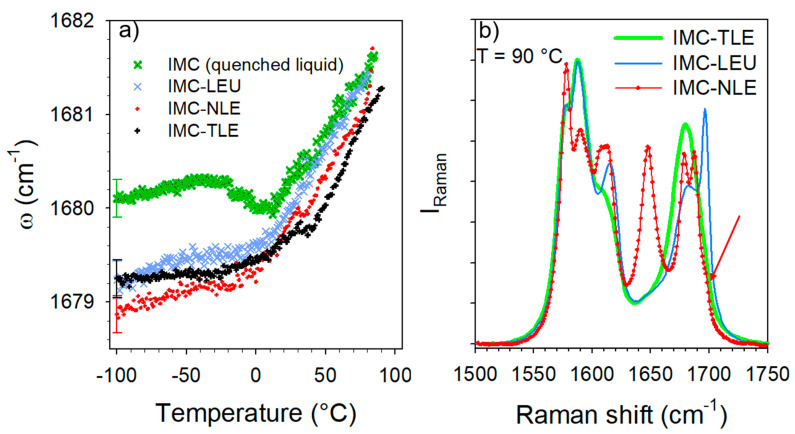
Analysis of the LFRS of the IMC–AA blends. (a) Spectra collected at 90 °C; (b) temperature dependence of the QES.
Figure 6
Figure 6
Analysis of the C=O stretching region of the IMC–AA blends. (a) Temperature dependence of the band frequency distinctive of H-bonding—only one error bar was reported for better clarity. (b) Spectra of the IMC–AA blends collected at 90 °C. The red arrow showing the subtle shoulder reflecting a very weak proportion of the γ phase after recrystallization mostly in the α phase in the IMC–NLE.
Figure 7
Figure 7
Temperature dependence of the Raman spectrum of the IMC–ARG blend collected upon heating at 1 °C/min (a) in the low-frequency region (the arrow indicating the Tg) and (b) in the C=O stretching region.
Figure 8
Figure 8
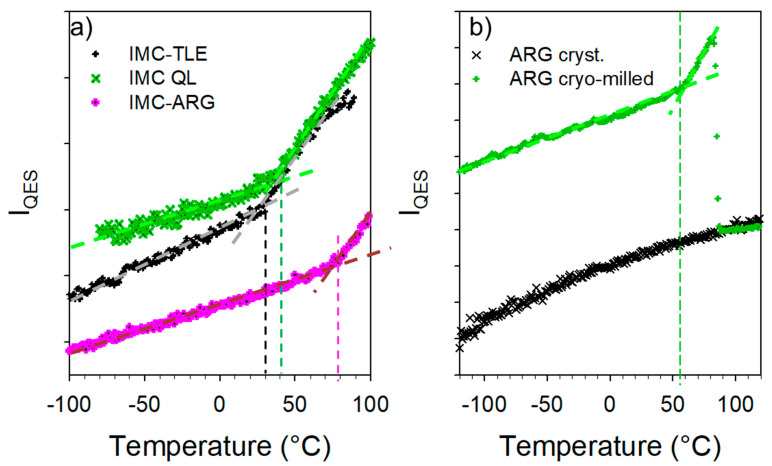
Temperature dependence of the quasielastic intensity (a) determined for IMC–TLE and IMC–ARG blends compared with that of the glassy state of the IMC and (b) determined in the amorphous ARG compared with that of the crystalline ARG.
Figure 9
Figure 9
Temperature dependence of the band distinctive of the H-bonding in the IMC–TLE and IMC–ARG blends. (a) T-dependence of the frequency—only one error bar was reported for better clarity. (b) Spectrum collected at −100 °C in the IMC–TLE and IMC–ARG blends.
Figure 10
Figure 10
Time dependence of the C=O stretching spectra of the co-amorphous blends exposed to 98% RH: (a) IMC–LEU; (b) IMC–TLE; (c) IMC–ARG.

References

    1. Rumondor A.C.F., Dhareshwar S.S., Kesisoglou F. Amorphous solid dispersions or prodrugs: Complementary strategies to increase drug absorption. J. Pharm. Sci. 2015;105:2498–2508. doi: 10.1016/j.xphs.2015.11.004. - DOI - PubMed
    1. Grohganz H., Priemel P.A., Lobmann K., Nielsen L., Laitinen R., Mullertz A., Van den Mooter G., Rades T. Refining stability and dissolution rate of amorphous drug formulations. Expert Opin. Drug Deliv. 2014;11:977–989. doi: 10.1517/17425247.2014.911728. - DOI - PubMed
    1. Liu J., Grohganz H., Lobmann K., Rades T., Hempel N.-J. Co-Amorphous Drug Formulations in Numbers: Recent Advances in Co-Amorphous Drug Formulations with Focus on Co-Formability, Molar Ratio, Preparation Methods, Physical Stability, In Vitro and In Vivo Performance, and New Formulation Strategies. Pharmaceutics. 2021;13:389. doi: 10.3390/pharmaceutics13030389. - DOI - PMC - PubMed
    1. Kasten G., Grohganz H., Rades T., Lobmann K. Development of a screening method for co-amorphous formulations of drugs and amino acids. Eur. J. Pharm. Sci. 2021;95:28–35. doi: 10.1016/j.ejps.2016.08.022. - DOI - PubMed
    1. Mishra J., Rades T., Lobmann K., Grohganz H. Influence of solvent composition on the performance of spray-dried co-amorphous formulations. Pharmaceutics. 2018;10:47. doi: 10.3390/pharmaceutics10020047. - DOI - PMC - PubMed

LinkOut - more resources