Review
. 2023 Feb 2;15(2):500.
doi: 10.3390/pharmaceutics15020500.

Cancer Treatment Using Different Shapes of Gold-Based Nanomaterials in Combination with Conventional Physical Techniques

Affiliations
Review

Cancer Treatment Using Different Shapes of Gold-Based Nanomaterials in Combination with Conventional Physical Techniques

Simona Tarantino et al. Pharmaceutics. .

Abstract

The conventional methods of cancer treatment and diagnosis, such as radiotherapy, chemotherapy, and computed tomography, have developed a great deal. However, the effectiveness of such methods is limited to the possible failure or collateral effects on the patients. In recent years, nanoscale materials have been studied in the field of medical physics to develop increasingly efficient methods to treat diseases. Gold nanoparticles (AuNPs), thanks to their unique physicochemical and optical properties, were introduced to medicine to promote highly effective treatments. Several studies have confirmed the advantages of AuNPs such as their biocompatibility and the possibility to tune their shapes and sizes or modify their surfaces using different chemical compounds. In this review, the main properties of AuNPs are analyzed, with particular focus on star-shaped AuNPs. In addition, the main methods of tumor treatment and diagnosis involving AuNPs are reviewed.

Keywords: cancer; diagnostics; gold nanoparticles; medical physics; nanomedicine; nanostars; therapy.


Conflict of interest statement

The authors declare no conflict of interest.

Figures

Figure 1
Figure 1
AuNPs atoms number as a function of surface area and size [17].
Figure 2
Figure 2
LSPR effect: plasmon oscillation for a AuNP [20].
Figure 3
Figure 3
Different sizes of spherical AuNPs correspond to different color solutions. Reprinted (adapted) with permission from [24]. Copyright 2007, American Chemical Society.
Figure 4
Figure 4
Cartesian graph of the different values of the melting point vs. AuNPs’ dimensions [17].
Figure 5
Figure 5
Different AuNP shapes [28].
Figure 6
Figure 6
AuNSs images acquired by Transmission Electron Microscopy (TEM) at different magnifications: 50 nm scale bar (a) and 500 nm scale bar (b) [30].
Figure 7
Figure 7
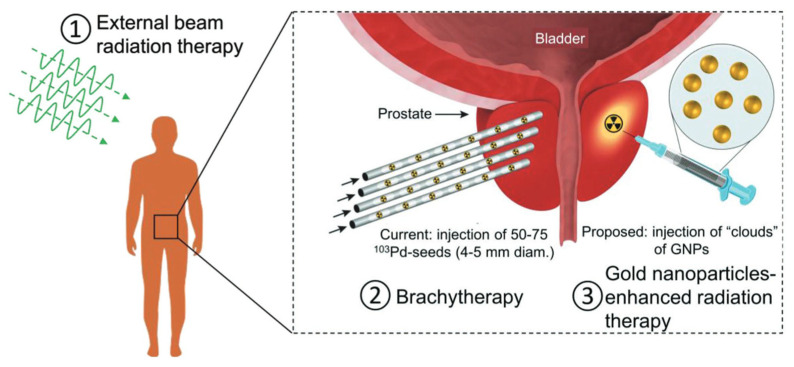
Three possible radiotherapy approaches: (1) External beam radiation therapy; (2) brachytherapy; (3) AuNPs-enhanced radiation therapy. Reprinted (adapted) with permission from [58], John Wiley and Sons.
Figure 8
Figure 8
Surface plasmon absorption spectra for different nanorods’ aspect ratios. Reprinted (adapted) with permission from [97], Copyright 2006 American Chemical Society.
Figure 9
Figure 9
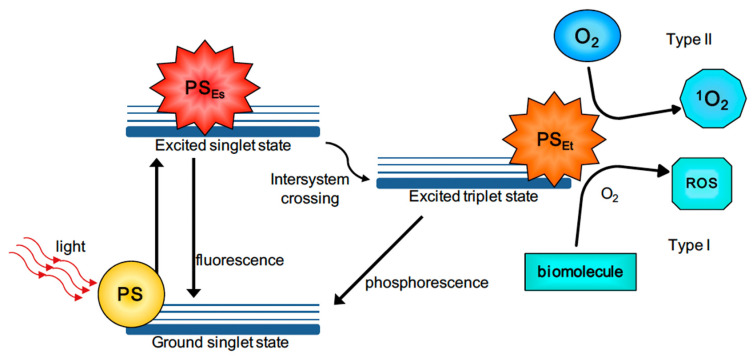
Reaction mechanism of PDT [113].
Figure 10
Figure 10
PA images of EGFR+ A431 cells labeled with 5 nm MAPS for different periods of time. PA images of 40 nm MAPS for comparison [142].
Figure 11
Figure 11
PA images of the two groups of mice after injection of (A) AuNSs and (B) RBCm-AuNSs. The images cover different periods of time from 0 h until 48 h [143].
Figure 12
Figure 12
SPECT/CT images of mice injected with 99mTc-Au-Ac-PENPs at (a) 0.5 h, (b) 1 h and (c) 2 h; SPECT/CT images of mice injected with 99mTc-Au-Gly-PENPs at (d) 0.5 h, (e) 1 h and (f) 2 h [152].
Figure 13
Figure 13
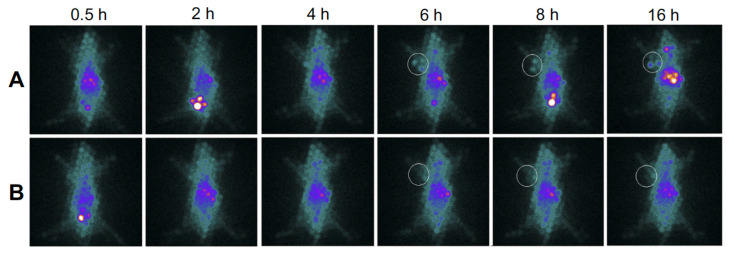
SPECT images of mice treated with (A) BmK CT-Au PENPs-131I and (B) Au PENPs, respectively, at different time points post-injection. The tumor site is highlighted by white circle [154].
Figure 14
Figure 14
(a) CT images for different GNS-FA concentration; (b) Hounsfield values dependent on the AuNSs concentrations. Reprinted (adapted) with permission from [167], Copyright 2021 American Chemical Society.
Figure 15
Figure 15
(A) PA images with Au nanorods@PDA as exogenous contrast; (B) PA images with Au nanorods as exogenous contrast. Reprinted (adapted) with permission from [168]. Copyright 2021 American Chemical Society.

References

    1. Gao Q., Zhang J., Gao J., Zhang Z., Zhu H., Wang D. Gold nanoparticles in cancer theranostics. Front. Bioeng. Biotechnol. 2021;9:647905. doi: 10.3389/fbioe.2021.647905. - DOI - PMC - PubMed
    1. Nejati K., Dadashpour M., Gharibi T., Mellatyar H., Akbarzadeh A. Biomedical applications of functionalized gold nanoparticles: A review. J. Clust. Sci. 2022;33:1–16. doi: 10.1007/s10876-020-01955-9. - DOI
    1. Spyratou E., Makropoulou M., Efstathopoulos E.P., Georgakilas A.G., Sihver L. Recent advances in cancer therapy based on dual mode gold nanoparticles. Cancers. 2017;9:173. doi: 10.3390/cancers9120173. - DOI - PMC - PubMed
    1. Huang X., El-Sayed M.A. Plasmonic photo-thermal therapy (PPTT) Alex. J. Med. 2011;47:1–9. doi: 10.1016/j.ajme.2011.01.001. - DOI
    1. Zhang Y., Yang L., Yang C., Liu J. Recent advances of smart acid-responsive gold nanoparticles in tumor therapy. Wiley Interdiscip. Rev. Nanomed. Nanobiotechnol. 2020;12:e1619. doi: 10.1002/wnan.1619. - DOI - PubMed

LinkOut - more resources