. 2023 Feb 8;15(2):574.
doi: 10.3390/pharmaceutics15020574.

Ultrasonically Fabricated Beta-Carotene Nanoemulsion: Optimization, Characterization and Evaluation of Combinatorial Effect with Quercetin on Streptozotocin-Induced Diabetic Rat Model

Affiliations

Ultrasonically Fabricated Beta-Carotene Nanoemulsion: Optimization, Characterization and Evaluation of Combinatorial Effect with Quercetin on Streptozotocin-Induced Diabetic Rat Model

Manohar Mahadev et al. Pharmaceutics. .

Abstract

Diabetes mellitus (D.M.) is a metabolic disease that has affected over 500 million people globally. Bioactive compounds such as β-carotene and Quercetin have gained research interest for their potential antidiabetic properties, and bioactives have reported superior combinatorial effects in several ailments, including D.M. However, poor oral bioavailability has limited their potential application. Thus, the present study was focused on developing ultrasonically fabricated β-Carotene nanoemulsion (βC-NE) by employing capmul as the oil phase, Gelucire 44/14 as surfactant and Acconon MCM C8 as co-surfactant. The 3 factor- 3 level Box-Behnken design (BBD) was applied to optimise the βC-NE and study the impact of selected independent variables such as % Smix (5 to 9%), amplitude (20-30%) and sonication time (2.5-7.5 min) on responses including globule size (G.S.), poly dispersibility Index (PDI) and entrapment efficiency (E.E.). Further, the combinatorial effect of βC-NE with Quercetin Nanoemulsion (QU-NE) in the streptozotocin-induced diabetic rat model was evaluated. The results exhibited that 7% Smix at 25% amplitude for 5 min produced βC-NE with a droplet size of 153.1 ± 12.25 nm, 0.200 ± 0.04 PDI, and 73.25 ± 3.25% E.E. The βC-NE showed superior in-vivo bioavailability by 5.38 folds. The βC-NE, combined with QU-NE, exhibited potential therapeutic benefits in controlling body weight, blood sugar level, lipid levels, and tissue damage markers. Additionally, the pancreatic cells and hepatic cells were well protected. These results demonstrate the potential benefits of βC-NE and QU-NE in combination and recommend them as a substitute strategy for diabetes.

Keywords: Box-Behnken design; beta-carotene; diabetes mellitus; nanoemulsion; quercetin; ultrasonication.


Conflict of interest statement

The authors declare no conflict of interest.

Figures

Figure 1
Figure 1
(A) solubility analysis of β-crt in various Nanoemulsion constituents; (B) % capmul Emulsification by chosen surfactants.
Figure 2
Figure 2
Ternary Phase Diagram depicting the nanoemulsion region obtained for capmul and tween 20 with various co-surfactants: (A) Propylene glycol; (B) Transcutol P and (C) Acconon at 1:1 ratio.
Figure 3
Figure 3
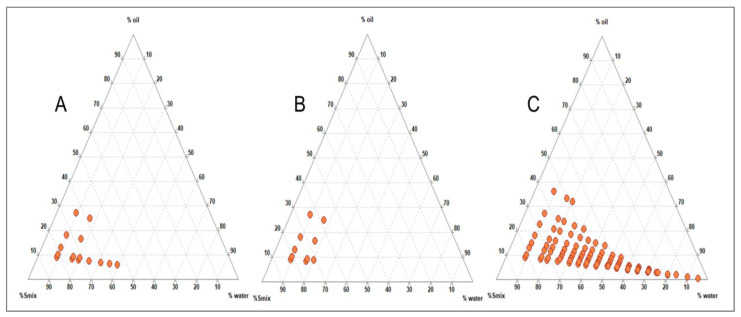
Ternary Phase Diagram depicting the nanoemulsion region obtained for capmul and gelucire with various co-surfactants: (A) Propylene glycol; (B) Transcutol P and (C) Acconon at 1:1 ratio.
Figure 4
Figure 4
Ternary Phase Diagram depicting the effect of Smix (Gelucire and Acconon) with capmul at various ratios: (A) 1:1; (B) 1:2; (C) 1:3; (D) 2:1 and (E) 3:1.
Figure 5
Figure 5
3D response surface graphs illustrating the interaction effect for the globule size of βC-NE: (A) Smix and % amplitude; (B) Smix and Sonication time; (C) % amplitude and sonication time; (D) Smix and % amplitude; (E) Smix and Sonication time; (F) % amplitude and sonication time; (G) Smix and % amplitude; (H) Smix and Sonication time, and (I) % amplitude and sonication time.
Figure 6
Figure 6
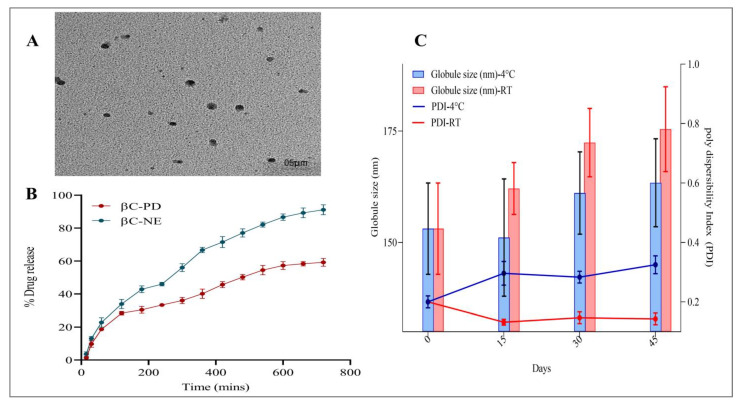
(A) TEM image of optimised βC-NE; (B) In-vitro drug release profile of βC-NE and βC-PD; (C) Effect of storage condition on globule size and PDI of optimised βC-NE.
Figure 7
Figure 7
Plasma concentration-time profile of optimised βC-NE and βC-PD.
Figure 8
Figure 8
Impact of βC-NE and βC-NE+QU-NE on body weight (B.W.). The data represent mean ± standard deviation. The significance was measured using one-way ANOVA. *** p < 0.001 vs. Normal group. # p < 0.05, ## p < 0.01 and ### p < 0.001 vs. Control group (n = 6).
Figure 9
Figure 9
Impact of βC-NE and βC-NE+QU-NE on: (A) blood glucose level; (B) oral glucose tolerance test on the 10th day; (C) Oral glucose tolerance test on the 20th day. The data represent mean ± standard deviation. The Significance was calculated employing one-way ANOVA: *** p < 0.001 vs. Normal group. # p < 0.05, and ### p < 0.001 vs. Control group (n = 6).
Figure 10
Figure 10
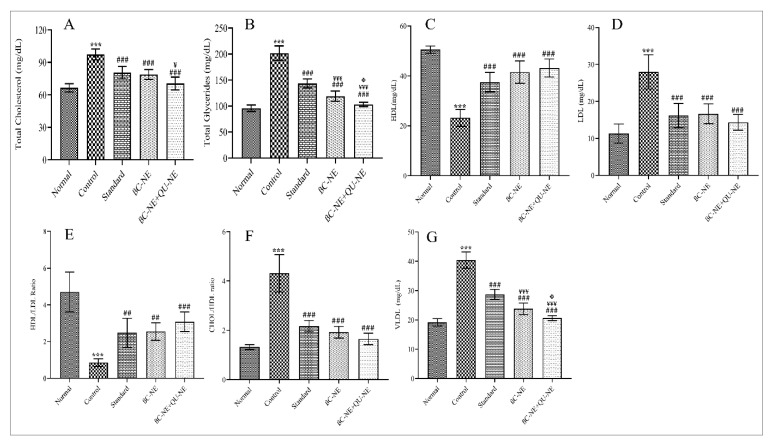
Impact of βC-NE and βC-NE+QU-NE on lipid profiles: (A) Total Cholesterol (T.C.); (B) Total Glycerides (T.G.); (C) High-density lipoproteins (HDL); (D) Low-Density Lipoproteins (LDL); (E) HDL/LDL ratio; (F) CHOL/HDL ratio, and (G) Very Low-Density Lipoproteins (VLDL). The data represent the mean ± standard deviation (n = 6). Significance was calculated employing one-way ANOVA. *** p < 0.001 vs. Normal group. ## p < 0.01, ### p < 0.001 vs. Control group ¥ p < 0.05 and ¥¥¥ p < 0.001 vs. Standard group Φ p < 0.05 vs. BC-NE group.
Figure 11
Figure 11
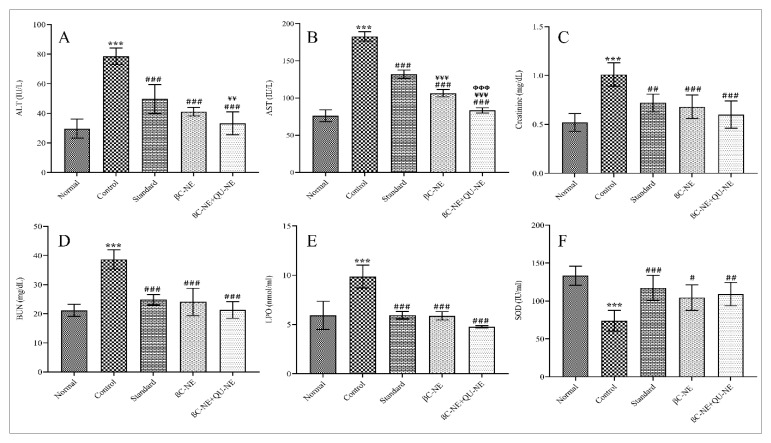
Impact of βC-NE and βC-NE+QU-NE on tissue injury and oxidative stress markers. (A) Alanine aminotransferase (ALT); (B) Aspartate aminotransferase (AST); (C) creatinine; (D) Blood–Urea–Nitrogen (BUN); (E) lipid peroxidation; (F) Superoxide dismutase (SOD). The data represent mean ± standard deviation. Significance was calculated employing one-way ANOVA. *** p < 0.001 vs. Normal group. # p < 0.05, ## p < 0.01 and ### p < 0.001 vs. Control group. ¥¥ p < 0.01 and ¥¥¥ p < 0.001 vs. Standard group. ΦΦΦ p < 0.001 vs. BC-NE group (n = 6).
Figure 12
Figure 12
Histopathological images of pancreatic and liver tissues after 21-day treatment (scale bar = 50 µm).

References

    1. Dhalaria R., Verma R., Kumar D., Puri S., Tapwal A., Kumar V., Nepovimova E., Kuca K. Bioactive compounds of edible fruits with their anti-aging properties: A comprehensive review to prolong human life. Antioxidants. 2020;9:1123. doi: 10.3390/antiox9111123. - DOI - PMC - PubMed
    1. Asemi Z., Alizadeh S.A., Ahmad K., Goli M., Esmaillzadeh A. Effects of beta-carotene fortified synbiotic food on metabolic control of patients with type 2 diabetes mellitus: A double-blind randomized cross-over controlled clinical trial. Clin. Nutr. 2016;35:819–825. doi: 10.1016/j.clnu.2015.07.009. - DOI - PubMed
    1. Lin D., Xiao M., Zhao J., Li Z., Xing B., Li X., Kong M., Li L., Zhang Q., Liu Y., et al. An Overview of Plant Phenolic Compounds and Their Importance in Human Nutrition and Management of Type 2 Diabetes. Molecules. 2016;21:1374. doi: 10.3390/molecules21101374. - DOI - PMC - PubMed
    1. Dhanya R., Arya A.D., Nisha P., Jayamurthy P. Quercetin, a Lead Compound against Type 2 Diabetes Ameliorates Glucose Uptake via AMPK Pathway in Skeletal Muscle Cell Line. Front. Pharmacol. 2017;8:336. doi: 10.3389/fphar.2017.00336. - DOI - PMC - PubMed
    1. Coskun O., Kanter M., Korkmaz A., Oter S. Quercetin, a flavonoid antioxidant, prevents and protects streptozotocin-induced oxidative stress and β-cell damage in rat pancreas. Pharmacol. Res. 2005;51:117–123. doi: 10.1016/j.phrs.2004.06.002. - DOI - PubMed

LinkOut - more resources